
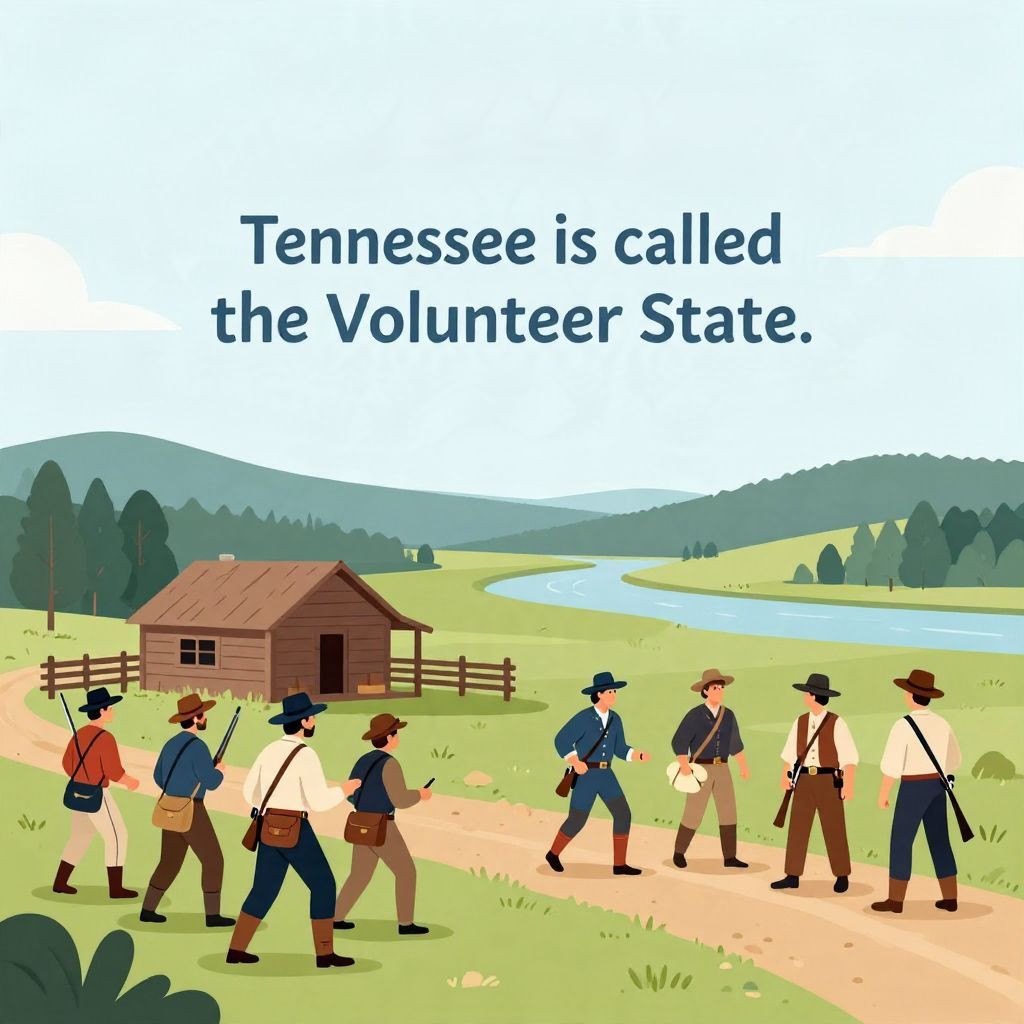
Why is Tennessee called the Volunteer State? The short answer is that the nickname grew out of the state’s reputation for supplying large numbers of volunteer soldiers in wartime, especially during the War of 1812 and the Mexican-American War. Over time, that habit of military service became part of Tennessee’s public identity.
The name is not just a romantic slogan. It reflects a real pattern in Tennessee history: men from the state repeatedly stepped forward for military service, and the state’s leaders and newspapers celebrated that willingness. The nickname became especially famous after the Battle of New Orleans in 1815 and again after the Mexican-American War in the 1840s.
Why is Tennessee called the Volunteer State?
Tennessee is called the Volunteer State because, in the early 19th century, Tennesseans were widely known for volunteering in large numbers for military service. The nickname took hold after the War of 1812, when Tennessee troops played a prominent role, and it was reinforced in the Mexican-American War, when the state again sent far more volunteers than expected.
The War of 1812 and the first major boost to the nickname
Tennessee volunteers and Andrew Jackson
The strongest early source of the nickname came from the War of 1812. Tennessee supplied thousands of militia volunteers, many of them under the command of Andrew Jackson. Jackson’s Tennessee troops became central to the defense of the Gulf Coast and to the victory at the Battle of New Orleans in January 1815.
That battle mattered enormously for Tennessee’s reputation. Jackson’s men were not the only troops involved, but their presence helped create a public image of Tennessee as a state whose citizens were ready to fight when called. In the years after the war, “volunteer” became a flattering shorthand for that military enthusiasm.
Why this mattered politically
In the early republic, state pride and military reputation were closely linked. A state that provided brave and numerous troops could gain influence and prestige. Tennessee, still relatively young and frontier-based, benefited from being seen as energetic, loyal, and martial. The nickname fit a broader national admiration for citizen-soldiers, especially in a country that valued militia service as a republican virtue.
The Mexican-American War made the nickname famous
Governor William Trousdale’s request
The nickname “Volunteer State” became especially well established during the Mexican-American War in 1846. When the federal government asked Tennessee for troops, the state responded with an overwhelming number of volunteers. Contemporary accounts and later historical summaries often note that Tennessee offered far more men than were requested, which strengthened the state’s association with volunteer military service.
This episode is important because it turned an older reputation into a widely recognized label. By the mid-19th century, Tennessee was no longer just a state with a military tradition; it was a state publicly celebrated for sending volunteers in excess of demand.
Popular memory and the nickname’s spread
State pride, newspapers, political speeches, and later school histories helped spread the nickname. Once people began repeating “Volunteer State,” it became part of Tennessee’s civic identity. The phrase was easy to remember, positive in tone, and tied to a story of sacrifice and patriotism, so it stuck.
What “volunteer” meant in the 19th century
Not the same as a modern volunteer organization
Today, “volunteer” often suggests unpaid community service. In early 19th-century military language, however, a volunteer was someone who enlisted or offered military service willingly, often in a militia or temporary wartime force. Tennessee’s nickname refers primarily to that older military meaning.
This distinction matters because the state’s identity was built around wartime enlistment, not around charitable volunteerism in the modern sense. The phrase emerged from military mobilization, frontier defense, and patriotic service.
Militia culture on the frontier
Tennessee’s early population included many settlers from the Upland South and backcountry regions, where militia service was a familiar part of life. Frontier communities often expected able-bodied men to be ready for defense against external threats, whether from war, raids, or instability on the borderlands. That culture made volunteer service more natural and more celebrated.
Was Tennessee really more “volunteer” than other states?
The nickname is symbolic, not a scientific ranking
It would be misleading to treat the nickname as a precise statistical claim that Tennessee had the highest volunteer rate in every conflict. Historical nicknames are often symbolic. Tennessee’s reputation grew because its volunteers were especially visible in key wars, not because historians can measure every state’s enlistment in exactly the same way across all periods.
Still, the nickname was not empty propaganda. Tennessee did repeatedly contribute large numbers of volunteers, and that pattern was noticeable enough to shape public memory. The state’s military role was real, even if the nickname simplified a more complicated history.
Frontier state identity and public memory
Tennessee’s image as a volunteer state also reflected how Americans remembered the frontier South. The state was associated with self-reliance, martial spirit, and readiness to defend the nation. Over time, that image became part of Tennessee’s official and unofficial identity, appearing in speeches, monuments, and later state symbolism.
Other historical factors behind the nickname
Andrew Jackson’s legacy
Jackson’s rise from Tennessee militia leader to national hero helped cement the state’s military reputation. His public image was tied to the volunteer tradition. Because Jackson became president and one of the most famous Americans of the era, Tennessee’s role in his military success gained lasting visibility.
State pride after the Civil War
Although the nickname predates the Civil War, later generations continued to use it because it fit Tennessee’s self-image. The Civil War complicated state memory, since Tennesseans fought on both sides and the state seceded before being readmitted to the Union. Even so, the older “Volunteer State” label remained useful because it pointed to a broader, less divisive tradition of military service.
Official adoption in popular culture
By the late 19th and early 20th centuries, the nickname was firmly established in popular culture. It appeared in newspapers, promotional materials, and eventually in sports and state branding. Once a nickname enters that kind of circulation, it can become more durable than the original historical event that inspired it.
Common myths and misunderstandings
It was not based on one single battle
A common misunderstanding is that Tennessee earned the nickname from just one famous event. In reality, the name developed through a sequence of military episodes, especially the War of 1812 and the Mexican-American War. The Battle of New Orleans was important, but it was part of a larger story.
It does not mean every Tennessean fought
The nickname should not be read literally as if every resident volunteered for war. Like all states, Tennessee had people who supported military action, people who opposed it, and people who were unable or unwilling to serve. The nickname highlights a public reputation, not universal behavior.
It was shaped by memory as much as by fact
Historical nicknames often sharpen messy realities into memorable symbols. Tennessee’s “Volunteer State” label grew from actual wartime service, but it was also reinforced by pride, storytelling, and political self-presentation. That combination of fact and memory is why the nickname endured.
Why the nickname still matters today
The phrase “Volunteer State” remains one of the best-known state nicknames in the United States because it captures a real historical pattern and a lasting cultural identity. It points to Tennessee’s role in early American wars, the prominence of citizen-soldiers in frontier society, and the way public memory can turn repeated service into a defining symbol.
In that sense, the nickname is more than a slogan. It is a compact summary of how Tennessee was seen in the early republic: a state whose people were expected to step forward when the nation needed them. For readers interested in the broader history behind state identity, military culture, and frontier politics, related topics such as Andrew Jackson’s military career or the War of 1812 offer useful context.