
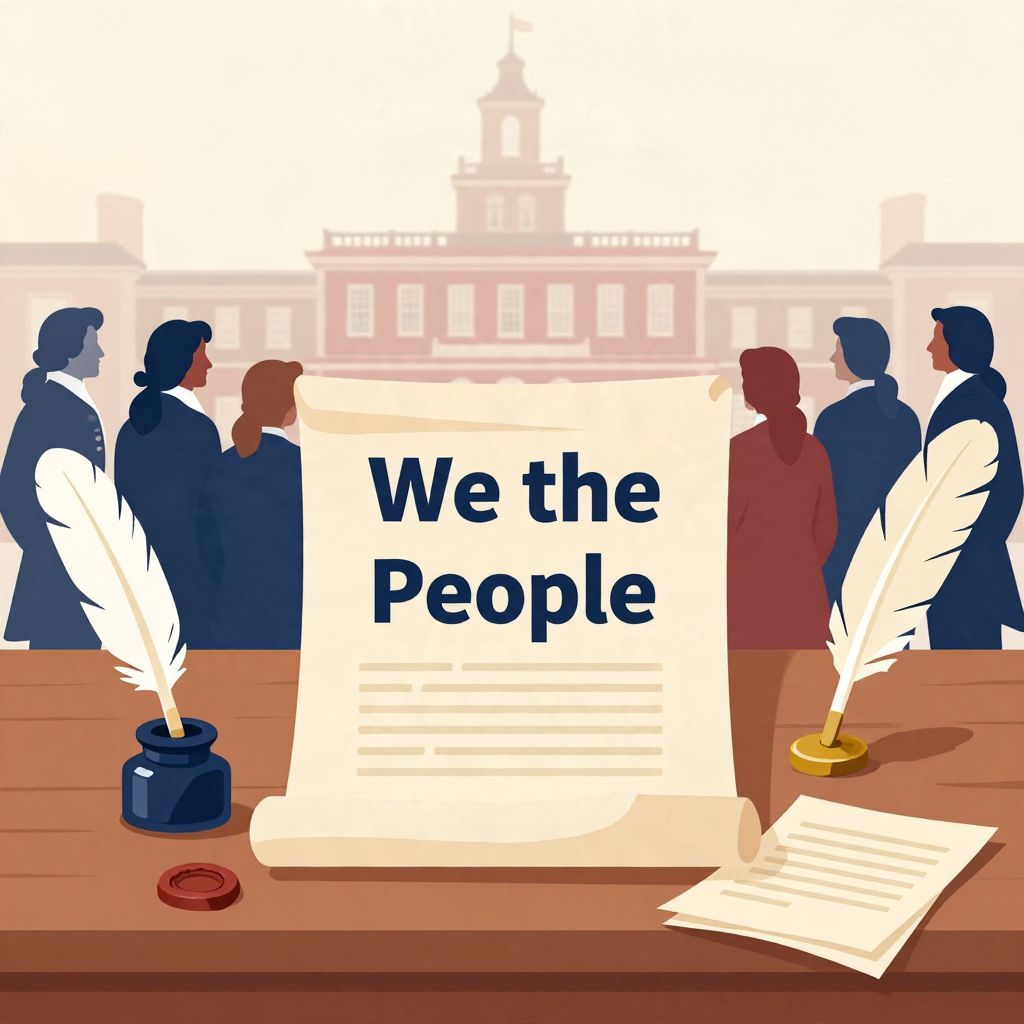
The phrase about self-government points to the opening words of the United States Constitution: “We the People.” These three words are famous because they announce that political authority comes from the people, not from a king, a parliament, or a state government acting alone.
That idea was revolutionary in 1787. The Constitution’s preamble begins by naming the source of legitimacy for the new federal government, and those words have shaped American constitutional debate ever since.
The idea of self-government is in the first three words of the Constitution: what are these words?
The first three words are “We the People.” They appear at the start of the Constitution’s preamble and express the principle that the government derives its authority from the people of the United States. In historical terms, this was a deliberate statement of popular sovereignty, replacing older ideas that power flowed from a monarch or from separate states alone.
Why “We the People” mattered in 1787
When delegates met in Philadelphia in 1787, the United States was still governed under the Articles of Confederation, a system that left the national government weak. The new Constitution aimed to create a stronger union, but its authors also wanted to avoid sounding like they were simply replacing one elite authority with another. “We the People” framed the document as the work of the nation’s citizens collectively.
Popular sovereignty, explained simply
Popular sovereignty means that political power ultimately belongs to the people. In the American founding era, this was a powerful idea because it challenged inherited rule and helped justify republican government. The Constitution did not create democracy in a modern, fully inclusive sense, but it did place the source of legitimacy in the people rather than in a hereditary ruler.
A new political language
The preamble’s wording also reflected a broader shift in political thought during the eighteenth century. Enlightenment ideas, the experience of the American Revolution, and colonial resistance to British rule all encouraged the belief that governments should rest on consent. “We the People” captured that shift in a short, memorable phrase.
What the Constitution’s preamble says
The Constitution’s preamble reads, in part, “We the People of the United States, in Order to form a more perfect Union…” It continues by listing the document’s purposes: establishing justice, ensuring domestic tranquility, providing for the common defense, promoting the general welfare, and securing the blessings of liberty. The opening words are important because they identify the authority behind those goals.
Why the preamble is important, but limited
Legally, the preamble is not usually treated as a separate source of enforceable rights in the same way as later constitutional clauses. Still, it matters historically and politically because it sets the tone for the entire document. It tells readers that the Constitution is not just a compact among states; it is an act by the people of the United States as a whole.
Who wrote “We the People”?
The Constitution was drafted by the Constitutional Convention in Philadelphia, but the exact phrasing of the preamble was refined during the final stages of the drafting process. Gouverneur Morris is often credited with shaping much of the Constitution’s final language, though the document was the product of collective debate rather than a single author’s work.
James Wilson and the idea of the people
James Wilson, a delegate from Pennsylvania, was one of the strongest advocates of national popular sovereignty at the convention. He argued that the Constitution should rest on the authority of the people rather than on the states alone. While historians do not usually attribute the phrase itself to one person with certainty, Wilson’s political thinking strongly matched its meaning.
Ratification and public meaning
The Constitution still needed approval from the states. During the ratification debates of 1787–1788, supporters of the Constitution used “We the People” to argue that the new government would be founded on a broader national consent. Critics, however, worried that the federal government might become too powerful and overshadow state authority.
How “We the People” reflected the American Revolution
The American Revolution had already challenged the idea that government authority came from a king. The Declaration of Independence in 1776 asserted that governments derive “their just powers from the consent of the governed.” The Constitution’s opening words built on that revolutionary principle and gave it a permanent institutional form.
From rebellion to constitutional government
After independence, Americans faced a hard problem: how could a people who had rejected monarchy create a stable government without recreating tyranny? The answer was a written constitution that defined powers, limited authority, and grounded the system in the people’s consent. “We the People” was the symbolic foundation of that solution.
Not all “the people” were included equally
It is important to be precise: in 1787, “the people” did not mean every adult living in America. Enslaved people were excluded from political rights, women could not vote, and many states restricted voting based on property, race, or religion. So while the phrase expressed a democratic ideal, the practice of self-government was limited and unequal.
How the phrase has been interpreted over time
Over the centuries, Americans have debated what “We the People” really means. Some have read it broadly, as a statement that all citizens share political authority. Others have emphasized the Constitution’s original context, noting that the founding generation did not create universal democracy. Both views are part of the historical conversation.
Expansion of political participation
In the nineteenth and twentieth centuries, constitutional amendments and social movements expanded the meaning of “the people” in practice. The abolition of slavery, the extension of voting rights to Black men, women’s suffrage, and later civil rights reforms all pushed the United States closer to the inclusive ideal suggested by the Constitution’s opening words.
A phrase that still shapes constitutional debate
Today, “We the People” is often invoked in arguments about voting rights, federal power, citizenship, and democratic legitimacy. Because the phrase is short and foundational, it remains one of the most cited lines in American political culture. Its enduring power comes from the fact that it is both descriptive and aspirational.
Common misconceptions about the first three words
One common misunderstanding is that the phrase means the Constitution created direct democracy. It did not. The framers designed a representative republic with checks and balances, not a system where citizens voted on every law. Another misconception is that the phrase was meant to include all residents equally from the beginning, which is not historically accurate.
It was not just a slogan
“We the People” was more than a patriotic phrase. It was a constitutional claim about legitimacy. By placing those words first, the framers signaled that the new government would rest on national authority rooted in the people’s consent. That was a major break from older imperial and monarchical traditions.
It was also not the whole story
At the same time, the phrase should not be romanticized. The early republic tolerated slavery, limited suffrage, and unequal treatment under law. The history of self-government in the United States is therefore a story of both founding ideals and later struggles to make those ideals real.
Why these three words remain famous
“We the People” endures because it is concise, memorable, and foundational. It captures the central promise of the Constitution: government exists by the authority of the governed. Few phrases in American history have carried so much symbolic weight in so few words.
So, if you are asking, “The idea of self-government is in the first three words of the Constitution. What are these words?” the answer is We the People. Historically, those words announced a new political order, one that claimed legitimacy from the nation’s citizens and not from a king. That ideal has never been simple or complete, but it has remained central to American constitutional life. For related history reading, you may also want to explore the Declaration of Independence and the Constitutional Convention of 1787.