
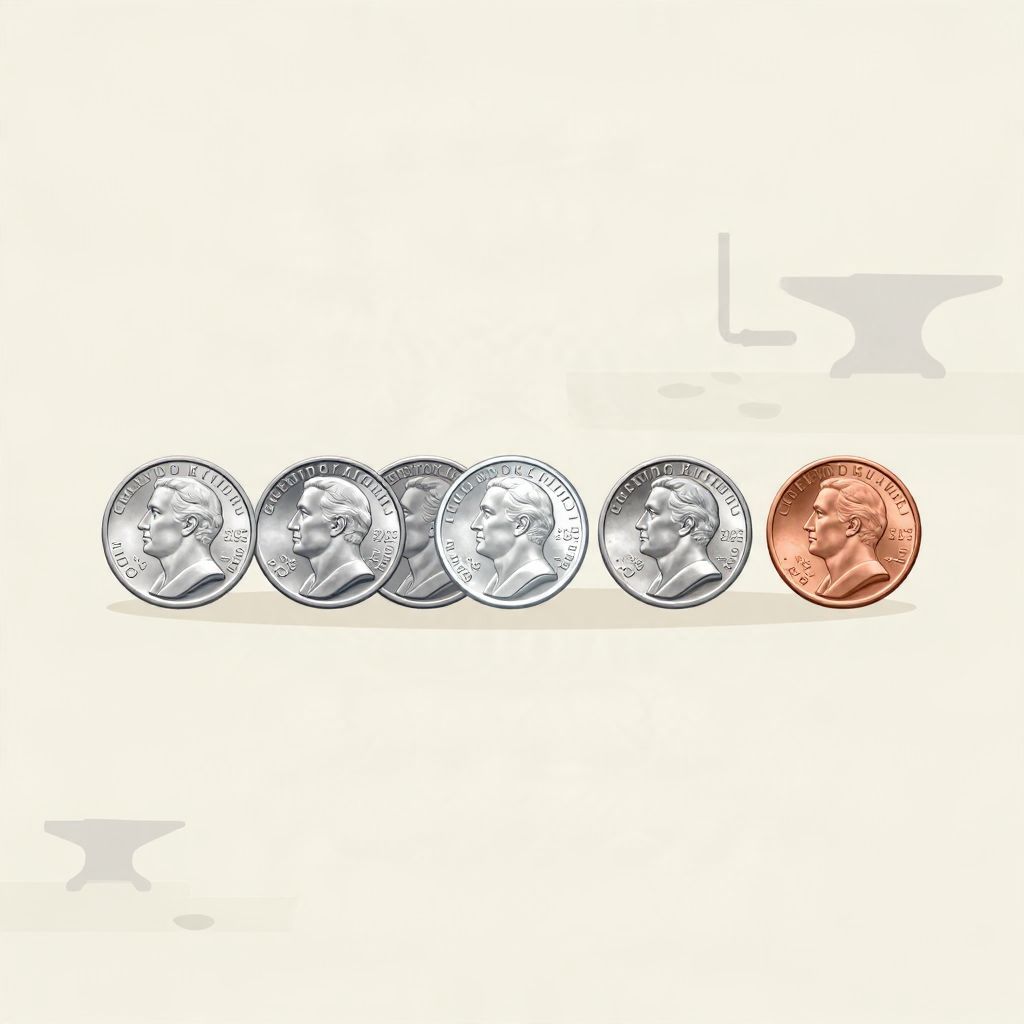
If you are asking what year half dollars are silver, the short answer is that most U.S. half dollars were made of silver from the first federal half dollar in 1794 through 1970, though the exact silver content changed over time. After 1970, regular circulation half dollars were no longer struck in silver for everyday use.
The story is tied to changes in American money, rising silver prices, and the federal government’s shift away from precious-metal coinage in the 1960s. Knowing the date is useful, but the history behind it explains why some half dollars are 90% silver, others are 40% silver, and modern ones are not silver at all.
What year half dollars are silver?
U.S. half dollars are generally silver if they were minted from 1794 through 1970. Coins dated 1964 and earlier are usually 90% silver, while 1965 to 1970 half dollars are 40% silver. Beginning in 1971, regular circulation half dollars were made from copper-nickel clad metal instead of silver.
The silver half dollar timeline
The answer depends on which kind of silver half dollar you mean, because the composition changed in stages rather than all at once. Here is the basic timeline:
- 1794–1836: Early U.S. half dollars were struck in silver under the original federal coinage system.
- 1837–1964: Standard circulating half dollars were 90% silver and 10% copper.
- 1965–1970: Half dollars were reduced to 40% silver during the coinage metal shortage.
- 1971 and later: Circulating half dollars became copper-nickel clad and no longer contained silver.
That means the most common collector rule is simple: any half dollar dated 1970 or earlier may contain silver, but the exact amount depends on the year and mint issue.
Why were half dollars made of silver in the first place?
In the early United States, silver was not just a decorative metal. It was part of the nation’s monetary foundation. The Coinage Act of 1792 established a decimal currency system and authorized silver coins, including the half dollar. At the time, precious-metal coinage was considered stable, familiar, and trustworthy in a young republic that wanted a reliable national currency.
Silver half dollars also fit the broader economic world of the 18th and 19th centuries, when many governments tied money to precious metals. A coin’s metal value mattered as much as its face value, and silver coins circulated widely in everyday commerce.
The early federal half dollar
The first U.S. half dollars were struck in the 1790s, and the denomination quickly became a standard part of American coinage. These early coins were made under the silver standards of the day, though their exact weight and design changed over time as the Mint refined production and the country’s monetary laws evolved.
Why did the silver content change?
The biggest break came in the 1960s. By then, the United States faced rising silver prices and a growing shortage of silver coinage in circulation. People were also hoarding silver coins because the metal inside them was becoming more valuable. That created pressure on the Treasury and the U.S. Mint to change the coinage system.
The result was a gradual move away from silver. Congress authorized reduced-silver half dollars in the mid-1960s, and the composition shifted from 90% silver to 40% silver. This was a compromise: the coin still looked and felt like a traditional half dollar, but it used less silver and was cheaper to produce.
The Coinage Act of 1965 and its effects
The Coinage Act of 1965 marked a turning point in U.S. coin history. It did not eliminate silver from all coins immediately, but it dramatically reduced silver content in circulating coinage. For half dollars, that meant a transition period rather than an overnight change. The older silver coins remained legal tender, while newer issues used a lower-silver formula.
This shift was part of a larger monetary change. Quarters and dimes lost silver in circulation as well, while the half dollar kept a reduced silver composition for a few more years because it was a larger denomination and had a different public role.
Which half dollars are 90% silver?
As a general rule, half dollars dated 1964 and earlier are 90% silver. That includes many famous and widely collected issues such as Walking Liberty half dollars, Franklin half dollars, and Kennedy half dollars dated 1964.
These coins contain the traditional silver-copper alloy used in U.S. coinage before the 1965 reform. They are often called “junk silver” in the coin market, though that term simply refers to their bullion value rather than their historical importance or collector appeal.
Examples of 90% silver half dollars
- Barber half dollars — 1892 to 1915
- Walking Liberty half dollars — 1916 to 1947
- Franklin half dollars — 1948 to 1963
- 1964 Kennedy half dollars — the first year of the Kennedy design, struck in 90% silver
The 1964 Kennedy half dollar is especially well known because it was issued soon after President John F. Kennedy’s assassination and became a highly collected coin. It is also the last regular U.S. half dollar made in the traditional 90% silver format.
Which half dollars are 40% silver?
Half dollars dated 1965 through 1970 are the main 40% silver issues. These include Kennedy half dollars struck for circulation and collectors during the transition away from silver. They contain less silver than earlier coins, but they are still distinct from modern clad half dollars.
These coins have a different metal composition and are often collected separately because they represent the bridge between the old silver era and the modern base-metal era.
Why the 40% silver coins matter
The 40% silver half dollars are historically important because they show how the government responded to a real monetary crisis. They were not simply a collector’s novelty. They were a practical compromise designed to keep the half dollar in circulation while reducing dependence on silver.
By 1971, however, even this reduced-silver approach ended for regular circulation issues.
What happened after 1970?
Starting in 1971, standard circulating half dollars were made with a copper core and outer layers of copper-nickel alloy. This “clad” construction replaced silver entirely for everyday coins. The half dollar remained legal tender, but it no longer functioned as a precious-metal coin.
That change reflects a broader pattern in modern coinage history: as the metal value of coins rises, governments usually move to cheaper alloys to keep production practical. The half dollar is one of the clearest examples of that shift in the United States.
Special silver half dollars after 1970
There are some later half dollars made for collectors that contain silver, but they are not regular circulation coins. Proof sets, special mint products, and commemorative issues may use silver in selected years. So if you are asking about everyday pocket-change half dollars, the answer remains that 1970 was the last year of silver half dollars for circulation.
How to identify a silver half dollar
If you have a half dollar and want to know whether it is silver, the date is the first clue, but not the only one. The easiest method is to check the year and mint type.
- Check the date. If it is 1970 or earlier, it may be silver.
- Look at the composition era. 1964 and earlier are usually 90% silver; 1965–1970 are usually 40% silver.
- Check for special issues. Some later collector coins may contain silver, even though circulation coins do not.
- Weigh or test if needed. Silver coins often weigh differently from clad coins, though wear can affect this.
Collectors also use edge appearance as a clue. Clad coins often show a visible copper stripe on the edge, while silver coins do not have the same layered look. Still, the date remains the most reliable first check.
Why the answer matters to collectors and historians
The question “what year half dollars are silver” is partly about value, but it is also about historical change. Silver half dollars connect to the early republic, the industrial age, the Great Depression, the postwar economy, and the inflationary pressures of the 1960s. A single denomination can reveal how American money adapted to changing economic realities.
For collectors, the difference between 90% silver, 40% silver, and clad coinage affects both bullion value and historical interest. For historians, the transition marks the end of an era in which circulating U.S. coins were expected to contain intrinsic precious-metal value.
The short answer, with the historical context
If you want the simplest answer: U.S. half dollars are silver if they were made in 1970 or earlier. Coins from 1964 and earlier are 90% silver, while 1965–1970 half dollars are 40% silver. From 1971 onward, regular circulation half dollars are no longer silver. That change reflects the broader history of how the United States moved from precious-metal coinage to modern clad money.
If you want to compare this change with other denominations, you may also find it useful to read about when quarters were made of silver and what year quarters stopped being silver.