
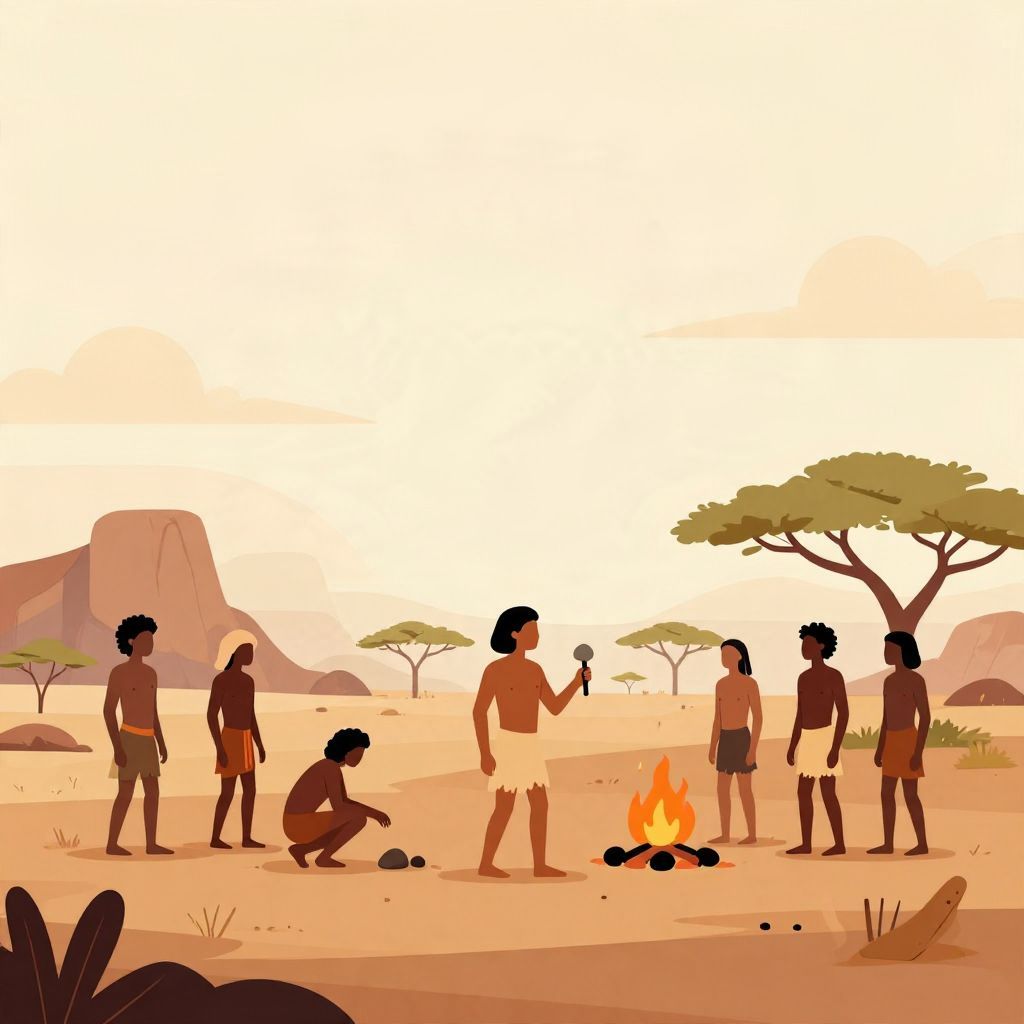
Who was the first person on Earth? It is a question that sounds simple, but history, archaeology, and human evolution do not support a single named individual. Modern humans emerged gradually over a long period, so there was no clear moment when one “first person” suddenly appeared.
Instead, scientists trace the origin of Homo sapiens to populations in Africa roughly 300,000 years ago. The answer depends on how you define “person”: biologically, culturally, or spiritually. That distinction matters, because the search for a first human is really a story about evolution, migration, and the beginnings of our species.
Who is the first person on Earth?
There is no historically identifiable “first person on Earth.” Human beings did not begin with one named individual; they evolved from earlier hominin populations over many generations. The earliest known Homo sapiens lived in Africa about 300,000 years ago, but they were part of a breeding population, not a single first person.
Why there is no single first human
The idea of one first person comes from everyday thinking, where births happen one at a time. Evolution works differently. Species change gradually across populations, so there is rarely a sharp boundary where one individual becomes the first of a new kind. A “first human” would require an exact line that nature does not provide.
Evolution is a process, not a switch
Our ancestors were not suddenly non-human one day and fully human the next. Over hundreds of thousands of years, small inherited changes accumulated in groups of early humans. Some individuals had traits that look more modern to us, but they still belonged to a larger population with many shared ancestors and descendants.
Population, not lone origin
Genetic evidence shows that human origins involve a population, not a single couple or isolated individual. All living humans are related through many ancestral lines. That means the “first person” question cannot be answered the way we might answer “Who was the first president?” or “Who invented the telephone?”
When did modern humans appear?
The earliest widely accepted fossils of Homo sapiens come from Africa and date to about 300,000 years ago. Important finds from Jebel Irhoud in Morocco have pushed the timeline back and helped show that modern humans emerged across parts of Africa, not from one tiny birthplace. The species developed gradually from earlier hominins.
Key stages in human evolution
- Earlier hominins lived in Africa millions of years ago and walked upright before modern humans existed.
- Early Homo sapiens appeared about 300,000 years ago, showing a mix of modern and more ancient traits.
- Migration out of Africa occurred in several waves, with major expansions around 60,000 to 70,000 years ago.
- Global settlement followed over tens of thousands of years as humans adapted to many environments.
What fossils can and cannot tell us
Fossils help establish when and where early humans lived, but they do not identify a single “first person.” A fossil is evidence of a population at a particular time, not a birth certificate for the species. Even the oldest known Homo sapiens remains represent one branch of a much larger and older family tree.
What do scientists mean by “first person”?
The phrase can mean different things depending on the field. In biology, it might refer to the first member of a species. In philosophy or religion, it may mean the first being with self-awareness, language, or moral understanding. In history, however, there is no documented individual who can be named as the first person on Earth.
Biological meaning
If “person” means anatomically modern human, then the answer is still not one person but an early population of Homo sapiens. These people were our species’ earliest known members, but they lived among relatives and neighboring groups, not as solitary pioneers.
Cultural and philosophical meaning
Some traditions ask when humans first gained reason, speech, or a soul. Those are important questions, but they belong to theology and philosophy rather than historical reconstruction. Different cultures answer them in different ways, and those answers cannot be verified in the same way as fossils or artifacts.
Myths and religious origin stories
Many societies preserve creation stories about the first human beings. These narratives are central to belief systems and cultural identity, but they are not the same as historical evidence. They explain meaning, purpose, and human relationships to the divine rather than offering a scientific account of species origins.
Adam and Eve in the Abrahamic traditions
In Judaism, Christianity, and Islam, Adam is often described as the first man, with Eve as the first woman. These are foundational religious figures, but historians treat them as theological and literary characters, not as individuals established by archaeological proof. Their significance lies in faith traditions, not empirical chronology.
Other creation traditions
Many Indigenous and ancient cultures have their own accounts of human beginnings. Some describe humans emerging from earth, water, animals, or ancestral beings. These stories are historically important because they reveal how communities understood life, kinship, and the world, even when they do not match scientific explanations.
What archaeology says about the earliest humans
Archaeology gives us tools, bones, burial evidence, and traces of daily life. From these, scholars reconstruct how early humans lived, hunted, made art, and formed communities. The record shows that being human was not just about anatomy; it also involved social behavior, cooperation, and symbolic thinking.
Evidence of early human behavior
- Stone tools show planning and skill long before written history.
- Burials suggest social care and possibly ritual behavior.
- Art and ornament point to symbolic thought and identity.
- Fire use transformed diet, safety, and social life.
Why behavior matters
Some researchers argue that “personhood” should include self-awareness, language, and social memory. Those qualities likely developed over time rather than appearing all at once. That is another reason the search for a first person is so difficult: the qualities that make humans distinct were themselves gradual achievements.
Did the first human live alone?
No. Humans are social animals, and the earliest Homo sapiens almost certainly lived in groups. Survival depended on cooperation, shared knowledge, child-rearing, and communication. A lone first person would not fit what we know about human evolution, because humans evolved in communities, not in isolation.
Why social life was essential
Early humans needed others to share food, protect children, pass on skills, and respond to environmental change. Social bonds likely shaped language and culture, which in turn helped humans adapt. In that sense, “the first person” is less important than the first human communities.
Common misconceptions about the first person on Earth
Popular discussions often simplify human origins into a single name or a single couple. That approach is understandable, but it misrepresents the evidence. Human evolution is a branching process, and the historical record does not support the idea of one clearly identifiable first individual.
Misconception 1: There was one first human
This is the most common misunderstanding. Species do not usually begin with a single person. They emerge through gradual change in populations over time.
Misconception 2: The first human can be named
We can name some of the oldest known human fossils or sites, but not the first person. The fossil record is incomplete, and no evidence identifies one individual as the first member of our species.
Misconception 3: Ancient stories and science say the same thing
Creation stories and scientific research answer different kinds of questions. One explains meaning and origin in sacred terms; the other reconstructs physical history through evidence. Both matter, but they should not be confused.
The lasting significance of the question
Asking who the first person on Earth was reveals something important about human curiosity. We want beginnings, names, and clear turning points. History and science often offer something more complex: long processes, shared ancestry, and many overlapping stories rather than one dramatic starting point.
That complexity does not make the answer less meaningful. It shows that humanity is the product of deep time, migration, adaptation, and community. If you want to explore related origins questions, you may also be interested in the oldest city in America and where Hinduism began. The key takeaway is simple: there was no single first person on Earth, only the long emergence of our species.