
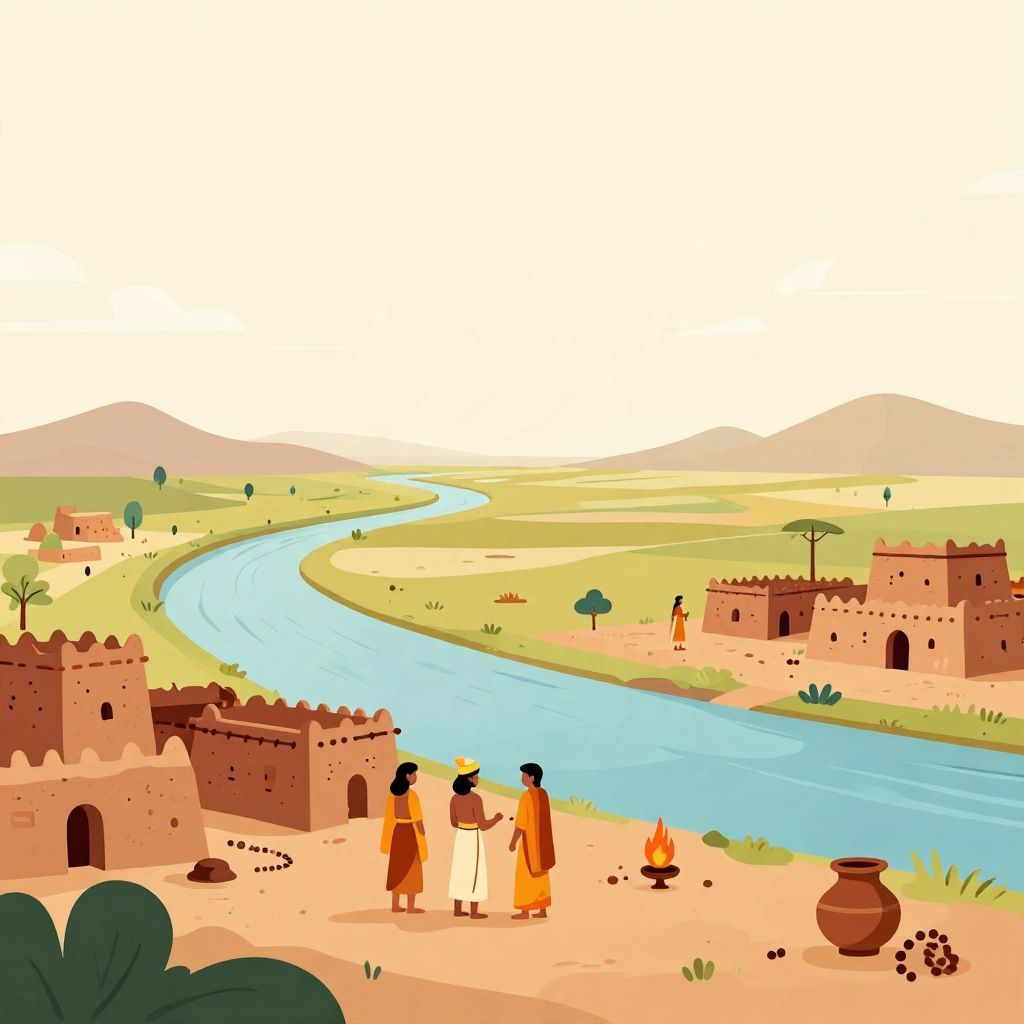
Where did Hinduism begin? The short answer is that Hinduism emerged in the Indian subcontinent, especially in the northwestern region of the ancient Indus and Sarasvati river areas, and then developed over many centuries across much of South Asia. It did not begin as a single event or from one founder; it grew gradually from early Vedic traditions, local religious practices, and philosophical ideas.
Because Hinduism is one of the world’s oldest living religions, its origins are complex. Historians usually trace its earliest roots to the second millennium BCE, while also recognizing that many beliefs and rituals are even older in local and prehistoric Indian traditions.
Where did Hinduism begin?
Hinduism began in the Indian subcontinent, with its earliest identifiable roots in the northwestern region of South Asia, particularly the area associated with the Indus Valley and later the Vedic world. Scholars generally see it as a long historical development rather than a religion founded at one place or moment.
The Indian subcontinent as the broad origin
The most accurate geographic answer is the Indian subcontinent: present-day India, Pakistan, Nepal, Bangladesh, and surrounding regions. Early Hindu traditions formed in this cultural landscape, where communities developed ritual practices, sacred poetry, temple worship, philosophical speculation, and social customs over a very long period.
It is important not to imagine Hinduism as beginning in a single city or temple. Instead, it arose from overlapping traditions in different regions. The northwest is especially important because that is where the earliest textual evidence, the Vedic hymns, appears. But later Hinduism also absorbed ideas from central, eastern, and southern India.
Why the northwest matters
The northwestern subcontinent matters because the earliest surviving religious texts linked to Hindu tradition, the Vedas, were composed by Indo-Aryan-speaking groups in this broad region. These communities lived after the decline of the mature Indus Valley Civilization and before the rise of large kingdoms in the Ganges plain.
That said, the Vedic tradition was not the whole of Hinduism. It became one major stream within a much wider religious world that included indigenous cults, fertility rites, village deities, ancestor worship, and later devotional movements. Hinduism’s origins are therefore both textual and cultural.
How Hinduism developed over time
Hinduism grew through centuries of change. Its earliest layer is often called Vedic religion, followed by the development of philosophical thought, devotional worship, temple traditions, and diverse regional practices. By the first millennium CE, these strands had come together into something recognizably Hindu, though still highly diverse.
1. Pre-Vedic and Indus Valley backgrounds
Before the Vedic age, the Indus Valley Civilization flourished roughly from about 2600 to 1900 BCE in what is now Pakistan and northwest India. This civilization left major urban sites such as Harappa and Mohenjo-daro, but it did not leave texts that can be confidently read and tied directly to later Hinduism.
Because of that, scholars are cautious. Some popular claims connect Indus seals, bathing rituals, or figurines directly to later Hindu gods and goddesses. These ideas are possible but not proven. The safer historical view is that the Indus world may have contributed cultural elements, but the evidence does not allow a simple line from Indus religion to Hinduism.
2. The Vedic period
The clearest early stage of Hindu development begins with the Vedic period, usually dated roughly from 1500 to 500 BCE, though exact dates remain debated. During this era, hymns collected in the Rigveda and other Vedic texts praised deities such as Indra, Agni, and Varuna and described sacrifices performed by priests.
These texts were composed and transmitted orally for generations before being written down much later. They reflect a world of pastoral and agricultural communities, ritual specialists, and evolving ideas about cosmic order, duty, and the power of sacred speech. This is one of the most important foundations of later Hindu thought.
3. The Upanishadic and philosophical turn
By the later Vedic age, roughly from 800 to 300 BCE, religious thought became more reflective and philosophical. The Upanishads explored questions about the self, ultimate reality, rebirth, karma, and liberation. These ideas became central to many Hindu traditions.
This was a major turning point. Religion was no longer defined only by sacrifice. It now included meditation, ethical conduct, knowledge, and the search for release from the cycle of rebirth. Concepts such as atman and Brahman became foundational in later Hindu philosophy.
4. The rise of epic, devotional, and temple traditions
From about 500 BCE to 500 CE, Hinduism continued to diversify. The great epics, especially the Mahabharata and Ramayana, took shape over long periods and became central to religious imagination. The Bhagavad Gita, embedded in the Mahabharata, offered an influential synthesis of devotion, duty, and spiritual knowledge.
At the same time, worship of deities such as Vishnu, Shiva, Devi, and others expanded. Local gods and goddesses were incorporated into larger traditions. Temples became increasingly important, and devotional practices known as bhakti grew in influence. This is when Hinduism became visibly plural and regionally varied.
Was Hinduism founded by one person?
No. Hinduism was not founded by a single prophet, teacher, or ruler. It emerged gradually from many communities, texts, rituals, and philosophical traditions. That is one reason historians describe it as a civilization’s religious tradition rather than a religion with one founder and one founding date.
Why there is no single founder
Some religions can be traced to a founder or a defining revelation. Hinduism is different. It includes many schools of thought, many gods and goddesses, and many forms of worship. Its authority comes from a long history of sacred texts, teachers, custom, and lived practice rather than one central institution.
Later Hindu tradition remembers sages, poets, and teachers, but these figures are not founders in the modern sense. The religion’s identity was shaped over centuries through debate, adaptation, and synthesis.
What evidence do historians use?
Historians study Hindu origins using archaeology, linguistics, comparative religion, and ancient texts. Each source has limits. Archaeology reveals settlements and material culture, language studies help trace Indo-Aryan migration and cultural exchange, and texts show how religious ideas evolved. No single source tells the whole story.
Textual evidence
The Vedas are the earliest major textual evidence. They show ritual religion, hymns, and early theological ideas. Later texts such as the Upanishads, epics, Puranas, and Dharma literature reveal how Hindu thought expanded into ethics, devotion, cosmology, law, and social order.
Because these texts were composed over centuries, they should not be read as one uniform message. They reflect changing historical contexts, not a frozen doctrine.
Archaeological evidence
Archaeology helps place Hinduism in a wider South Asian setting. Excavations show continuity and change in settlement patterns, ritual spaces, figurines, and material culture. However, archaeology rarely allows a direct identification of “Hinduism” in its later form during the earliest periods.
That caution matters. A ritual object or symbol may have religious significance without proving a direct link to a specific later deity or practice. Responsible history avoids overclaiming.
Linguistic and migration evidence
Linguistic evidence suggests that Indo-Aryan languages entered the subcontinent from outside the region over time, blending with local cultures. This process is often discussed in relation to the spread of Vedic traditions. Most scholars today see this as cultural interaction and gradual integration rather than a simple replacement of one people by another.
This broader movement helps explain why early Hinduism contains both inherited Indo-European elements and deeply local South Asian features.
How did local traditions shape Hinduism?
Hinduism was shaped by constant interaction between elite ritual traditions and local religious life. Village deities, fertility cults, sacred trees, river worship, ancestor rites, and regional customs all influenced the religion’s growth. Hinduism is best understood as a family of traditions that absorbed and reinterpreted many sources.
Regional diversity
Different parts of India developed distinctive forms of worship. In some places, devotion centered on Vishnu or Shiva; in others, on goddesses, local spirits, or saint-poets. This diversity is one reason Hinduism spread so successfully across the subcontinent: it could adapt to local needs while preserving shared ideas.
Over time, Sanskrit texts and regional languages interacted. Sacred learning was not confined to one social group or one region, even though access to religious authority was often unequal. The result was a tradition both unified and diverse.
Common misunderstandings about Hindu origins
One common misunderstanding is that Hinduism began at a single moment in the Indus Valley. Another is that it was invented by the Vedas alone. Both are too simple. Hinduism is older and broader than any one text, and its formation involved centuries of exchange between many communities.
- Myth: Hinduism started in one city or with one founder.
- Historical view: It developed gradually across the Indian subcontinent.
- Myth: The Indus Valley Civilization was definitely Hindu in the later sense.
- Historical view: It may have influenced later traditions, but the evidence is not conclusive.
- Myth: Hinduism appeared fully formed in the Vedas.
- Historical view: The Vedas are foundational, but later philosophical and devotional developments were equally important.
Why the question matters today
Asking where Hinduism began is not just about geography. It helps explain how one of the world’s oldest religious traditions formed through migration, adaptation, and long cultural continuity. It also shows why Hinduism cannot be reduced to a single doctrine, place, or historical moment.
The best historical answer is that Hinduism began in the Indian subcontinent, especially in the northwestern region, and took shape over many centuries through the blending of Vedic religion, local practices, philosophical inquiry, and devotional traditions. For readers interested in how cultures evolve over time, related topics like cultural divergence and sequent occupance can help explain how one tradition grows from many layers of earlier human life.