
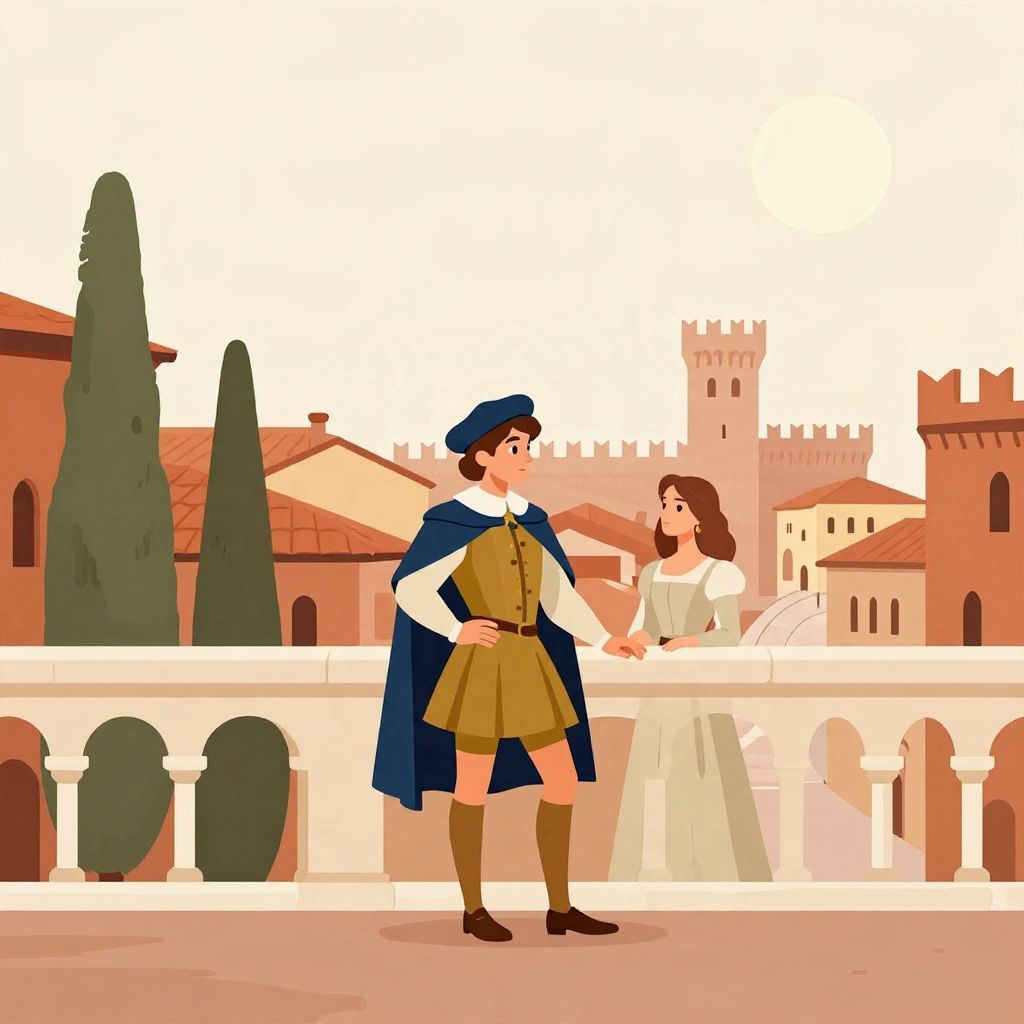
“How old is Romeo?” is a deceptively simple question, because Romeo is not a historical person with a documented birth record. He is a literary character created by William Shakespeare, and his age is never stated exactly in the play. Still, the text gives enough clues to estimate his age with some confidence.
Most readers and scholars place Romeo in his mid-to-late teens, usually around 16 or 17 years old. That estimate fits the play’s language, his family’s expectations, and the social world of Renaissance Verona that Shakespeare imagined.
How old is Romeo?
Romeo is generally understood to be about 16 or 17 years old in Romeo and Juliet. Shakespeare never gives a precise age for him, but the play strongly suggests that he is a teenager, close in age to Juliet, who is explicitly said to be almost 14. Romeo’s age is therefore an informed literary estimate, not a fixed historical fact.
Why Romeo’s age is not stated exactly
Shakespeare rarely gives exact ages unless they matter directly to the plot. In Romeo and Juliet, Juliet’s age is mentioned because it affects the pressure on her family and the timing of her proposed marriage. Romeo’s age, by contrast, is left implicit. That silence has led readers to infer his age from his behavior, his relationships, and the social norms of the story.
What the play tells us
- Juliet is described as “not yet fourteen.”
- Romeo behaves like an adolescent nobleman rather than a fully established adult.
- His friends, especially Mercutio and Benvolio, treat him as a young man still shaped by emotion and impulse.
- The speed of the romance and the intensity of his reactions fit a teenage protagonist.
These clues do not prove an exact number, but they make a teenage Romeo the most reasonable reading.
Romeo’s age in the historical timeline of the play
Romeo and Juliet is set in Renaissance Verona, a stylized Italian city-state rather than a carefully documented historical setting. Shakespeare wrote the play in the mid-1590s, drawing on earlier Italian tales of star-crossed lovers. Romeo’s age is part of the dramatic design: he is young enough for passion to overwhelm judgment, yet old enough to be expected to think and act like an adult.
Key timeline points
- Pre-Shakespearean sources: Earlier versions of the Romeo-and-Juliet story circulated in Italian and English literature before Shakespeare adapted it.
- c. 1595: Shakespeare likely wrote Romeo and Juliet.
- In the play: Romeo is presented as a young nobleman in love, probably around 16 or 17.
- Later interpretation: Modern readers often emphasize how youth and haste drive the tragedy.
This timeline matters because Romeo’s age is not a biographical detail from a real archive. It is a literary choice that shapes the meaning of the tragedy.
What scholars infer about Romeo’s age
Scholars usually estimate Romeo’s age by comparing him with Juliet and by reading the play’s social cues. In the world Shakespeare presents, noble families could arrange marriages for teenagers, and young men were expected to move quickly toward adult roles. Romeo’s emotional volatility, romantic idealism, and impulsive decisions all support the reading that he is still very young.
Why 16 or 17 is the usual estimate
Juliet is nearly 14, and the play treats her as unusually young even for marriage. Romeo must be old enough to move independently, attend social events, duel, and travel between households, but not so old that his behavior seems mature. A mid-teen estimate fits both conditions. Many readers therefore place him a little older than Juliet, but not by much.
That estimate also matches the dramatic balance of the play: two adolescents, not seasoned adults, make choices that spiral into catastrophe.
How Romeo’s age shapes the tragedy
Romeo’s youth is central to the meaning of the story. Shakespeare does not present the tragedy as the failure of a wise adult couple. Instead, it is the story of two young people whose love is sincere but whose judgment is limited by age, family conflict, and social pressure. Romeo’s inexperience helps explain why he moves so quickly from heartbreak over Rosaline to devotion to Juliet.
Youth, haste, and emotion
- Romeo falls in love quickly.
- He marries Juliet in secret almost immediately.
- He reacts intensely to conflict and loss.
- He makes decisions with lasting consequences before he has time to reflect.
The play’s power comes partly from this contrast: Romeo’s feelings are real, but his age makes him vulnerable to bad timing and rash action.
Romeo in the context of Shakespeare’s time
In Elizabethan England, ideas about age and adulthood were different from modern ones. People often married earlier, and social adulthood could begin in the teenage years, especially among the nobility. That does not mean Shakespeare expected audiences to see Romeo as fully mature. Rather, a teenage Romeo would have been recognizable as someone on the threshold between youth and adult responsibility.
Renaissance expectations of young men
Young noblemen were often expected to learn courtly behavior, defend family honor, and prepare for marriage. Romeo’s conduct reflects that world, but he does not yet possess the steadiness associated with older authority figures like Lord Capulet or Friar Laurence. His age helps explain why he is caught between boyhood and adulthood.
In that sense, Romeo is not just “young.” He is dramatically young in a society where age carried strong expectations about honor, obedience, and marriage.
Is there any evidence Romeo is older?
Some readers have imagined Romeo as a young adult in his late teens or early twenties, especially in performance. Stage productions sometimes cast older actors to make the romance feel more familiar to modern audiences. But that is a theatrical choice, not a textual certainty. The play itself gives no strong evidence that Romeo is significantly older than 17 or 18.
Why modern productions sometimes age him up
- Older actors can make the romance more comfortable for contemporary audiences.
- Some productions want to reduce the sense of adolescent impulsiveness.
- Modern viewers may find teenage marriage historically distant or emotionally unsettling.
Even so, the original dramatic logic works best when Romeo remains very young. His age is part of the tragedy’s urgency.
Romeo and Juliet: age as a theme, not just a detail
Romeo’s age matters because Shakespeare uses youth as a major theme. The lovers are not only opposed by family hatred; they are also trapped by the speed of their own lives. Their youth makes their love feel pure and immediate, but it also makes them vulnerable to error. The tragedy asks what happens when passion outruns experience.
Why the age question keeps coming up
Readers ask “How old is Romeo?” because the answer changes how the story feels. If he is 16 or 17, the play becomes a tragedy of adolescence, where first love collides with social violence. If he were older, the story would feel less like a warning about youthful haste and more like a broader romantic disaster. Shakespeare’s likely choice of a teenage Romeo gives the play much of its emotional force.
Bottom line: how old is Romeo?
Romeo is best understood as a teenager, probably about 16 or 17 years old, though Shakespeare never states his age outright. That estimate is based on the play’s clues, the age of Juliet, and the historical setting Shakespeare evoked. Romeo’s youth is not a minor detail; it is one of the main reasons the tragedy feels so immediate and heartbreaking. For more age-based historical questions, you may also enjoy how old Joshua was when Moses died and how old Diana was when she married Charles.