
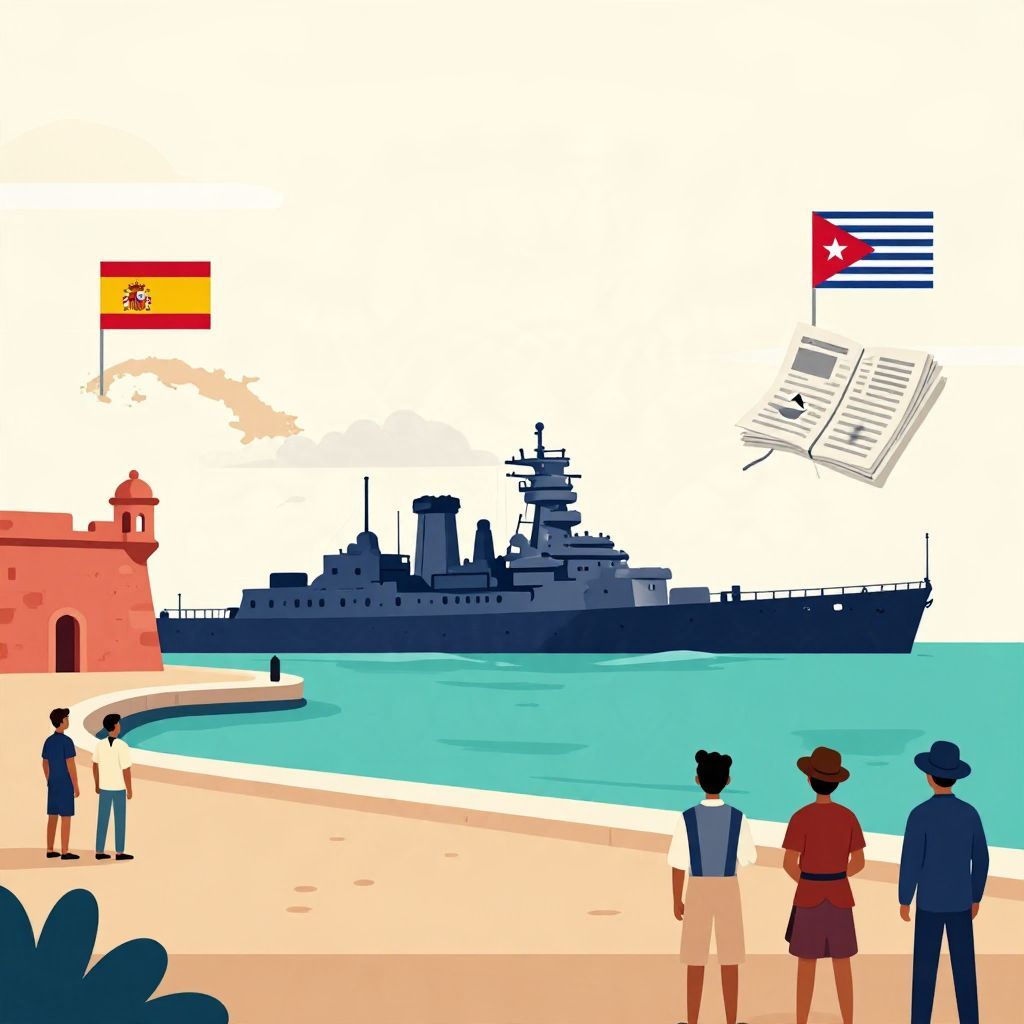
What caused the Spanish-American War? The short answer is that a mix of Cuban rebellion, U.S. expansionism, economic interests, sensational journalism, and a sudden crisis over the USS Maine pushed the United States and Spain into war in 1898.
Behind the outbreak was a longer struggle over empire in the Caribbean and the Pacific. The war did not come from one single event alone; it grew out of decades of Cuban resistance to Spanish rule, American strategic ambitions, and a public mood increasingly willing to see war as a way to reshape U.S. power overseas.
What caused the Spanish-American War?
The Spanish-American War was caused by the combination of Cuban independence movements, harsh Spanish colonial rule, U.S. economic and strategic interests, and public outrage after the USS Maine exploded in Havana Harbor in February 1898. Yellow journalism intensified tensions, while American leaders also saw an opportunity to expand influence in the Caribbean and the Pacific.
The Cuban struggle for independence
Cuba was the central issue. For decades, many Cubans had fought to break free from Spanish colonial rule. Spain treated Cuba as one of its most valuable remaining colonies, and Cuban rebels repeatedly rose against it in the nineteenth century. The most important prewar uprising began in 1895, when independence fighters launched a major revolt against Spanish authority.
Why Cuba mattered so much
Cuba was economically important because of sugar production, trade, and its location near the southern coast of the United States. Spain wanted to keep the island for prestige and revenue, while Cuban rebels wanted self-rule. The conflict became increasingly brutal, especially as Spanish forces tried to suppress the rebellion through reconcentration policies that forced rural civilians into controlled areas, causing widespread suffering and disease.
American newspapers and politicians used these reports to argue that Spain was acting cruelly. Some of this concern was humanitarian, but it also reflected U.S. interest in shaping events close to home. Cuba’s location made instability there a strategic issue for Washington as well as a moral one.
How U.S. expansionism shaped the crisis
By the 1890s, the United States had become more interested in overseas power. Many Americans believed the country should play a larger role in world affairs, protect trade routes, and secure naval bases. This was part of a broader era of American imperialism, when industrial growth, military planning, and political ambition encouraged expansion beyond the continental United States.
Strategic and economic motives
Business leaders wanted stable markets and investment opportunities. Naval strategists, influenced by thinkers such as Alfred Thayer Mahan, argued that a strong navy and overseas bases were essential to national power. Cuba, Puerto Rico, and the Philippines all mattered in this larger vision. The war therefore fit a pattern of U.S. interest in controlling key locations and expanding influence in the late nineteenth century.
It would be too simple, however, to say the war was caused only by greed. Many Americans sincerely believed they were helping oppressed Cubans. The motives were mixed: humanitarian concern, nationalism, commercial interest, and strategic calculation all played a role.
Yellow journalism and public pressure
Newspapers owned by figures such as William Randolph Hearst and Joseph Pulitzer competed fiercely for readers. Their papers often used dramatic headlines, emotional language, and exaggerated stories about Spanish atrocities in Cuba. This style became known as yellow journalism, and it helped create a climate in which war seemed both necessary and exciting to many readers.
What yellow journalism did—and did not do
Yellow journalism did not invent the Cuban crisis, and historians are careful not to blame the war entirely on the press. Spain’s colonial policy and the Cuban rebellion were already real. But sensational reporting magnified public anger, hardened attitudes, and made compromise harder. It also increased pressure on American politicians, who had to respond to an increasingly war-ready public mood.
Some popular accounts claim that newspaper publishers single-handedly caused the war. That is an exaggeration. The press mattered, but it worked within a larger political and imperial context already moving toward confrontation.
The explosion of the USS Maine
The immediate trigger came on February 15, 1898, when the U.S. battleship USS Maine exploded in Havana Harbor, killing more than 260 American sailors. The cause of the explosion was not clearly known at the time, and modern historians generally do not treat Spain as proven guilty. Still, many Americans quickly assumed Spanish responsibility.
“Remember the Maine”
The slogan “Remember the Maine” became a rallying cry. Public outrage surged, and the disaster made diplomacy much harder. Although the exact cause of the explosion remains debated, the political effect was immediate. The event created a powerful emotional push toward war, especially when combined with months of hostile reporting and rising tension over Cuba.
It is important to distinguish between the historical fact of the explosion and the assumption made by many Americans afterward. The explosion itself caused anger; the belief that Spain was responsible helped turn that anger into war fever.
Spanish colonial policy and the limits of reform
Spain was not simply a passive victim of American aggression. It had long defended its empire and resisted foreign pressure. In Cuba, Spanish authorities tried reforms at different moments, but they often came too late or were seen as inadequate. The colonial government struggled to defeat the rebellion while also maintaining legitimacy.
Why compromise failed
By the late 1890s, trust had collapsed on all sides. Cuban rebels wanted independence, not limited autonomy. Many Americans no longer believed Spain could govern Cuba humanely or effectively. Spanish leaders, meanwhile, saw surrendering Cuba as a blow to national honor and imperial survival. This deadlock made escalation increasingly likely.
In that sense, the war was not just caused by one dramatic incident. It was the result of a colonial system that had become unstable and a diplomatic environment in which neither side could easily back down.
The broader imperial context of 1898
The Spanish-American War was part of a wider global age of empire. European powers were expanding overseas, and the United States was beginning to do the same. The war reflected a moment when industrial nations linked military strength, trade, and national prestige. Cuba was the spark, but the fuel came from a larger imperial world.
Why the Philippines mattered too
Although Cuba was the main cause of the war, the conflict quickly expanded to the Philippines, where U.S. forces attacked Spanish holdings in the Pacific. This shows that the war was not only about Cuban independence. It also became a vehicle for American overseas expansion, proving that the United States was prepared to fight for influence far beyond its borders.
That broader outcome matters when asking what caused the war. The immediate cause was the crisis over Cuba and the Maine, but the deeper cause was the United States’ growing willingness to act as an imperial power.
Chronology of the road to war
The path to war can be seen in a few key steps:
- 1895: Cuban rebels launch a major independence uprising against Spain.
- 1896–1897: Spanish repression and reconcentration policies intensify suffering in Cuba.
- 1897–1898: U.S. newspapers sharply increase anti-Spanish coverage.
- February 15, 1898: The USS Maine explodes in Havana Harbor.
- April 1898: The United States declares war on Spain.
This sequence shows that the war was not a sudden accident. It developed through a chain of political, military, and media pressures that made conflict increasingly likely.
Was the war really caused by the Maine?
The Maine was the immediate trigger, but not the full cause. If the ship had never exploded, war might still have come, though perhaps later or under different circumstances. The deeper causes were Cuba’s independence struggle, Spain’s colonial policies, and American expansionist ambitions. The explosion simply gave those tensions a dramatic focal point.
Historians generally avoid treating any single explanation as sufficient. The best answer is that the war resulted from overlapping causes: empire, rebellion, public opinion, and strategic opportunity.
What happened after the war?
The war lasted only a few months, but its consequences were enormous. Spain lost control of Cuba, Puerto Rico, Guam, and the Philippines. The United States emerged as a major overseas power. Cuba became formally independent in 1902, though American influence remained strong. The war marked a turning point in U.S. history, signaling a new era of intervention and expansion.
It also sparked debate at home. Some Americans celebrated the war as a liberation of oppressed peoples, while others criticized it as imperial conquest. That debate continued into the twentieth century and remains important for understanding U.S. foreign policy.
Conclusion
The Spanish-American War was caused by a combination of Cuban resistance to Spanish rule, Spanish colonial repression, U.S. imperial and economic ambitions, sensational press coverage, and the emotional shock of the USS Maine explosion. The war was not the product of one cause alone, but of a volatile mix of local rebellion and global power politics. For related background, see what American imperialism was and what mercantilism was.