
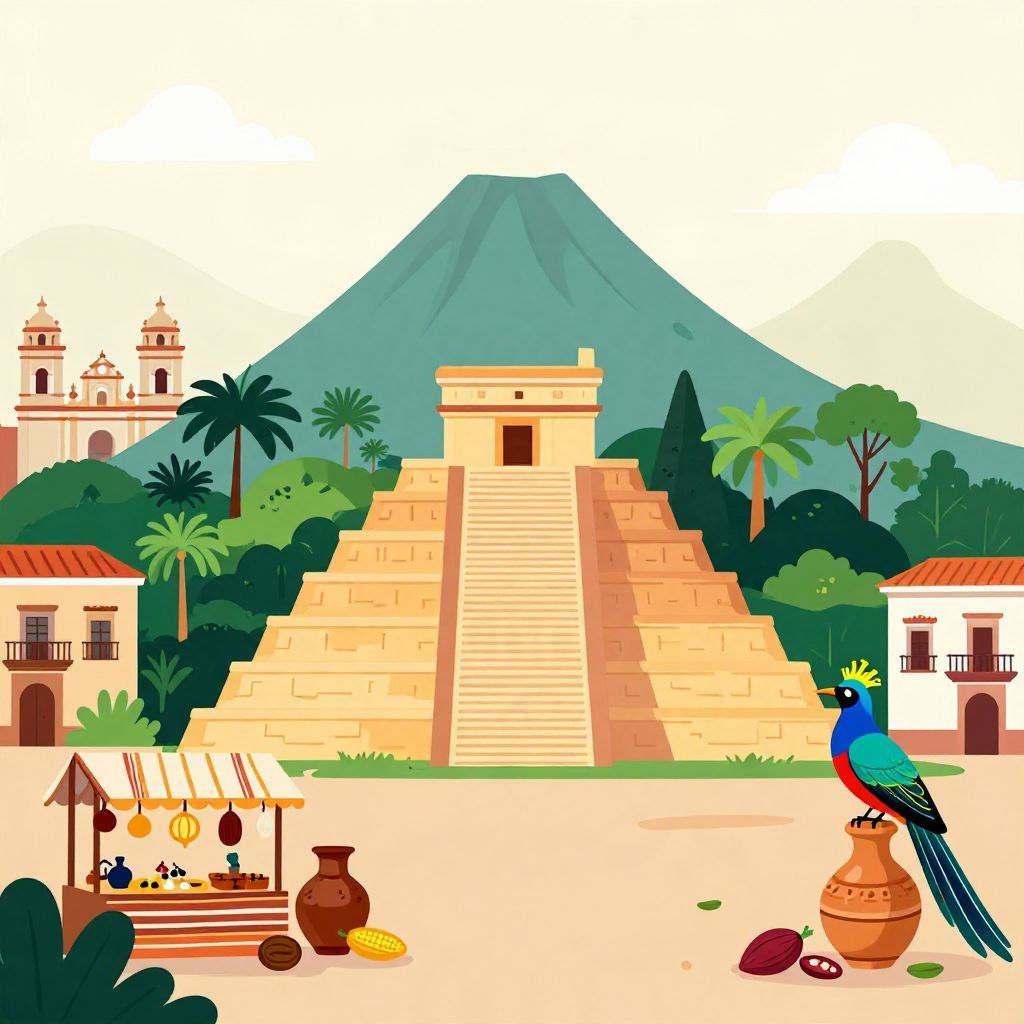
What is Guatemala known for? The country is best known for its extraordinary Maya heritage, dramatic volcanic landscapes, colorful Indigenous cultures, Spanish colonial cities, and world-famous coffee. Its history stretches from ancient Maya city-states to the upheavals of conquest, independence, civil war, and modern nationhood.
Guatemala’s identity has been shaped by both deep continuity and dramatic change. To understand what it is known for, you need to look at its ancient civilizations, colonial past, cultural traditions, and the natural geography that still defines everyday life.
What Is Guatemala Known For?
Guatemala is known for its Maya archaeological sites, living Indigenous traditions, colonial architecture, volcanoes, lakes, and coffee production. It is also recognized for a long and complex history that includes Spanish conquest, independence in 1821, political instability, and a strong cultural legacy that remains visible in language, textiles, religion, and food.
Ancient Maya Civilization and Archaeological Heritage
One of the most important reasons Guatemala is famous is that it was a major center of the ancient Maya world. Long before Spanish rule, Maya societies built cities, developed writing systems, tracked astronomy, and created sophisticated political and religious traditions. Their legacy remains central to Guatemala’s historical identity.
Tikal and other major sites
Among the best-known Maya sites in Guatemala is Tikal, a powerful city in the Petén region that flourished especially between about the 4th and 9th centuries CE. Tikal was part of a network of rival city-states, not a single empire. Its temples, plazas, and inscriptions show the scale and complexity of Maya urban life.
Other important sites include El Mirador, Quiriguá, and Yaxhá. These places reveal that Guatemala was not only a homeland of the Maya in the distant past, but also one of the main regions where their civilization reached its peak. Archaeologists continue to study these sites because they help explain trade, warfare, kingship, and environmental change in ancient Mesoamerica.
Living Maya culture
Guatemala is also known for the fact that Maya culture did not disappear after the collapse of the classic city-states. Millions of Guatemalans today identify as Maya and speak Indigenous languages such as K’iche’, Q’eqchi’, Kaqchikel, and Mam. Traditional clothing, weaving, religious practices, and community customs remain visible in many regions.
This continuity matters historically. Guatemala is often described not simply as a place with ancient ruins, but as a country where Indigenous history is still part of the present. That makes it especially significant in the broader history of the Americas.
Spanish Conquest and Colonial Guatemala
Guatemala is also known for its colonial history. The Spanish conquest began in the early 16th century, after Pedro de Alvarado and his forces entered the region in the 1520s. Conquest was not a single event but a long and violent process shaped by alliances, resistance, disease, and the Spanish effort to control labor and tribute.
Antigua and colonial architecture
One of Guatemala’s most famous colonial cities is Antigua Guatemala, founded in the 16th century and later damaged by earthquakes. It became the colonial capital and is known today for its churches, convents, and preserved streetscapes. The city reflects the Spanish imperial style adapted to a seismically active region.
Antigua is often associated with baroque architecture, religious festivals, and the visual beauty that draws modern visitors. Historically, however, it also represents the colonial order: Spanish authority, Catholic evangelization, and the social hierarchy imposed on Indigenous populations.
Religious and social change under Spain
Under Spanish rule, Guatemala became part of the Captaincy General of Guatemala, a major administrative region in Central America. Catholicism spread widely, but it often blended with Indigenous beliefs and practices. This produced forms of religious life that were neither purely Spanish nor purely preconquest Maya, but a mixture shaped by centuries of adaptation.
Colonial society was unequal. Spaniards and creole elites held most political power, while Indigenous communities and enslaved Africans faced coercion and marginalization. Understanding Guatemala’s colonial history helps explain later struggles over land, labor, and identity.
Independence and the Making of a Nation
Guatemala is known for becoming independent from Spain in 1821, along with much of Central America. But independence did not immediately create a stable nation-state. The region passed through several political arrangements before Guatemala emerged as a separate republic in the 19th century.
From empire to republic
After independence, Central America briefly joined the Mexican Empire and then became part of the Federal Republic of Central America. That federation later collapsed, and Guatemala became an independent republic in its own right. This process was marked by conflict between liberal and conservative factions, debates over church power, and disputes over land and regional authority.
These struggles mattered because they shaped modern Guatemala’s institutions. The country’s political history was not a smooth transition from colony to nation. It was a contested process in which elites, military leaders, and rural communities all played different roles.
Volcanoes, Highlands, and Natural Beauty
Guatemala is famous for its dramatic geography. The country lies in a seismically active region and has numerous volcanoes, mountain ranges, lakes, and fertile valleys. This landscape has influenced settlement patterns, agriculture, trade routes, and even political power.
Why the landscape matters historically
Volcanic soils have supported agriculture for centuries, especially in the highlands. At the same time, earthquakes and eruptions have repeatedly damaged towns and cities, including colonial Antigua. Guatemala’s geography has therefore been both a source of prosperity and a recurring challenge.
The country is also known for scenic places such as Lake Atitlán, surrounded by volcanoes and Indigenous communities. While often celebrated today for tourism, the region has long been a lived cultural landscape rather than just a picturesque destination.
Coffee and Agricultural History
Another major answer to what Guatemala is known for is coffee. Coffee became one of the country’s most important export crops in the 19th century and helped shape land ownership, labor systems, and foreign trade. Its rise was tied to liberal reforms that encouraged commercial agriculture.
How coffee changed the country
The expansion of coffee production brought wealth to some landowners but also intensified inequality. Large estates expanded, and Indigenous communities often lost land or were pushed into labor arrangements that favored plantation owners. Coffee helped integrate Guatemala into the global economy, but it also deepened social divisions.
Today, Guatemalan coffee is known internationally for quality and regional variety. Historically, though, it is important because it transformed the country’s economy and reinforced patterns of elite power that lasted well into the 20th century.
Language, Textiles, and Cultural Identity
Guatemala is known for its rich cultural diversity. One of the country’s most distinctive features is the coexistence of Spanish with many Indigenous languages. This multilingual reality reflects both the endurance of Maya communities and the uneven legacy of colonial rule.
Traditional clothing and weaving
Guatemalan textiles are among the country’s most recognizable cultural expressions. Many Maya communities produce woven garments, especially huipiles, that feature local designs, colors, and symbols. These textiles are not just decorative; they can express community identity, status, and regional tradition.
Because patterns vary from place to place, clothing in Guatemala often tells you where a person comes from. That makes textiles a living historical record, preserving artistic forms that go back generations while continuing to evolve in the present.
Festivals and religious traditions
Guatemala is also known for religious festivals that combine Catholic and Indigenous elements. Holy Week processions, local saints’ celebrations, and community rituals are important in many towns. Some traditions are deeply rooted in Spanish Catholic practice, while others reflect older Indigenous meanings that survived and adapted over time.
This blending is one reason Guatemala’s culture is so distinctive. It shows how conquest did not erase older traditions completely, but instead produced new forms of belief and ceremony.
20th-Century Conflict and Civil War
Guatemala is also known for its painful modern history, especially the civil war that lasted from 1960 to 1996. This conflict involved the Guatemalan state, leftist insurgent groups, Indigenous communities, and rural populations caught in the middle. It was one of the longest and deadliest conflicts in Latin American history.
Roots of the conflict
The war cannot be understood without earlier political struggles. In the mid-20th century, Guatemala experienced reform efforts, military intervention, and Cold War pressure. Land inequality and state repression fueled rebellion, while counterinsurgency campaigns caused immense suffering, particularly in Indigenous areas.
Historians generally agree that the war had devastating human consequences, including massacres, displacement, and widespread trauma. The conflict left a lasting mark on national memory and on the relationship between the state and Indigenous communities.
Aftermath and memory
The 1996 peace accords ended the war formally, but they did not erase its effects. Guatemala continues to grapple with questions of justice, memory, inequality, and political reform. In this sense, what Guatemala is known for includes not only ancient greatness and cultural beauty, but also the unfinished work of reconciliation.
Food, Markets, and Everyday Life
Guatemala is often associated with colorful markets, traditional foods, and a strong local culture of trade and community life. Foods such as tamales, pepián, and corn-based dishes reflect the deep importance of maize in Mesoamerican history. Markets remain important social spaces where language, textiles, produce, and craft traditions meet.
These everyday practices matter historically because they show continuity across centuries. Guatemala’s identity is not only found in ruins or major political events, but also in ordinary habits that preserve older cultural patterns.
What Makes Guatemala Historically Distinct?
Guatemala stands out because it combines several layers of history in one place. It is a country where ancient Maya civilization, Spanish colonial rule, independence struggles, agricultural transformation, and modern conflict all shaped the present. Few countries in the Americas have such a visible overlap of pre-Columbian, colonial, and contemporary Indigenous history.
- Ancient Maya legacy in cities, writing, astronomy, and political organization
- Living Indigenous cultures with many Maya languages still spoken today
- Colonial heritage visible in Antigua and religious traditions
- Volcanic geography that shaped settlement and agriculture
- Coffee production that transformed the economy in the 19th century
- Civil war history that continues to influence politics and memory
So, what is Guatemala known for? It is known for being one of the great historical heartlands of the Maya world, for its striking landscapes and colonial cities, and for a cultural identity that has endured conquest, reform, conflict, and change. If you want to explore more connected topics, you might also enjoy reading about where coffee originally came from and the wider history behind Machu Picchu.