
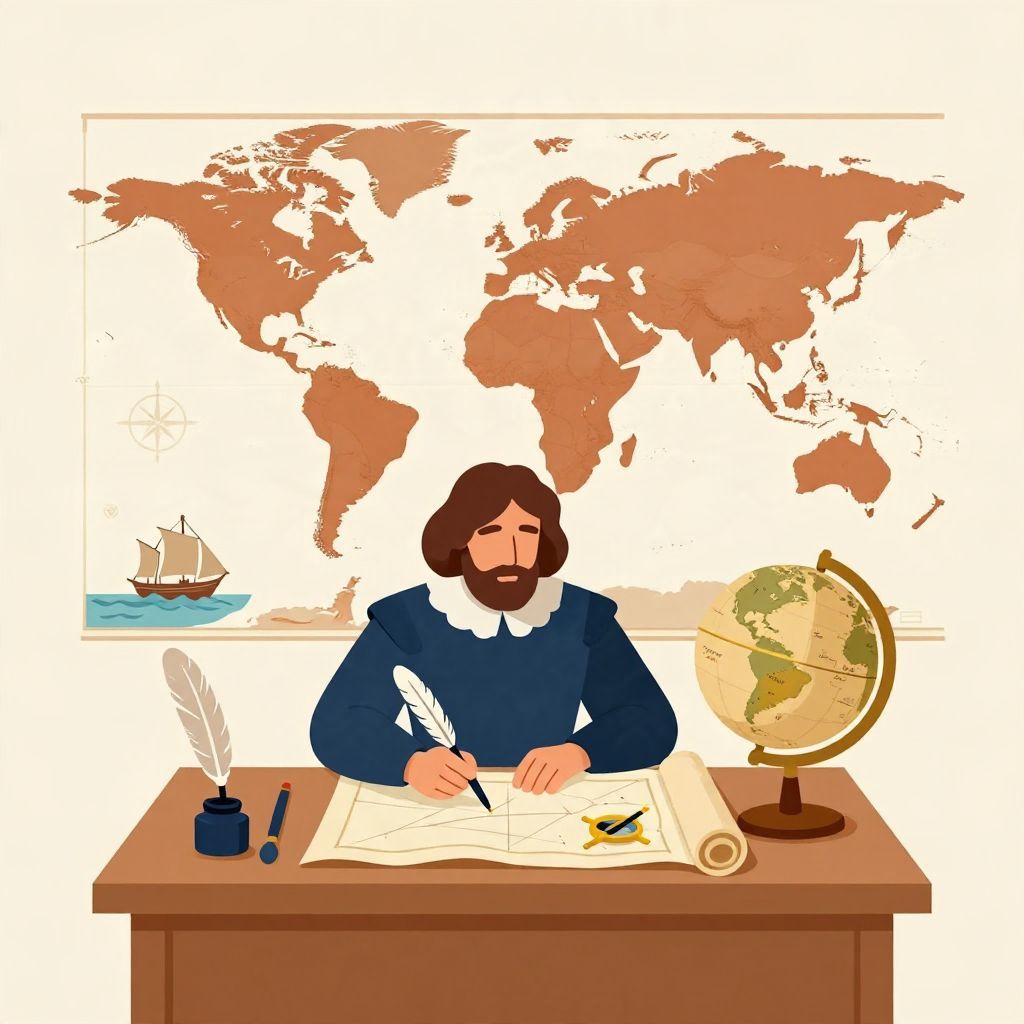
Why is America called America? The short answer is that the name comes from Amerigo Vespucci, an Italian navigator whose reports helped Europeans understand that the lands across the Atlantic were not Asia but a separate “New World.” A mapmaker later used a Latinized form of his name, America, and the label spread.
That simple answer hides a longer story about exploration, mapmaking, and the way Europeans named newly described places in the early 1500s. The name did not begin as the official title of a country. It first appeared on a map, then gradually came to mean the continents and, eventually, the United States.
Why is America called America?
America is called America because the name was first applied to the newly described lands of the Western Hemisphere by the cartographer Martin Waldseemüller in 1507. He used the feminine Latin form of Amerigo Vespucci’s name, “America,” to label the southern part of the New World on a map and in an accompanying text.
The role of Amerigo Vespucci
Amerigo Vespucci was not the first European to reach the Americas, and he did not “discover” them in the modern sense. Indigenous peoples already lived there, and Norse voyagers had reached parts of North America centuries earlier. Vespucci’s importance lay in his written accounts of voyages along the South American coast in the late 1490s and early 1500s. Those reports argued that these lands were not the edge of Asia, but a separate continent.
That idea mattered. In the age of exploration, Europeans were still trying to fit new discoveries into old geographic models. If the lands across the Atlantic were a new continent, they needed a new name. Vespucci’s name became attached to that new understanding, not because he claimed the honor himself, but because others used his writings and reputation in naming the map.
Martin Waldseemüller’s 1507 map
The strongest historical evidence for the origin of the name comes from Waldseemüller’s 1507 world map, often called the Universalis Cosmographia. In a related text, he and his colleagues explained that since Europe, Asia, and Africa had female names, the newly recognized land should be called America after Amerigo Vespucci. This was a scholarly naming decision, not a royal decree.
At first, the name referred mainly to what we now call South America. Over time, mapmakers expanded it to include North America as well. By the 16th and 17th centuries, “America” was becoming a general geographic term for the lands of the Western Hemisphere.
How the name spread from a map to a continent
Once a name appeared on an influential map, it could travel quickly through European scholarship and cartography. Other mapmakers copied, adapted, or debated the label. Because maps were among the most important tools for trade, navigation, and imperial planning, a successful map term could become standard even without a formal naming ceremony.
Why one map mattered so much
Early modern Europe was a world of printed books, atlases, and learned correspondence. A map published in a respected center of learning could shape how educated readers understood the globe. Waldseemüller’s map did not instantly settle the matter everywhere, but it helped establish “America” as a plausible and useful name for the newly recognized lands.
There was also a practical reason the name endured: it was easy to use. “America” was shorter and more flexible than longer descriptive phrases such as “the New World” or “the Indies,” both of which were used at the time. As European knowledge grew, “America” became the preferred term for the western continents.
From one continent to two
Today, people use “America” in different ways. In some contexts, it means the United States of America. In others, it refers to the continents of North and South America together, or to the Western Hemisphere more broadly. This variation developed gradually and reflects different linguistic traditions, especially in English and Spanish.
Historically, the name first belonged to the continents, not to the United States. The country later adopted the word in its official title, United States of America, after independence in the late 18th century. That is why “America” can mean both a continent and a nation, depending on context.
Was America named after Amerigo Vespucci?
Yes, in the standard historical explanation, the name America was derived from Amerigo Vespucci’s first name, Latinized as Americus, and then turned into the feminine form America. This is the widely accepted origin among historians of cartography and exploration, though the exact chain of naming has been discussed for centuries.
Why the feminine form?
Waldseemüller and his circle followed a common Renaissance practice of giving newly identified lands feminine names, matching Europe, Asia, and Africa. The choice of a feminine ending was therefore stylistic as well as linguistic. It was not because the land itself was thought to be female in any literal sense, but because that was the convention used in learned Latin geography.
Did Vespucci deserve the honor?
That question has long sparked debate. Some later writers felt Christopher Columbus should have received the naming honor because he reached the Caribbean in 1492. But Columbus believed until the end of his life that he had reached lands near Asia. Vespucci’s accounts were influential because they emphasized a new geographic reality: this was a separate landmass, not simply the outskirts of known Asia.
So the name “America” reflects not just who arrived first, but whose descriptions helped Europeans understand what they had found. In that sense, the name honors interpretation as much as exploration.
What historical context led to the naming of America?
The naming of America emerged from the broader Age of Exploration, when European states sought sea routes to Asia, new trade opportunities, and strategic advantage. Portuguese, Spanish, and later English, French, and Dutch expeditions transformed European maps and challenged older medieval ideas about the world.
Key developments in the early 1500s
- 1492: Columbus crossed the Atlantic and reached the Caribbean.
- Late 1490s to early 1500s: Vespucci took part in voyages and wrote accounts describing the lands as a separate world.
- 1507: Waldseemüller’s map used the name America.
- 16th century: The name spread through European maps and books.
- Later centuries: “America” came to refer broadly to the continents and, in common speech, especially to the United States.
This chronology shows that the name was not the result of a single dramatic event. It developed through exploration, reporting, and cartographic consensus. Naming in the early modern world was often a process, not a moment.
Common myths and misunderstandings
Because the name is so familiar, several myths have grown up around it. The most common is that America was named directly by Columbus. Another is that the name was chosen by a king, pope, or government. Neither claim is supported by the historical record.
Myth 1: Columbus named America
Columbus did not name America. He never used that term for the lands he reached. He remained convinced that he had arrived in Asia or near it, and his own naming practices reflected that belief. The name America came later, after other Europeans concluded that these lands formed a separate continent.
Myth 2: The name was official from the beginning
There was no single official naming ceremony for America. The word entered usage through printed maps and scholarly discussion. Over time, repeated use made it standard. This is common in history: many geographic names become accepted because they are useful, not because they are formally announced.
Myth 3: “America” always meant the United States
In the 16th and 17th centuries, “America” referred to the continents, not a country. The modern habit of using “America” to mean the United States developed later, especially in English-language usage. That shift reflects the political rise of the United States, not the original meaning of the name.
Why the name still matters today
The word “America” carries centuries of history in a single term. It reflects European exploration, the creation of new maps, and the process by which the Old World tried to understand the New World. It also reminds us that names are historical products: they are made by people, shaped by power, and changed by use.
At the same time, the name can obscure older histories. Long before Europeans arrived, the Americas were home to diverse Indigenous civilizations with their own names for their lands. The European label “America” became dominant because of colonial expansion, not because it was the only or original name for the region.
Conclusion
America is called America because a 1507 mapmaker named the newly recognized lands after Amerigo Vespucci, whose writings helped Europeans realize they had encountered a separate continent. The name spread through maps and books, then expanded in meaning over time. For related reading, see where the name America came from and one reason colonists came to America.