
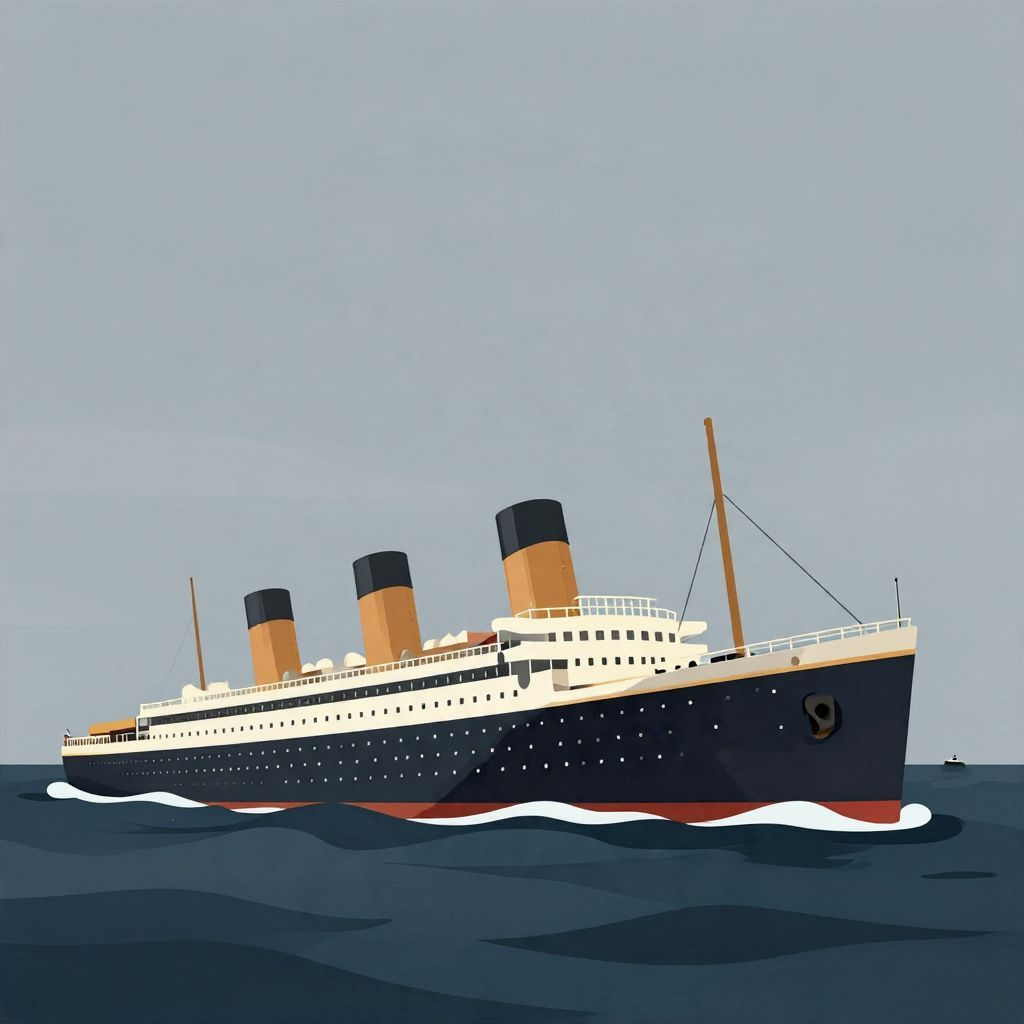
The question “How did the Titanic break in half?” gets to the heart of one of the most famous disasters in modern history. For decades, some people doubted that the ship actually split apart, but the wreck’s discovery in 1985 confirmed it did. The breakup happened during the final moments of the sinking, after the ship’s structure was overwhelmed by stress as the bow plunged and the stern rose.
Understanding why the Titanic broke in half helps explain not only how the ship sank, but also why the disaster killed so many people and changed maritime safety forever.
How Did the Titanic Break in Half?
The Titanic broke in half when extreme structural stress overwhelmed the ship as it sank at a steep angle. The bow filled with water and pulled downward while the stern was lifted out of the sea, bending the hull until it fractured near the middle, roughly between the third and fourth funnels, before the two sections separated completely.
What Happened in the Final Minutes
The breakup did not happen at the moment of collision with the iceberg. The ship struck the iceberg at about 11:40 p.m. on 14 April 1912 and remained afloat for more than two hours. During that time, flooding spread through several forward compartments, and the ship gradually lost buoyancy and stability.
As the bow sank deeper, the stern rose higher out of the water. This created a dangerous bending force along the ship’s length. The Titanic was built with a strong steel hull, but it was not designed to endure such a severe angle of stress while one end was submerged and the other end was partly unsupported.
The bending force that doomed the ship
Think of the ship like a very long beam. Once the front was heavy with water and the back was lifted, the hull was forced into a dramatic curve. The middle section experienced enormous tension on one side and compression on the other. That combination eventually caused the steel structure to fail.
Eyewitness accounts from survivors describe the ship’s stern lifting steeply, lights still burning, and then a sudden violent change as the vessel gave way. The exact sequence of the fracture was not fully understood for many years, but modern study of the wreck and historical testimony supports the conclusion that the ship broke apart while still above the surface.
Why the Titanic Broke: The Structural Causes
The breakup was the result of several factors working together: flooding, weight distribution, hull stress, and the ship’s design. No single flaw alone explains the disaster. Instead, the Titanic’s structure was pushed beyond its limits by the way water entered the ship and by the forces created as it tilted more and more steeply.
Flooding in the forward compartments
The iceberg damage opened multiple compartments along the starboard bow. The Titanic was designed with watertight compartments, but it could only survive flooding in a limited number of them. Once water spread beyond that limit, the bow became progressively heavier and sank lower.
As the forward end went down, the ship’s center of gravity shifted. That made the stern rise, which in turn increased the strain on the hull. The structure was strong, but not infinitely flexible. A ship this large could not simply bend without consequence.
Stress concentration near the middle
The ship likely fractured near the area between the third and fourth funnels, where the bending forces were especially severe. This was not necessarily because the middle was weak in an ordinary sense. Rather, it was the point where the upward force on the stern and the downward pull of the bow created the greatest stress.
Some historians and engineers have debated the exact location and timing of the fracture. That debate matters because it helps explain the mechanics of the sinking, but the broad conclusion is well established: the hull failed under the strain of being bent in two directions at once.
Did the Titanic Break Before It Disappeared?
Yes. The Titanic broke apart before it fully sank beneath the surface. For many years after 1912, some official accounts and public assumptions suggested the ship went down intact. That idea persisted partly because survivors saw the disaster in darkness, confusion, and distance, making exact observation difficult.
When the wreck was found, it was discovered in two large main sections on the ocean floor, confirming what many survivor testimonies had long suggested. The bow section lies some distance from the stern section, showing that the ship separated before reaching the seabed.
Why people once thought it sank whole
Several factors helped create the mistaken belief that the Titanic sank in one piece:
- The breakup happened at night, in poor visibility.
- Passengers and crew were scattered across lifeboats and the deck.
- The final moments were chaotic and terrifying, making precise observation difficult.
- Early official inquiries did not fully settle the structural question.
Later evidence, especially the wreck site and careful study of survivor accounts, made the breakup much harder to dispute.
What the Wreck Revealed
The discovery of the Titanic’s wreck in 1985 transformed the historical understanding of the sinking. The ship was found split into two major sections, with a debris field between them. This physical evidence strongly supported the conclusion that the hull failed during the sinking rather than after it had already disappeared beneath the sea.
The wreck also showed how violently the ship separated. The bow section remained relatively intact compared with the stern, while the stern section was heavily damaged and twisted. This difference fits the idea that the stern, after rising out of the water and then plunging back down, endured extreme structural stress.
Why the stern was so damaged
The stern likely suffered more chaos than the bow because it was lifted, partially emptied of support, and then dropped back into the sea. That sequence would have placed immense strain on internal structures, machinery, and the hull itself. When the stern finally descended, it did so in a far more broken condition than the bow.
How the Breakup Affected the Death Toll
The breakup mattered because it changed the final phase of the sinking and likely made the loss of life even worse. Once the ship split, the stern briefly remained afloat before sinking, but the breakup itself would have thrown people into the freezing sea and intensified panic. The disaster was already catastrophic, but the structural failure added another layer of danger.
Even before the breakup, the number of lifeboats was far too small for everyone aboard. The ship’s structural failure did not create the shortage, but it made the final minutes more chaotic. In the end, more than 1,500 people died, largely from drowning and hypothermia in the North Atlantic.
Why the Titanic Breakup Matters Historically
The Titanic’s breakup matters because it changed both historical understanding and maritime safety. It showed that large modern ships could fail in dramatic ways if structural limits were exceeded. It also demonstrated the importance of lifeboat capacity, emergency procedures, and ship design that accounts for catastrophic damage.
In the years after the disaster, maritime regulations changed in significant ways. Safety drills, lifeboat requirements, wireless communication standards, and ice patrols all received greater attention. The Titanic became a powerful symbol of technological confidence outrunning practical safety.
A lesson in design and hubris
The Titanic was celebrated as one of the most advanced ships of its era, and that reputation encouraged a sense of confidence. But the breakup showed that impressive size and engineering do not eliminate risk. A ship can be state-of-the-art and still be vulnerable if its safety systems are inadequate for worst-case scenarios.
That lesson remains relevant well beyond the history of one ship. It is one reason the Titanic continues to fascinate historians, engineers, and the public alike.
What We Know, and What Remains Debated
Historians and engineers agree on the broad outline: the Titanic struck an iceberg, flooded forward, developed a dangerous bend, broke in two, and sank. Some details remain debated, especially the precise moment the fracture began and the exact stresses at work in the hull. Those uncertainties are normal in historical reconstruction, especially for an event witnessed under extreme conditions.
What is not seriously in doubt is that the ship broke apart because the sinking created forces the structure could not withstand. The wreck, survivor testimony, and later analysis all point to that conclusion.
Conclusion
The Titanic broke in half because flooding in the bow caused the ship to sag deeply at the front while the stern rose high out of the water, bending the hull until it failed under enormous stress. That structural failure happened during the final moments of the sinking, before the ship disappeared beneath the Atlantic. It remains one of the clearest examples of how a single disaster can reshape engineering, safety, and memory for generations.