
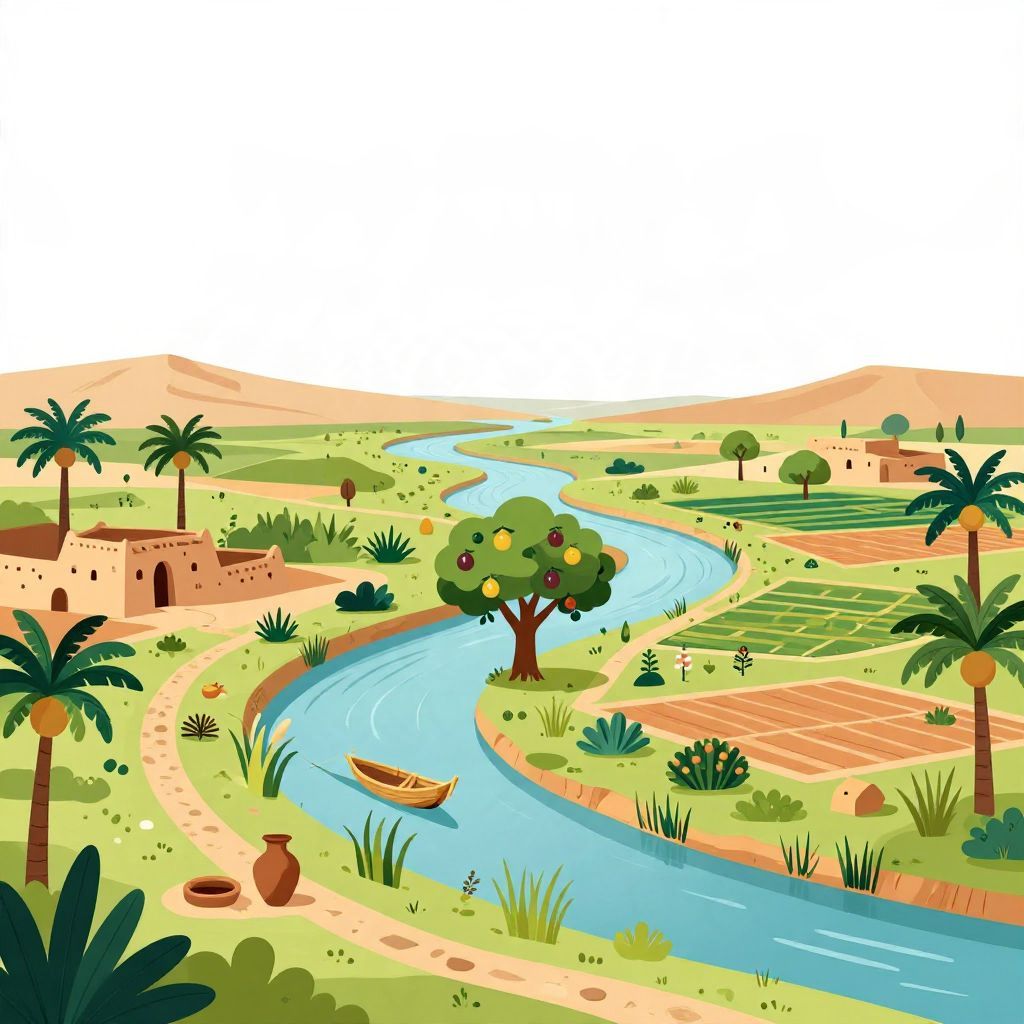
Where was the Garden of Eden located? It is one of the oldest and most enduring historical-religious questions in the world. The short answer is that no location can be proven with historical or archaeological certainty, because Eden belongs to a sacred origin story rather than a recoverable place on a map.
Still, the biblical text itself gives clues that have led scholars, theologians, and later readers to place Eden somewhere in the ancient Near East, often near Mesopotamia. Those clues have inspired centuries of interpretation, from literal geographic searches to symbolic readings about humanity’s beginnings.
Where Was the Garden of Eden Located?
The Garden of Eden cannot be identified with certainty. In the Book of Genesis, it is described as a divinely planted garden from which four rivers flow, including the Tigris and Euphrates. Because those rivers are real and associated with Mesopotamia, many interpreters have placed Eden somewhere in or near that region, but the text does not give enough detail for a definitive historical location.
What the Biblical Text Actually Says
The main source for Eden is Genesis 2–3. The garden is described as a place watered by a river that then divides into four branches: Pishon, Gihon, Tigris, and Euphrates. Two of those names are well known from ancient geography, while the other two remain uncertain. That mix of recognizable and mysterious details is one reason the location has never been settled.
The four rivers and why they matter
- Tigris and Euphrates are major rivers of Mesopotamia, the broad region of modern Iraq and neighboring areas.
- Pishon and Gihon are not securely identified with real rivers by historians or archaeologists.
- The text may be using geography to make a theological point rather than to provide a surveyor’s map.
Because the river system in Genesis does not match any known modern or ancient river network exactly, the passage has long been read as a blend of geography, symbolism, and sacred memory. The text preserves a sense of place, but not a precise address.
The Most Common Historical Interpretations
Most historical interpretations place Eden in the broader ancient Near East, especially Mesopotamia, the land between the Tigris and Euphrates. This is the strongest geographic clue in the biblical account. Even so, scholars disagree on whether Eden was meant to be a literal place, a literary symbol, or a sacred origin landscape remembered through ancient tradition.
Mesopotamia as the leading candidate
Mesopotamia is often proposed because it fits the biblical river names and because early Israelite literature emerged in a world shaped by Mesopotamian cultures. Ancient peoples of the region saw great rivers as sources of life, fertility, agriculture, and civilization. A garden planted by God in such a setting would have carried powerful meaning for ancient readers.
Some interpreters have suggested locations in southern Iraq, near the marshlands or the meeting of the Tigris and Euphrates. Others have looked farther north, where the rivers are closer together. None of these proposals can be verified archaeologically as Eden itself.
Other proposed locations
- Persian Gulf region: Some theories place Eden in a now-submerged area, especially if river courses changed over time.
- Armenian highlands: Because several major rivers rise in this broader region, some readers have argued for a northern origin.
- Symbolic geography: Many scholars think the text is not trying to identify a discoverable site at all.
These theories show how difficult it is to map a sacred narrative onto real-world geography. River systems shift, coastlines change, and ancient names can be reused or reinterpreted over centuries. Even if the story reflects a real landscape memory, it has been shaped by religious meaning more than by cartography.
Why Scholars Do Not Treat Eden as a Verifiable Historical Site
Historians work with evidence that can be checked: inscriptions, ruins, settlement layers, maps, and datable texts. Eden does not appear in that kind of evidence as a confirmed location. Instead, it appears in a foundational religious narrative that explains human origins, moral choice, labor, suffering, and separation from divine presence.
The limits of archaeology
Archaeology has revealed much about ancient Mesopotamia, including cities, irrigation systems, temples, and written records. But no excavation has produced a site that can be identified as the Garden of Eden. That absence does not prove the story is meaningless; it simply means the narrative belongs to a different category than a recoverable ancient city or battlefield.
In historical study, this distinction matters. A place may be culturally important without being archaeologically identifiable. Eden is best understood as a sacred origin place in a religious tradition, not as a site that historians can confidently pinpoint on a modern map.
How Ancient Readers May Have Understood Eden
For ancient audiences, Eden likely functioned as more than a lost garden. It represented an ideal beginning: abundance, harmony, direct access to God, and the absence of death and toil. The story explains why human life is marked by struggle and why paradise is no longer available in the same way.
Connections to wider ancient Near Eastern ideas
Ancient Mesopotamian literature also contains stories of divine gardens, sacred trees, and human longing for immortality. While Genesis is distinctive in its theology, it emerged in a cultural world where such images were familiar. That background helps explain why Eden is described with lush vegetation, flowing water, and a sacred boundary.
This does not mean Genesis copied other traditions in a simple way. Rather, it shows how biblical writers used familiar ancient imagery to express a unique religious message about creation, obedience, and human responsibility.
Eden in Jewish, Christian, and Islamic Tradition
The question of Eden’s location has mattered across centuries because the story has been read in Jewish, Christian, and later Islamic traditions as part of humanity’s earliest history. Each tradition has approached the text with different emphases, but all have treated Eden as profoundly significant.
Jewish interpretation
In Jewish interpretation, Eden is often discussed as both a real and symbolic place, depending on the commentator. Rabbinic literature frequently explores the meaning of the garden, the tree of life, and the human condition rather than insisting on a single geographic answer.
Christian interpretation
Christian writers often linked Eden to ideas of fall, sin, and redemption. In medieval and early modern Europe, some tried to identify the garden geographically, but many theologians emphasized its spiritual meaning: a lost state of innocence and communion with God.
Islamic tradition
Islamic tradition also preserves the story of Adam and the garden, though interpretations of location vary and the emphasis often falls on moral testing, repentance, and divine mercy. As with the other Abrahamic traditions, the deeper lesson is usually more important than a fixed map coordinate.
Why People Have Kept Searching for Eden
The search for Eden has lasted for centuries because it touches both curiosity and longing. People have wanted to know where humanity began, where paradise was lost, and whether a place of perfect harmony ever existed on earth. That desire has driven explorers, theologians, and amateur interpreters alike.
Common reasons the search continues
- To reconcile sacred text with physical geography.
- To locate humanity’s “first home” in historical terms.
- To connect biblical narrative with archaeology and ancient history.
- To understand whether Eden was literal, symbolic, or both.
Yet every serious attempt runs into the same problem: Genesis gives clues, not coordinates. The story is ancient, but it is not written like a modern travel guide. Its purpose is theological and moral, not topographical.
What Can Be Said with Confidence
There are a few historically responsible conclusions that can be stated clearly. First, the Garden of Eden is not a location that historians can verify. Second, the biblical description most strongly points toward the ancient Near East, especially Mesopotamia. Third, the story’s lasting importance lies less in exact geography than in its explanation of human origins and human separation from paradise.
Careful conclusion on location
If one asks, “Where was the Garden of Eden located?” the best evidence-based answer is: it is unconfirmed, but the text most likely imagines a setting somewhere in or near Mesopotamia. That is a scholarly inference, not a proven fact.
The Garden of Eden remains one of history’s most powerful origin stories precisely because it resists simple mapping. It belongs to the borderland between geography, memory, and theology. For readers interested in the wider biblical world, the related history of where Canaan was located and the traditions surrounding where Noah’s Ark landed can provide useful context for understanding how ancient sacred geography was imagined.