
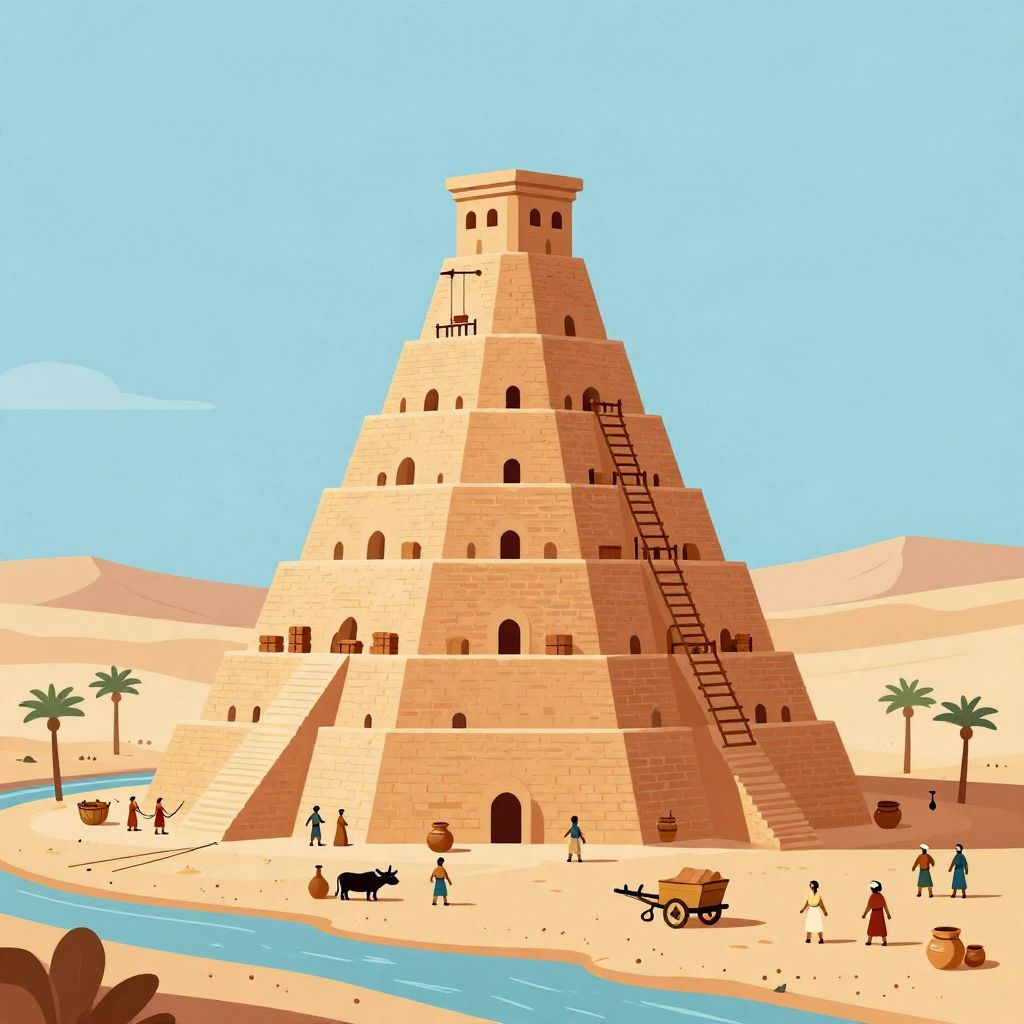
The Tower of Babel is one of the best-known stories in the Bible, and one of the most frequently asked questions about it is simple: how tall was it? The short answer is that no one knows, because the Bible does not give a number. The story is a theological narrative, not a measured architectural record, and historians have to treat it that way.
What we can do is look at the biblical text, the ancient Near Eastern world behind it, and the kinds of monumental towers that inspired the story. That gives us a much clearer picture of what the Tower of Babel may have represented, even if its exact height remains unknown.
How Tall Was the Tower of Babel?
The Tower of Babel’s height is not stated in the Bible, so there is no historical measurement to recover. In the Genesis account, the builders want a tower “with its top in the heavens,” which is symbolic language rather than a precise architectural specification. Scholars generally understand the story as a mythic explanation for human language diversity, not a report of an actual surveyed structure.
What the Bible Actually Says About the Tower
The Tower of Babel appears in Genesis 11:1–9. The people of the earth, speaking one language, decide to build a city and a tower to make a name for themselves and avoid being scattered. God responds by confusing their language and dispersing them across the earth. The city is called Babel because of this confusion.
No height is given in the text
Unlike a modern building record, the biblical narrative does not provide dimensions, floors, or materials beyond basic references to brick and bitumen. The phrase “with its top in the heavens” is best read as a literary image of ambition and overreach. It suggests a tower that is extraordinarily tall in symbolic terms, not necessarily one that can be calculated in meters or feet.
Why the wording matters
Ancient writers often used height language to express status, power, or divine challenge. A tower reaching “to heaven” could mean a structure that seemed awe-inspiring from ground level, or a project intended to rival the divine order. In other words, the story is about human pride and unity turned into fragmentation, not about engineering measurements.
What Kind of Tower Was Babel Likely Based On?
Most historians and biblical scholars connect the Tower of Babel story with the ziggurat, a stepped temple tower found in ancient Mesopotamia. Ziggurats were real, large, and highly visible monuments built in cities such as Babylon, Ur, and Uruk. They were not “towers” in the modern sense of office buildings, but religious platforms with a sacred function.
Ziggurats in ancient Mesopotamia
Ziggurats were usually built of mudbrick, sometimes with baked brick on the outside. They rose in stages and often supported a shrine at the top. Their purpose was to connect heaven and earth symbolically, making them a strong cultural fit for the Babel story. The biblical author may have been responding to the grandeur of Babylonian architecture and religion.
The most famous candidate: Etemenanki
One structure often linked to Babel is Etemenanki, a ziggurat in Babylon dedicated to the god Marduk. Ancient sources suggest it was rebuilt and enlarged over time, especially under Nebuchadnezzar II in the 6th century BCE. Estimates of its height vary, but many reconstructions place it at roughly 90 meters (about 300 feet) when complete, though the exact figure is uncertain.
That said, Etemenanki is not proven to be the historical Tower of Babel. It is better understood as a likely inspiration for the biblical image, not a confirmed match. The story may reflect the memory of Babylon’s monumental architecture rather than a single identifiable building.
Why Historians Do Not Treat Babel as a Measured Building
The Tower of Babel story belongs to the world of ancient religious literature. It is shaped by theology, symbolism, and cultural memory. Because of that, historians do not approach it like a surviving construction project with blueprints and archaeological remains that can be measured directly.
Myth, memory, and meaning
Ancient myths often preserve real places and historical experiences in symbolic form. Babel may reflect Mesopotamian city life, imperial ambition, and the impressive scale of Babylonian religious architecture. But the story’s purpose is not to preserve engineering data. It explains why people speak different languages and why human pride leads to division.
Archaeology has limits here
Archaeology can tell us about Babylonian bricks, foundations, and temple towers. It cannot confirm the exact tower described in Genesis, because no surviving inscription or structure identifies a “Tower of Babel” in the way the story is told. The original tower, if any real model existed, was likely part of a much larger cultural and literary tradition.
How Tall Could a Real Ancient Tower Get?
Even though Babel itself cannot be measured, comparing it to ancient towers helps put the story in perspective. Mesopotamian ziggurats were among the tallest buildings of their age, but they were far shorter than modern skyscrapers. Their height was impressive in an ancient cityscape of low, mudbrick buildings.
Approximate ancient examples
- Ziggurat of Ur: originally around 20 meters high in its reconstructed form, though the ancient height may have varied.
- Chogha Zanbil in present-day Iran: one of the best-preserved ziggurats, originally several tiers high and likely around 50 meters in total height before damage.
- Etemenanki in Babylon: often estimated at around 90 meters when fully rebuilt, though this remains debated.
These structures show that a “tower to the heavens” was not impossible as a literary image. Ancient builders could create monumental towers that dominated the skyline. But even the tallest known ancient ziggurats were still human constructions, not literal bridges into the sky.
Where Was the Tower of Babel Supposed to Be?
Genesis places Babel in the land of Shinar, a biblical term commonly associated with southern Mesopotamia, especially the region of Babylonia. This is the same broad area where Babylon later became a major imperial city. The setting matters because it ties the story to one of the ancient world’s great centers of power and building.
Babylon as a symbol
In the Hebrew Bible, Babylon often represents political power, exile, and human arrogance. The Tower of Babel story likely draws on that symbolism. By linking the tower to Babylon, the text turns a famous imperial city into a lesson about the limits of human self-assertion.
Not a GPS location
Because the story is theological and literary, there is no precise archaeological address for Babel. The name points to a cultural and geographic world rather than a single excavated monument. That is why claims that the exact tower has been found should be treated cautiously.
Why the Story Became So Famous
The Tower of Babel has endured because it addresses timeless questions: Why do humans speak different languages? Why do great projects fail? What happens when ambition outruns humility? The story offers a memorable answer in narrative form, and later readers have continued to interpret it in many ways.
Language and division
One of the story’s most lasting themes is the origin of linguistic diversity. The Bible presents language confusion as a divine response to human pride. Historically, of course, language diversity developed over long periods through migration, separation, and cultural change. The story is not a scientific explanation, but it captures a deep human fascination with difference and communication.
Architecture as moral symbol
Towers in ancient literature often symbolize power, heaven-reaching ambition, or political centralization. Babel uses architecture to make a moral point. The builders want permanence and fame; the result is fragmentation. That contrast is part of why the story has remained influential in religious, literary, and artistic traditions for centuries.
So, How Tall Was the Tower of Babel?
The most accurate answer is that we do not know. The Bible does not provide a height, and the Tower of Babel is best understood as a symbolic story rather than a documented building. If the narrative was inspired by Mesopotamian ziggurats, then the imagined tower may have resembled a monumental structure that could have stood tens of meters tall, perhaps even approaching the scale of Babylon’s great temple tower traditions. But that remains an informed comparison, not a confirmed measurement.
In historical terms, the real significance of Babel is not its exact height but what it represented: the power of cities, the ambition of rulers, the unity of language, and the limits placed on human pride. If you want to explore more biblical history and its settings, you may also find it useful to read about whether the Bible mentions dinosaurs and where Noah’s Ark landed.