
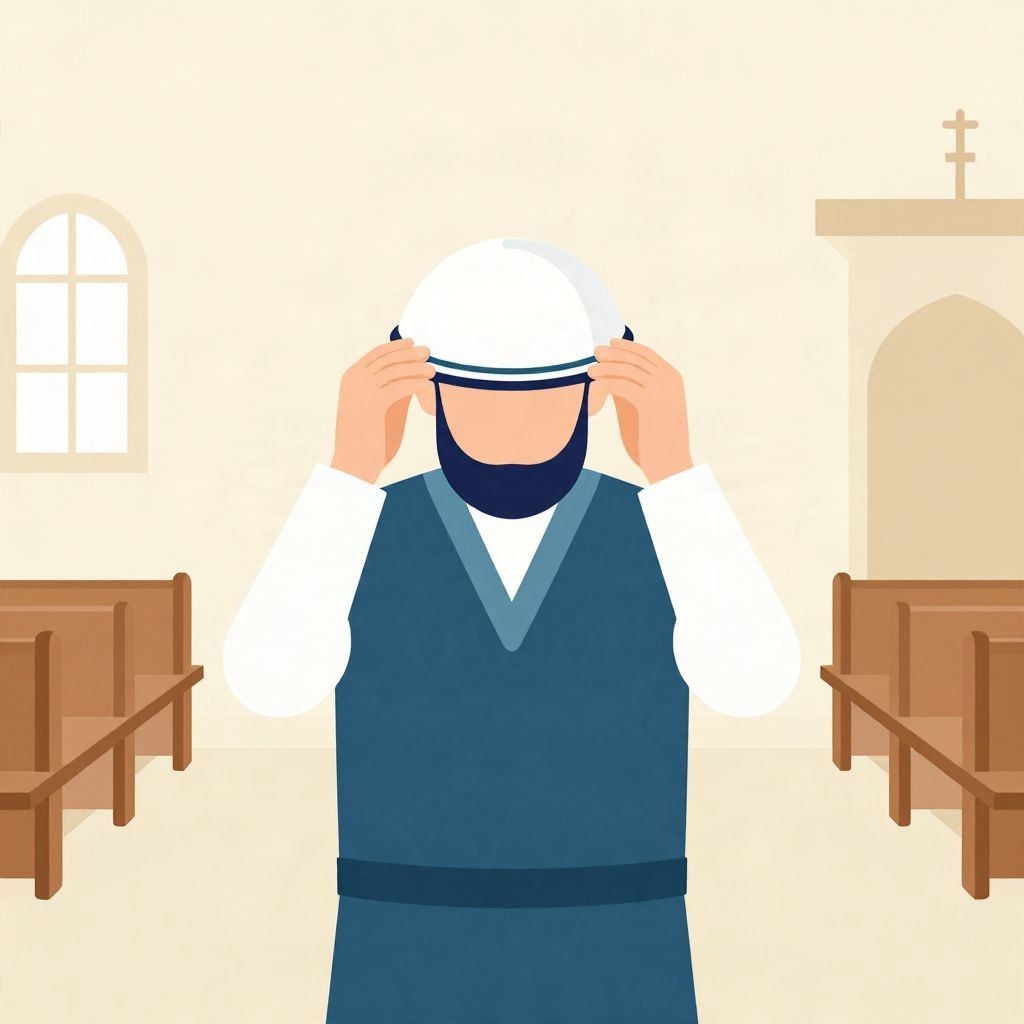
What is a yamaka? In Jewish life, a yamaka is a small head covering worn by many Jewish men and, in some communities, by women as well. It is most often called a kippah in Hebrew; “yamaka” is a common alternate spelling and pronunciation in English.
Its history is not tied to one single inventor or moment. Instead, the practice grew over centuries as a sign of reverence, identity, and communal custom, becoming one of the most recognizable symbols of Jewish observance in the modern world.
What Is a Yamaka?
A yamaka is a small cap or skullcap worn on the crown of the head. In Jewish tradition, it serves as a visible reminder of God’s presence and human humility. The term is widely used in English, but the more standard Hebrew word is kippah. Different communities use different styles, materials, and rules for when it should be worn.
Where Did the Yamaka Come From?
The yamaka did not begin as a single formal religious law. Its roots lie in long-standing Jewish customs of covering the head as a sign of respect before God. Over time, what began as a pious habit became more regularized in Jewish communities, especially in medieval and early modern times. By the modern era, the kippah had become a familiar marker of Jewish religious identity.
Early Jewish head covering customs
Jewish sources from antiquity and late antiquity suggest that some Jews covered their heads in prayer or in sacred settings, but the evidence does not point to one universal rule for all Jews at all times. The custom appears to have developed gradually, shaped by local culture, rabbinic teaching, and changing ideas about modesty and reverence.
From custom to common practice
By the medieval period, many Jewish communities treated head covering as an expected sign of piety, especially during prayer, study, and blessing. In some places, it became a near-constant practice for religious men. In others, it remained more limited to worship or formal religious moments. This variation is important: the yamaka’s history reflects diversity within Jewish life rather than a single uniform rule.
Why Do Jews Wear a Yamaka?
The main meaning of the yamaka is reverence. Wearing it expresses awareness that a person stands before God at all times. It can also signal belonging to the Jewish people and, in some settings, a commitment to religious observance. For many wearers, it is both a spiritual reminder and a cultural identifier.
Religious meaning
In Jewish thought, covering the head can express humility and restraint. The body is not treated casually in sacred space, and the head covering becomes a small but constant sign of respect. Although different communities explain the practice in different ways, the underlying idea is often the same: a person should remember that divine authority is above human authority.
Identity and visibility
In modern history, the yamaka also became a public marker of Jewish identity. In societies where Jews were sometimes pressured to hide their difference, wearing a kippah could be an act of openness or defiance. In other settings, it simply marked membership in a community. Its meaning therefore changed with historical context.
Is “Yamaka” the Same as “Kippah”?
Yes. In everyday English, “yamaka” usually refers to the same head covering that Jews call a kippah in Hebrew. The word “yarmulke,” another common English form, is also widely used. These terms overlap in meaning, though “kippah” is the most standard term in Hebrew and in many formal Jewish contexts.
Why are there different words?
The variety of names reflects the movement of Jewish communities across languages and regions. As Jews lived in Hebrew-, Aramaic-, Yiddish-, and other language-speaking environments, local speech produced different terms. English borrowed and adapted several of them, which is why more than one word is common today.
How Did the Yamaka Become a Recognizable Jewish Symbol?
The yamaka became especially visible in the modern period, when Jews increasingly lived in public, urban, and often non-Jewish societies. As Jewish communities interacted more with broader cultures, the small head covering stood out as a clear sign of religious difference. What had once been mainly a devotional practice became, in many places, a public symbol of Jewish life.
Modernity and changing Jewish life
In the 18th, 19th, and 20th centuries, Jewish life changed dramatically through emancipation, migration, secularization, and new forms of religious reform and revival. Some Jews continued to wear a kippah constantly, while others reserved it for synagogue or religious occasions. The result was not uniformity but a wider range of practice than in earlier periods.
Different communities, different customs
Today, observance varies among Orthodox, Conservative, Reform, and secular Jews, as well as among communities in Israel, Europe, the Americas, and elsewhere. Some men wear a yamaka all day; others only for prayer, blessings, or meals; some women wear one in certain communities. The practice depends heavily on tradition, family custom, and religious interpretation.
What Does the Yamaka Look Like?
There is no single standard design. A yamaka may be knitted, crocheted, velvet, leather, satin, or made from other materials. It may be plain, embroidered, colorful, or decorated with symbols. Size also varies, from small caps that sit lightly on the crown to larger coverings that fit more securely.
Styles and community preferences
- Knitted kippot are common in some modern Orthodox and national-religious communities.
- Black velvet kippot are often associated with more traditional or Haredi settings, though styles vary widely.
- Decorative kippot are often worn at weddings, bar and bat mitzvahs, and other celebrations.
These styles are not merely fashion choices. They can express communal affiliation, level of observance, or the occasion itself.
When Is a Yamaka Worn?
Practice differs, but common times include prayer, Torah study, blessings, synagogue attendance, and religious meals. Some Jews wear a kippah at all times as a constant reminder of God. Others wear it only in sacred or communal settings. In some families, boys begin wearing one at a young age, while in others the custom develops later.
Not a universal legal requirement in the same way everywhere
It is important to distinguish custom from law. In many Jewish communities, wearing a head covering is strongly expected, but the exact obligation is interpreted differently across traditions and authorities. Historical practice shows a broad and enduring custom, not a single unchanged rule applied identically everywhere.
The Yamaka in Jewish History and Public Life
The yamaka has mattered not only as a religious object but also as a historical symbol. In times of persecution, visible Jewish markers could make people vulnerable. In times of greater freedom, the same marker could become a proud statement of continuity. Its meaning has therefore shifted with the political and social conditions of each era.
Persecution, assimilation, and resilience
Under regimes hostile to Jewish identity, some Jews hid or removed visible signs of religion to reduce danger. In more open societies, others emphasized such signs as a way to preserve heritage. The yamaka thus sits at the intersection of devotion, survival, and identity.
In Israel and the diaspora
In Israel, the kippah is common in many religious and traditional settings, but not universal. In the diaspora, its visibility can be even more pronounced because it marks Jewish identity in a minority context. In both settings, the head covering can communicate faith, community, or personal conviction.
Common Misunderstandings About the Yamaka
Because the yamaka is so familiar, it is easy to make assumptions about it that are not historically accurate. One common misunderstanding is that all Jews have always worn it in exactly the same way. In reality, usage has varied by time, place, and community. Another is that it is only a “religious hat,” when it can also function as a symbol of belonging and memory.
What it is not
- It is not a uniquely ancient object unchanged since biblical times.
- It is not worn in exactly the same manner by every Jewish community.
- It is not only about outward display; for many wearers, it carries deep inward meaning.
Why the Yamaka Still Matters
The yamaka remains important because it connects everyday action with historical continuity. A small cap worn on the head can carry centuries of religious practice, communal identity, and cultural memory. Its endurance shows how a modest object can become one of the most recognizable signs of a living tradition.
In short, a yamaka is a Jewish head covering, more commonly called a kippah, whose history grew from custom into a lasting symbol of reverence and identity. If you want to explore the term further, see our related guides on what a kippah is and what a yamaka is.