
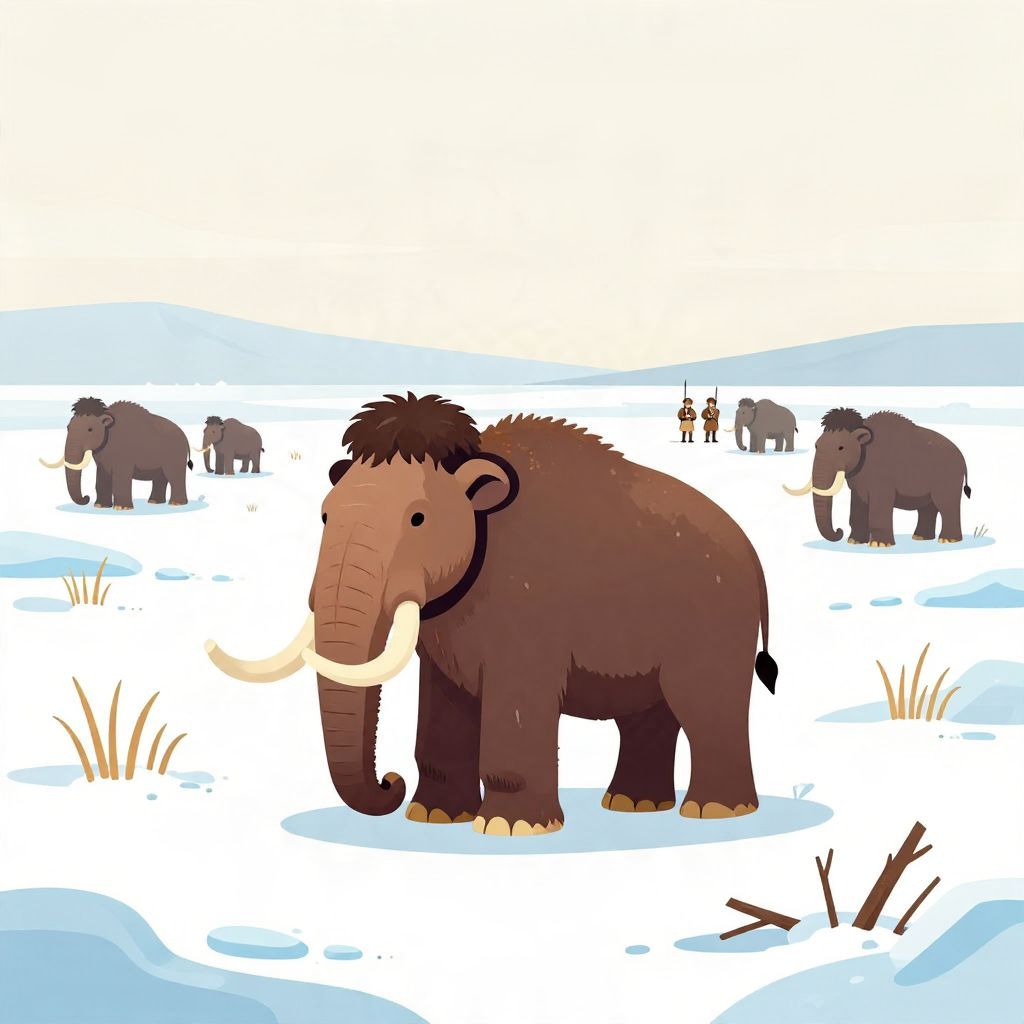
Why did woolly mammoths go extinct? The short answer is that they disappeared because several pressures came together at once: a warming climate changed the cold grassland habitat they depended on, and human hunters likely added extra stress. For many mammoth populations, the combination was enough to push already vulnerable herds past recovery.
Their extinction was not a single event but a long decline that unfolded unevenly across Eurasia and North America after the last Ice Age.
Why Did Woolly Mammoths Go Extinct?
Woolly mammoths went extinct mainly because the end of the Ice Age transformed their environment, shrinking the cold, dry “mammoth steppe” they needed for food and survival. Human hunting probably contributed in some regions, especially where mammoth populations were already small and isolated. In most scholarly explanations, extinction resulted from climate change, habitat loss, and human pressure acting together.
The Mammoth World Before Extinction
Woolly mammoths (Mammuthus primigenius) were adapted to the cold, open landscapes of the late Pleistocene, especially the vast grasslands of northern Eurasia and North America. They had thick fur, layers of fat, and curved tusks suited to life in freezing conditions. Their diet depended on grasses, sedges, and other low-growing plants.
For tens of thousands of years, mammoths thrived in a broad ecosystem often called the mammoth steppe. This was not a frozen wasteland but a productive, cold, dry environment with enough vegetation to support large herbivores. Mammoths shared it with other Ice Age animals such as woolly rhinoceroses, giant deer, horses, and steppe bison.
A changing climate after the Ice Age
As the last glacial period ended, roughly between 19,000 and 11,700 years ago, temperatures rose and glaciers retreated. Forests and wetter landscapes expanded into areas that had once been open steppe. That shift mattered enormously. Mammoths were built for grazing in cold, dry grasslands, not for moving through dense woodland or surviving on changing plant communities.
This environmental change did not kill mammoths overnight. Instead, it gradually reduced the size and quality of their habitat. Populations became more fragmented, and smaller herds were less resilient to disease, harsh winters, and breeding problems. In historical terms, extinction often happens this way: not through one dramatic catastrophe, but through long-term ecological pressure.
How Climate Change Hurt Woolly Mammoths
The warming climate affected mammoths in several connected ways. First, it reduced the amount of suitable grazing land. Second, it altered seasonal patterns of snow, rain, and vegetation. Third, it likely changed the broader food web on which mammoths depended. Even if mammoths could survive in cold conditions, they were not equally adaptable to a rapidly changing environment.
Habitat loss and food shortage
One of the strongest explanations for mammoth extinction is habitat loss. As shrubs, trees, and wetter tundra spread, the open steppe shrank. Mammoths needed large areas of forage to sustain their size. When that forage became patchier, herds may have had to travel farther, compete more intensely, and reproduce less successfully.
Large animals are especially vulnerable when their habitat becomes fragmented. A few poor seasons can be survived by a large, connected population, but isolated groups have less room for error. That is one reason many mammoth populations disappeared earlier than others.
Population decline before extinction
Evidence suggests that mammoths were already in decline in many places before they vanished completely. Some populations persisted in refuges long after the main continental herds were gone. This pattern supports the idea that extinction was not caused by one sudden event but by a slow weakening of the species across different regions.
Did Humans Cause Woolly Mammoths to Go Extinct?
Humans probably played a role, but the scale of that role is still debated. Archaeological evidence shows that Ice Age humans hunted mammoths and used their bones, tusks, and hides. In some regions, especially where mammoth numbers were already low, hunting may have been enough to hasten local extinction. Most historians and archaeologists, however, do not treat humans as the only cause.
Hunting pressure and human expansion
Modern humans spread into mammoth habitats late in the Ice Age. In North America, this occurred around the same broad period as major environmental change. Human groups were mobile hunters, and mammoths were valuable prey. A single mammoth provided a great deal of meat, fat, bone, and ivory, making it an attractive target.
That said, the question is not simply whether humans hunted mammoths, but whether they hunted them fast enough to drive a healthy species extinct on their own. The evidence does not support a simple one-cause answer everywhere. In some places, human hunting likely mattered more; in others, climate change appears to have been the dominant force.
The “overkill” debate
Some scholars have argued for a “blitzkrieg” or overkill model, in which newly arrived humans rapidly hunted large Ice Age animals to extinction. Others argue that climate change was primary and that human hunting was secondary. Today, many researchers favor a combined explanation: mammoths were weakened by environmental change, and human hunting increased the pressure on shrinking populations.
This balanced view fits the evidence better than either extreme. Mammoths did not vanish simply because humans appeared, and they did not vanish because of climate alone. Their extinction was likely the result of interacting causes.
Why Some Mammoths Survived Longer Than Others
Not all woolly mammoths disappeared at the same time. Some mainland populations survived longer than others, and a few isolated groups lasted thousands of years after most mammoths were gone. This uneven timeline is important because it shows how local conditions shaped extinction.
Island refuges and delayed extinction
One of the best-known examples is Wrangel Island in the Arctic Ocean, where a small mammoth population survived until roughly 4,000 years ago. Another island population survived on St. Paul Island in the Bering Sea until around 5,600 years ago. These late survivors lived in isolated environments far from the main continental range.
Their survival also reveals the downside of isolation. Small populations can persist for a time, but they are vulnerable to inbreeding, limited food, and random disasters. On islands, even a stable climate does not guarantee long-term survival if the population is too small.
Genetic weakness and small populations
Researchers have suggested that some late mammoth groups may have suffered from low genetic diversity. In small populations, harmful mutations can accumulate, and reproductive success can decline. This does not mean genetics alone caused extinction, but it may have made the last mammoths less able to cope with stress.
What the Fossil Record Tells Us
The fossil and archaeological record supports a gradual decline rather than a single extinction moment. Mammoth remains become rarer in some regions as the climate warms. At the same time, human sites sometimes show mammoth bones and tools associated with butchery, indicating direct interaction. The record is incomplete, but it points to a complex process rather than one simple trigger.
Evidence and uncertainty
Because mammoth remains are scattered across huge regions and thousands of years, exact cause-and-effect is hard to prove in every location. Dating can be difficult, and local conditions varied widely. That is why historians and scientists often speak in terms of probabilities rather than certainty.
What is well supported is this: mammoths were already under environmental stress when humans expanded into many of their habitats. In some places, the two pressures likely reinforced each other.
The Broader Historical Context of the Ice Age Extinctions
Woolly mammoths were not alone. Many large Ice Age mammals disappeared around the end of the Pleistocene, including giant ground sloths in the Americas, saber-toothed cats, and woolly rhinoceroses in Eurasia. The timing suggests a broader ecological transformation, not a mammoth-specific disaster.
This matters because mammoth extinction was part of a larger pattern in which climate shifts and human expansion reshaped ecosystems across the world. The end of the Ice Age was one of the most significant environmental transitions in human history. It changed where people could live, what animals they could hunt, and how landscapes evolved.
So, Why Did Woolly Mammoths Go Extinct?
Woolly mammoths went extinct because they were caught between a warming world and growing human pressure. Climate change reduced the cold grasslands they depended on, breaking up their habitat and limiting food. Human hunting likely accelerated the decline in some places, especially among small, isolated herds. Their extinction was therefore a combined ecological and historical process, not a single sudden event.
In the end, woolly mammoths remind us that even highly successful species can disappear when their environment changes faster than they can adapt. If you want to explore the Ice Age further, you may also be interested in how woolly mammoths went extinct and what woolly mammoths ate.