
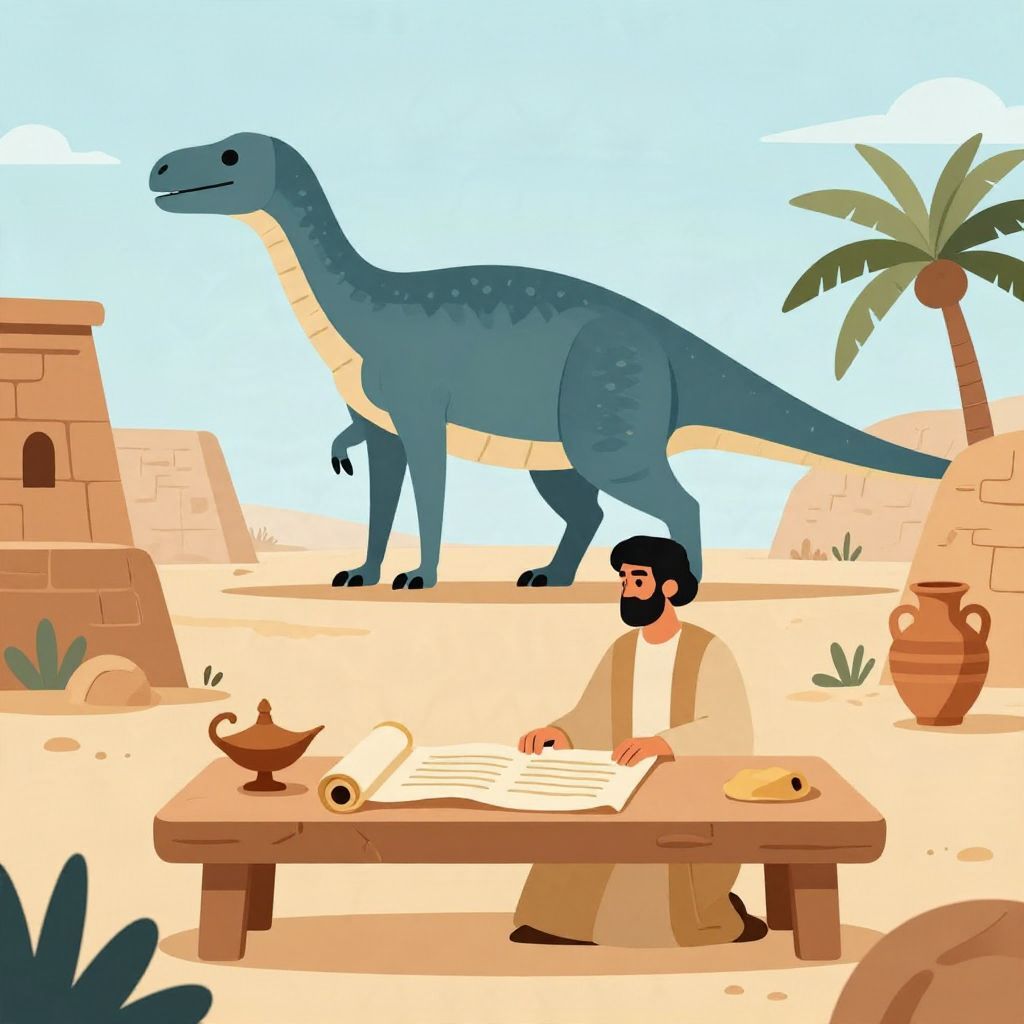
Does the Bible mention dinosaurs? The short answer is no, not by the modern scientific term “dinosaur.” The Bible was written long before the word existed, and its authors described the natural world in the language and ideas of the ancient Near East.
That does not mean the Bible is silent about large or mysterious creatures. It does contain references to powerful animals and symbolic beasts, which later readers have sometimes connected to dinosaurs. The historical question is therefore not whether the Bible names dinosaurs, but how ancient texts, ancient animals, and modern interpretation fit together.
Does the Bible Mention Dinosaurs?
No biblical book explicitly mentions dinosaurs as a scientific category. The term dinosaur was coined in 1842 by the British anatomist Richard Owen, centuries after the Bible took shape. Biblical writers instead used the vocabulary available to them for real animals, mythic imagery, and poetic symbols.
Because of that, claims that the Bible “mentions dinosaurs” depend on interpretation. Some readers argue that certain passages describe dinosaur-like creatures; others say those texts refer to known animals such as cattle, crocodiles, lions, or mythic beings used for literary effect. Historically, the safest answer is that the Bible does not directly identify dinosaurs.
Why the Bible Does Not Use the Word “Dinosaur”
The Bible was composed over many centuries, roughly from the first millennium BCE into the first century CE, in Hebrew, Aramaic, and Greek. Its authors lived in a world that knew elephants, camels, lions, crocodiles, and other large animals, but not in a world that classified fossils as evidence of extinct prehistoric reptiles. The concept of dinosaurs belongs to modern geology and paleontology.
The modern term came much later
The word “dinosaur” means “terrible lizard,” but it is a nineteenth-century scientific label, not an ancient one. Before paleontology became a formal science, people interpreted large bones in many different ways: as remains of giants, dragons, or unusual animals. Only in the modern era did scholars begin to understand dinosaurs as a distinct group of extinct reptiles that lived millions of years ago.
Ancient authors wrote in their own cultural framework
Biblical writers were not trying to produce a zoological catalogue. Their texts are theological, historical, legal, poetic, and prophetic. When they mention creatures, they usually do so to make a moral, symbolic, or narrative point. That is why the Bible can describe a “beast” in vivid language without intending a modern scientific identification.
Passages People Often Connect to Dinosaurs
Several biblical passages are frequently cited in discussions about dinosaurs. These texts are important, but none of them clearly proves that the Bible is describing dinosaurs in the modern sense. Instead, they show how ancient language can be read in different ways.
Behemoth in the Book of Job
Job 40 describes Behemoth as a massive creature with great strength, a tail likened to a cedar, and bones like bronze. Some readers see this as a dinosaur, especially because of the large tail imagery. Others argue it is a stylized description of a hippopotamus, an elephant, or a mythical land beast used to emphasize God’s power over creation.
Historically, the strongest point is that Job is poetic literature. Poetic description often uses exaggeration, metaphor, and vivid comparison. A “tail like a cedar” may be a literary image rather than a literal anatomical claim. For that reason, Behemoth cannot be identified with confidence as a dinosaur.
Leviathan in the Book of Job and the Psalms
Leviathan appears in Job 41, Psalm 74, and Isaiah 27. It is portrayed as a powerful sea creature, sometimes associated with chaos and divine victory. Some modern interpreters compare Leviathan to a dinosaur or dragon-like reptile. Scholars of ancient literature usually see it as part of a wider Near Eastern tradition of sea-monster imagery.
In the ancient world, sea monsters symbolized danger, disorder, and the untamed forces of nature. Leviathan is therefore best understood as a theological and poetic figure, not as a straightforward zoological reference. It may draw on real creatures such as crocodiles or on mythic imagery familiar to ancient audiences.
“Great sea creatures” in Genesis
Genesis 1:21 says God created the “great sea creatures.” Some readers have taken this as a possible reference to dinosaurs or prehistoric marine reptiles. Historically, however, the phrase is broad and general. It likely refers to large sea animals and also signals that even the most awe-inspiring creatures are part of creation under God’s authority.
This is an important example of how modern readers can read later scientific categories back into ancient texts. Genesis is not offering a fossil record. It is presenting a theological account of order, creation, and divine sovereignty.
How Ancient People Understood Large Creatures
To understand why the Bible does not mention dinosaurs directly, it helps to look at how ancient societies interpreted unusual animals and bones. In the ancient Near East, people encountered elephants, crocodiles, large serpents, and unfamiliar sea life. They also found large fossils in some regions, though they did not explain them using modern geology.
Myth, symbol, and observation mixed together
Ancient texts often blend observation with symbolism. A writer might describe a real crocodile in exaggerated terms, or use a monster image to represent chaos. This does not make the text false in its own literary context; it means the text was not written to answer modern scientific questions.
That distinction matters. If a passage uses animal imagery, historians ask what the original audience would have understood, not what a twenty-first-century reader might wish it had meant. In most cases, the original audience would have heard a familiar creature or symbolic monster, not a dinosaur.
What About Creation Narratives and Young-Earth Claims?
Some religious traditions, especially within young-earth creationism, argue that humans and dinosaurs lived at the same time and that the Bible implies this. They often point to Genesis, Job, or flood narratives as evidence. This interpretation is part of modern religious debate, not a consensus of biblical scholarship or paleontology.
Different ways of reading Genesis
There are several major approaches to Genesis among believers and scholars:
- Literal six-day creation, which reads the creation days as ordinary 24-hour periods.
- Day-age or framework views, which treat the creation account as theological structure rather than a strict timeline.
- Literary and symbolic readings, which emphasize the text’s ancient style and purpose.
These interpretations lead to different conclusions about the age of the earth and the place of prehistoric life. However, the historical fact remains that the biblical text itself does not use dinosaur terminology and was not written in the language of modern science.
Fossils and the modern debate
Dinosaurs are known through fossils, which are studied using geology, radiometric dating, comparative anatomy, and other scientific methods. Those methods place dinosaurs in deep prehistory, long before humans. The Bible, by contrast, is a collection of ancient writings concerned with covenant, worship, law, kingship, exile, wisdom, and faith. The two bodies of evidence belong to different kinds of inquiry.
Historical Context: When the Bible Was Written
The Bible did not emerge all at once. Its books were written across many centuries in different historical settings. The Hebrew Bible developed in ancient Israel and Judah, especially during the monarchic, exilic, and post-exilic periods. The New Testament was written in the first century CE within the Roman world.
Because of this long composition history, biblical language reflects ancient agricultural, pastoral, royal, and imperial societies. It does not reflect nineteenth-century science. That is why the text speaks of sheep, oxen, locusts, lions, and sea monsters, but not of dinosaurs as a recognized category.
Chronology at a glance
- Ancient Near Eastern period: biblical traditions develop in cultures that used symbolic animal imagery.
- First millennium BCE: major Hebrew biblical texts are composed and edited.
- First century CE: New Testament writings are produced in the Roman imperial world.
- 1842: the term dinosaur is coined in modern science.
So What Should Readers Conclude?
The most careful historical answer is that the Bible does not explicitly mention dinosaurs, because dinosaurs were not a known scientific category when the biblical books were written. Passages such as Behemoth, Leviathan, and the “great sea creatures” can inspire dinosaur interpretations, but those readings are debated and usually rest on modern assumptions rather than direct textual evidence.
In historical terms, the Bible is best read as an ancient collection of religious texts shaped by the language, worldview, and literary habits of the ancient Near East. Its value lies in what it was written to communicate, not in whether it anticipated modern paleontology. If you are interested in the Bible’s historical background, you may also want to explore the original language of the Bible and when the Bible was written.