
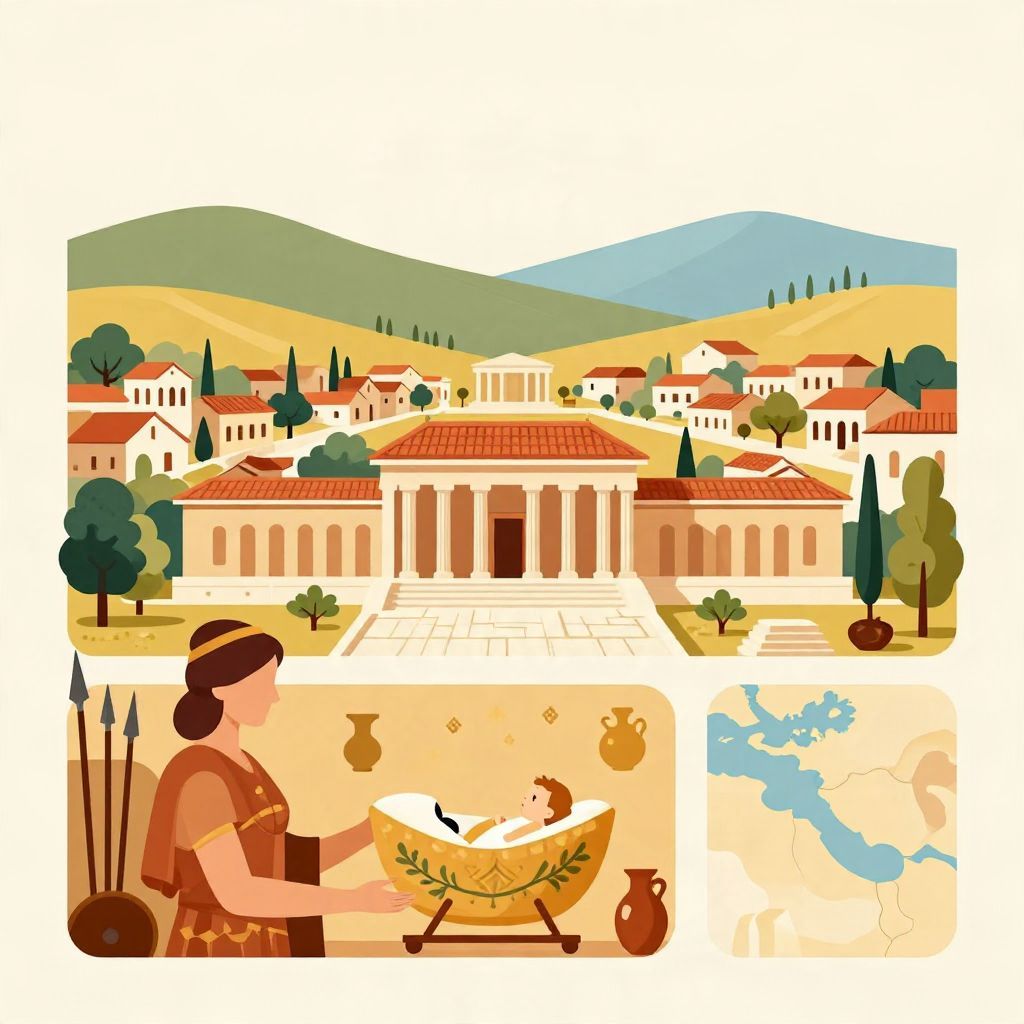
Alexander the Great was born in Pella, the royal capital of ancient Macedon, in northern Greece. Most historians place his birth in 356 BCE, during the reign of his father, King Philip II. While the exact day is uncertain, the birthplace itself is well established in the historical tradition and fits what is known about the Macedonian court.
His birth at Pella mattered because it placed him at the center of a kingdom that was rapidly becoming a major power. From that court, Alexander inherited the resources, education, and political ambitions that later shaped his conquest of the Persian Empire.
Where Was Alexander the Great Born?
Alexander the Great was born in Pella, the capital of the ancient kingdom of Macedon, in 356 BCE. Pella was the seat of the Macedonian royal family and the place where Philip II’s court was based. Although ancient writers preserve several stories around Alexander’s birth, the most reliable historical conclusion is that his birthplace was Pella, in the region of Macedonia in the north of the Greek world.
Why historians identify Pella
The strongest evidence comes from the consistent ancient tradition linking Alexander’s early life to the Macedonian court at Pella. As the royal capital, it was the natural place for the king’s family to live, govern, and raise heirs. No credible ancient source places his birth elsewhere. Some later legends tried to add drama to his origin, but they do not overturn the basic historical consensus.
Pella in the fourth century BCE
Pella was not a small village but a politically important city with palaces, administrative buildings, and connections to the wider Mediterranean world. Under Philip II, it became the center of a kingdom that was transforming from a regional power into a dominant force in Greece. Alexander’s birth there placed him inside a court culture shaped by warfare, diplomacy, and elite education.
What Was Macedon Like at the Time of His Birth?
Alexander was born into a kingdom that was still viewed by many southern Greeks as somewhat marginal, yet Macedon was becoming stronger under Philip II. The kingdom controlled strategic territory, cavalry resources, and access to northern trade routes. By the time Alexander was a child, Macedon was no longer isolated; it was increasingly central to Greek politics.
Philip II’s rise
Philip II had reformed the Macedonian army, strengthened royal authority, and expanded Macedonian influence. His success created the conditions that made Alexander’s later campaigns possible. Being born in Pella meant Alexander grew up in a court where military organization and statecraft were everyday realities rather than abstract ideas.
Macedonia and the Greek world
Whether Macedon was fully “Greek” was debated in antiquity, and modern historians still discuss how ancient Macedonians identified themselves. What is clear is that Macedon was deeply connected to Greek language, religion, and culture, while also maintaining its own royal traditions. Alexander’s upbringing reflected this mixed environment.
When Was Alexander the Great Born?
Alexander was born in 356 BCE. The exact date is traditionally given as late July, often associated with the sixth or seventh day of the Macedonian month Hekatombaion, but ancient chronology is not perfectly secure. Historians are confident about the year; the precise day is less certain because ancient calendars did not align neatly with modern ones.
Why the exact date is uncertain
Ancient historians did not use a single universal calendar. Macedonian, Greek, and later Roman systems could differ, and surviving accounts were written down after the events. As a result, the year 356 BCE is accepted, but the exact day remains approximate rather than absolute.
What Do Ancient Sources Say About His Birth?
Ancient writers preserve several traditions about Alexander’s birth, but they vary in detail and purpose. Some stories are historical, while others are symbolic or legendary. The safest reading is to separate the basic fact of his birth at Pella from the more dramatic tales that later surrounded him.
Historical tradition versus legend
- Historical core: Alexander was born to Philip II and Olympias at Pella.
- Likely date: 356 BCE.
- Legendary additions: omens, prophetic dreams, and miraculous signs attached to his birth in later storytelling.
These legends were common in ancient biography. Rulers and conquerors were often given extraordinary birth stories to suggest that their greatness had been foretold. In Alexander’s case, such stories helped explain how a Macedonian prince became one of the most famous conquerors in history.
The role of Olympias
Alexander’s mother, Olympias, was a powerful figure from Epirus. Ancient sources often emphasize her influence and the intense atmosphere of the royal household. Her background added another layer to Alexander’s identity, linking him to both Macedonian kingship and broader Greek heroic traditions.
Why Pella Was Important to Alexander’s Early Life
Pella was more than Alexander’s birthplace; it was the environment that shaped his early development. As the royal capital, it exposed him to politics, military planning, diplomacy, and elite culture from childhood. The city was the starting point of the life that would later take him across Asia.
Education and court culture
Growing up at Pella meant Alexander was surrounded by aristocratic expectations. He was trained to rule, command, and speak in public. Later tradition says Aristotle tutored him, though the details of that education are debated. Even so, it is clear that his upbringing was unusually ambitious and carefully prepared for kingship.
Royal succession
Alexander’s birth in the royal capital also mattered politically. He was born into a succession environment where legitimacy, family alliances, and military support all counted. Being the son of Philip II and Olympias gave him a strong claim to the throne, though that claim would still need to be secured after Philip’s death.
Did Alexander Stay in Pella?
Alexander spent his early years in and around the Macedonian court, but he did not remain there permanently. As he grew older, he was drawn into military and political life. Pella remained important as the symbolic center of his kingdom, even after he began campaigning far from Macedonia.
From birthplace to empire
The contrast between Pella and Alexander’s later career is striking. He began life in a northern royal capital and ended it ruling an empire that stretched from Greece to Egypt and deep into Asia. His birthplace marks the starting point of a journey that reshaped the ancient world.
Common Misunderstandings About His Birthplace
Because Alexander became a global historical figure, people sometimes associate him with many places: Greece, Macedonia, Egypt, Persia, or even mythic locations. But birthplace and later conquests are not the same thing. He was born in Pella, and his later travels do not change that basic fact.
Not born in Alexandria or elsewhere
It is worth noting that Alexander was not born in any of the cities named after him, including Alexandria in Egypt. Those cities were founded later during or after his campaigns. His birthplace was the Macedonian capital long before his empire existed.
Macedonia and modern geography
Today, Pella lies in modern Greece, in the region historically associated with ancient Macedon. Because the ancient world does not map perfectly onto modern national borders, people sometimes describe Alexander differently depending on modern political context. Historically, however, the answer remains the same: he was born in Pella, Macedon.
Why His Birthplace Still Matters
Knowing where Alexander the Great was born helps explain how he became who he was. Pella was the political heart of a rising kingdom, and Alexander’s birth there placed him at the center of power from the beginning. His story is not just about conquest; it is also about the making of a ruler in a highly competitive royal environment.
Historical significance of the location
Pella connects Alexander to the broader transformation of Macedon in the fourth century BCE. Without Philip II’s court, the military reforms, and the political culture of the capital, Alexander’s later achievements would have looked very different. The birthplace is therefore not a trivial detail but a clue to the world that formed him.
In short, Alexander the Great was born in Pella, the royal capital of Macedon, in 356 BCE. That setting placed him at the center of a rising kingdom and helps explain the political and military world that shaped his future. For related reading, see where Alexander the Great was from and where Alexander the Great was buried.