
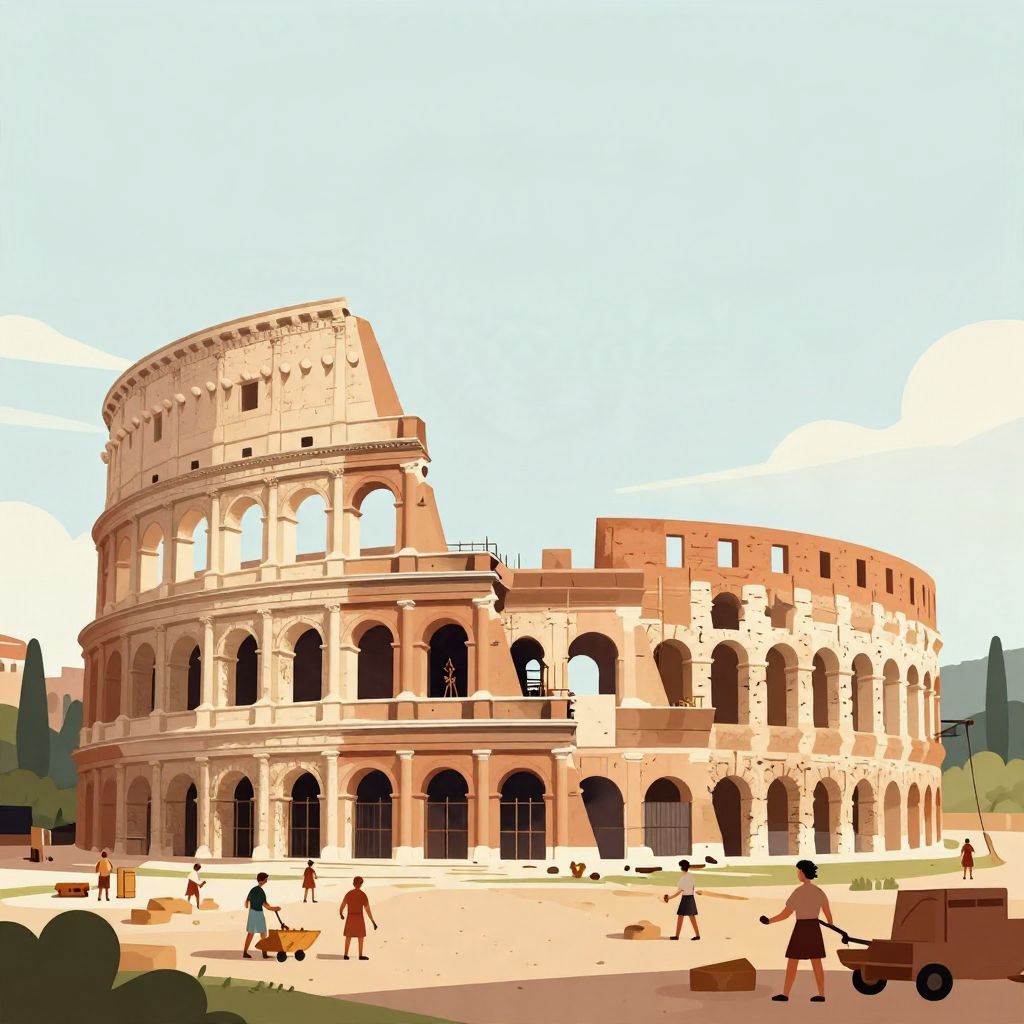
How long did it take to build the Colosseum? The short answer is that construction began around AD 72 under Emperor Vespasian and was largely completed by AD 80 under his son Titus, so the main structure took about eight years to build. Some finishing work and later modifications continued after that, but the famous amphitheater was usable within that relatively short span.
The Colosseum’s speed of construction was impressive for any era, especially for a monument of its size and complexity. Its rapid completion reflected Roman engineering skill, imperial resources, and the political need to create a grand public building that would symbolize the new Flavian dynasty.
How long did it take to build the Colosseum?
The Colosseum took about eight years to build, from roughly AD 72 to AD 80. That timeline refers to the main construction of the amphitheater itself. Ancient sources and archaeological evidence suggest that the building was sufficiently complete for public use by the time Titus dedicated it, even though some decorative and structural work may have continued afterward.
The timeline of construction
The Colosseum was built in stages, not all at once. Roman builders first prepared the site, then raised the massive outer shell, internal vaults, seating tiers, and circulation passages. Because the project was enormous, the work required a large labor force and careful coordination of materials, transport, and design.
Key phases
- AD 70–72: Site preparation and planning began after the destruction of Nero’s artificial lake in central Rome.
- AD 72–79: The main structure rose, including the exterior walls, seating, corridors, and arena floor system.
- AD 80: Titus dedicated the amphitheater with games and public celebrations.
- After AD 80: Later emperors, especially Domitian, made additions and improvements.
Why was the Colosseum built so quickly?
The Colosseum was completed relatively quickly because the Roman state could mobilize enormous resources. The empire controlled stone quarries, skilled architects, engineers, craftsmen, and a large workforce. The project also benefited from Roman experience with arches, concrete, vaulting, and standardized building methods that made large-scale construction more efficient.
Roman engineering made speed possible
Roman builders were not inventing amphitheaters from scratch. They were refining well-established techniques. The Colosseum used opus caementicium (Roman concrete), travertine stone, brick, tufa, and metal clamps. Its repeated structural elements—arches, corridors, and vaults—allowed teams to work on different sections at the same time.
Imperial power accelerated the project
Vespasian had strong political reasons to finish the building quickly. The Colosseum stood on land once occupied by Nero’s lavish private palace complex, including an artificial lake. By replacing that space with a public amphitheater, the emperor presented himself as a ruler restoring the city to the people. The project was therefore both practical and symbolic.
Who built the Colosseum?
The Colosseum was commissioned by Emperor Vespasian and completed under Emperor Titus, with later work under Domitian. The exact identities of the architects are not firmly known, and ancient evidence does not preserve a single universally accepted name. What is clear is that the project was an imperial undertaking supported by Rome’s administrative and military systems.
The Flavian dynasty and public image
The amphitheater is often called the Flavian Amphitheater because it was built by the Flavian emperors. For the dynasty, the building served as propaganda in stone. It advertised stability after a period of civil war and projected generosity through free public entertainment. In this sense, the speed of construction mattered politically as much as architecturally.
What was the Colosseum built for?
The Colosseum was built for public spectacles, especially gladiatorial contests, animal hunts, and other large entertainments. It was designed to hold tens of thousands of spectators and to manage crowds efficiently. The building’s layout shows that Roman planners wanted not only grandeur but also order, visibility, and fast movement of people in and out of the arena.
A building for mass entertainment
Unlike a temple or palace, the Colosseum was meant to be used by the public on a regular basis. Its seating arrangement reflected Roman social hierarchy, with different classes assigned different sections. The structure also included complex underground spaces for animals, scenery, and stage machinery, which made the spectacles more dramatic.
How big was the Colosseum project?
The Colosseum was one of the largest and most ambitious building projects in the ancient world. Its scale helps explain why an eight-year timeline was so remarkable. The amphitheater was a huge oval structure with multiple levels, a sophisticated seating system, and a dense network of passages beneath and around the arena.
Notable facts about the structure
- It could hold a very large audience, often estimated at around 50,000 to 80,000 people.
- Its exterior featured stacked arches and columns in different classical orders.
- Its interior relied on vaults and corridors that made crowd movement faster and safer.
- The arena could be adapted for different kinds of spectacles.
Because the building was so large, “completion” is a flexible term. The basic amphitheater was ready by Titus’s dedication, but later changes meant the Colosseum remained a living monument rather than a finished object frozen in time.
Did the Colosseum really take only eight years?
Yes, for the main structure, eight years is the standard historical answer. That said, ancient buildings often had long afterlives of alteration and repair. The Colosseum was damaged by fires, earthquakes, and neglect over the centuries, and emperors repeatedly restored or modified it. So while the initial build was fast, its history as a monument continued for many centuries.
Why historians are careful with exact dates
Ancient chronology is sometimes less precise than modern records. The dates AD 72 and AD 80 are well supported in broad terms, but details such as the exact start day, the pace of every building phase, or the completion of decorative elements are not always known. Historians therefore speak in approximate terms when discussing the construction timeline.
What happened after the Colosseum was built?
After its dedication, the Colosseum became one of the most important public venues in Rome. It hosted games for centuries, although its use changed over time as the Western Roman Empire weakened. Earthquakes, fires, and stone robbing damaged it, and parts of the structure were repurposed in later medieval and early modern periods.
Lasting significance
The Colosseum survived not because it remained untouched, but because it remained useful in different ways across history. Even in ruin, it continued to symbolize Roman power, urban life, and the engineering achievements of antiquity. Today it is one of the clearest surviving examples of how Roman architecture combined spectacle, politics, and practical design.
The historical answer in one sentence
The Colosseum took about eight years to build, from around AD 72 to AD 80, with later finishing work and modifications continuing afterward under the Flavian emperors.
If you want to place that timeline in a broader Roman context, it also helps to compare the monument’s age with how old the Colosseum is and with other major state projects that were completed over long periods, such as those discussed in this overview of the Qin dynasty’s duration. The Colosseum’s story shows that even in the ancient world, monumental architecture could be built with remarkable speed when empire, engineering, and politics aligned.