
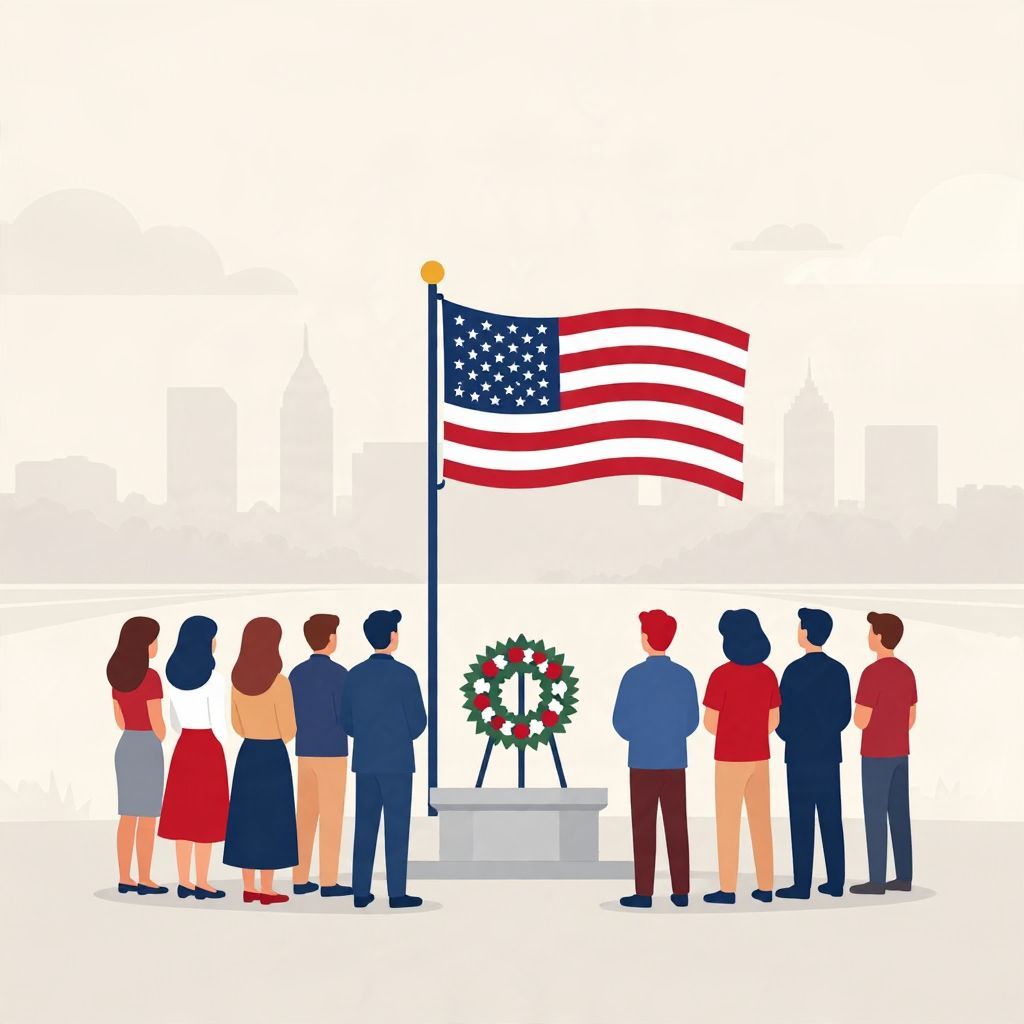
Patriot Day is a United States observance that honors the victims of the September 11, 2001 terrorist attacks. It is not a federal holiday in the sense of a day off from work for most people, but a day of remembrance marked each year on September 11.
The observance emerged in the early 2000s as Americans sought a formal way to remember the nearly 3,000 people killed in the attacks on New York City, Washington, D.C., and Pennsylvania. Its meaning is tied to grief, national unity, and public memorialization rather than celebration.
What Is Patriot Day?
Patriot Day is a U.S. day of remembrance observed every September 11 to honor the people killed and affected by the 2001 terrorist attacks. Congress designated it after the attacks, and the president issues an annual proclamation. Americans often mark the day with moments of silence, memorial services, and the display of flags at half-staff.
Why Was Patriot Day Created?
Patriot Day was created because the September 11 attacks became a defining national trauma. The attacks destroyed the World Trade Center towers in New York, damaged the Pentagon, and brought down United Airlines Flight 93 in Pennsylvania after passengers resisted the hijackers. The scale of the loss made a dedicated remembrance day politically and culturally significant.
The observance also reflected a broader historical pattern: societies often create memorial days after major shocks, especially wars, assassinations, or mass-casualty events. In this case, the goal was not simply to commemorate the dead, but to establish a recurring civic ritual that could help frame collective memory.
When Did Patriot Day Begin?
Patriot Day was established in the months after the attacks and first observed in 2002. Congress officially designated September 11 as Patriot Day through a joint resolution, and President George W. Bush signed the measure into law on December 18, 2001. The first annual observance followed the next September.
It is important to distinguish the legal designation from the wider public use of the name. Many Americans were already referring to September 11 as a day of remembrance before the formal law took effect, but the federal designation gave the observance an official place in the national calendar.
How Is Patriot Day Observed?
Patriot Day is observed through remembrance rather than celebration. The day is not typically associated with parades or festivities. Instead, it is marked by solemn public and private acts that emphasize mourning, gratitude, and reflection.
Common observances include:
- A moment of silence at 8:46 a.m. Eastern Time, the approximate time the first plane struck the North Tower.
- Flag display at half-staff on public buildings and many private institutions.
- Memorial ceremonies in New York, at the Pentagon, and in communities across the country.
- Reading of names of those who died in the attacks, especially at formal memorial events.
- Volunteering and service, which some people view as a way to honor victims and first responders.
Because Patriot Day is a day of remembrance, schools, workplaces, and local governments often adapt their own practices. Some communities hold educational programs about the events of 2001, while others focus on prayer, silence, or civic service.
Is Patriot Day a Federal Holiday?
Patriot Day is not a federal holiday in the usual sense. Federal holidays generally mean government offices close and many workers receive a day off. Patriot Day, by contrast, is a federal observance. That means it is officially recognized, but it does not automatically close schools, businesses, or government offices.
This distinction matters historically because it shows how the United States chose to memorialize September 11. The government created a formal day of remembrance without turning it into a holiday of leisure. That choice reflects the solemn nature of the event and the desire to keep the day focused on memory.
The Historical Background of September 11, 2001
To understand Patriot Day, it helps to understand the events it commemorates. On the morning of September 11, 2001, 19 hijackers associated with al-Qaeda seized four commercial airplanes. Two were flown into the World Trade Center in New York City, one struck the Pentagon near Washington, D.C., and one crashed in a field near Shanksville, Pennsylvania after passengers attempted to retake the plane.
The attacks killed 2,977 victims, not including the 19 hijackers. The dead included office workers, airline passengers, firefighters, police officers, military personnel, and other first responders. The attacks also injured thousands more and caused long-term physical, psychological, and political consequences.
Historians often describe September 11 as a turning point in modern U.S. history because it reshaped foreign policy, domestic security, airport screening, intelligence practices, and public attitudes toward terrorism. Patriot Day belongs to that larger historical legacy.
Why the Name “Patriot Day”?
The name “Patriot Day” reflects a desire to frame remembrance in terms of national solidarity and civic duty. It does not honor military victory or political triumph. Instead, it signals respect for the victims, first responders, and a public response shaped by resilience.
The term can sometimes be confused with other observances, especially “Patriots’ Day,” which is a separate holiday in parts of New England commemorating the battles of Lexington and Concord. The two are unrelated in origin, date, and meaning. Patriot Day is specifically tied to September 11.
How Patriot Day Became Part of American Memory
Public memory of the September 11 attacks developed quickly. In the immediate aftermath, Americans gathered at vigils, memorials, and spontaneous community events. Over time, the annual observance became more structured, with national ceremonies, museum exhibits, and permanent memorial sites.
The creation of the National September 11 Memorial & Museum in New York City and memorials at the Pentagon and in Pennsylvania helped anchor the day in physical spaces. These sites give the observance a local and national dimension: they commemorate specific places of loss while also representing a shared national experience.
Key stages in the development of Patriot Day:
- September 11, 2001: the attacks occur and immediate memorial gatherings begin.
- Late 2001: Congress passes a resolution designating September 11 as Patriot Day.
- 2002 onward: annual observances begin across the United States.
- Following years: memorial institutions and traditions deepen public remembrance.
Patriot Day, Memorialization, and Civic Ritual
Patriot Day is part of a long historical tradition in which nations create ritualized days of mourning after traumatic events. Such observances help societies process loss, teach historical memory, and define shared values. In the case of Patriot Day, those values include remembrance, gratitude for first responders, and reflection on the consequences of political violence.
At the same time, the day can carry different meanings for different people. For some, it is primarily a personal day of mourning for family members lost in the attacks. For others, it is a civic moment to reflect on national unity, public service, or the costs of war and security policy that followed. These layers of meaning are part of why the observance remains significant more than two decades later.
What Patriot Day Is Not
Because the name is similar to other holidays, Patriot Day is sometimes misunderstood. It is helpful to separate fact from confusion.
- It is not Independence Day. It does not celebrate the founding of the United States.
- It is not Patriots’ Day. That is a different regional holiday in Massachusetts and Maine.
- It is not a festive holiday. Its purpose is remembrance, not celebration.
- It is not a day off for most Americans. It is a federal observance, not a federal holiday.
Why Patriot Day Still Matters
Patriot Day remains important because it keeps a major historical event in public view. As time passes, anniversaries can fade from immediate memory, but official observances help preserve the historical record. They also remind later generations that the attacks of 2001 were not abstract events; they were human tragedies with lasting consequences.
In that sense, Patriot Day is both a memorial and a lesson in modern history. It marks a specific date, but it also reflects how a nation remembers trauma, honors the dead, and turns grief into ritual.
In short, Patriot Day is the United States’ annual day of remembrance for the September 11, 2001 attacks. It is observed on September 11 with solemn ceremonies, moments of silence, and flags at half-staff. For readers interested in how nations remember painful events, see also what Remembrance Day is and why Columbus Day changed over time.