
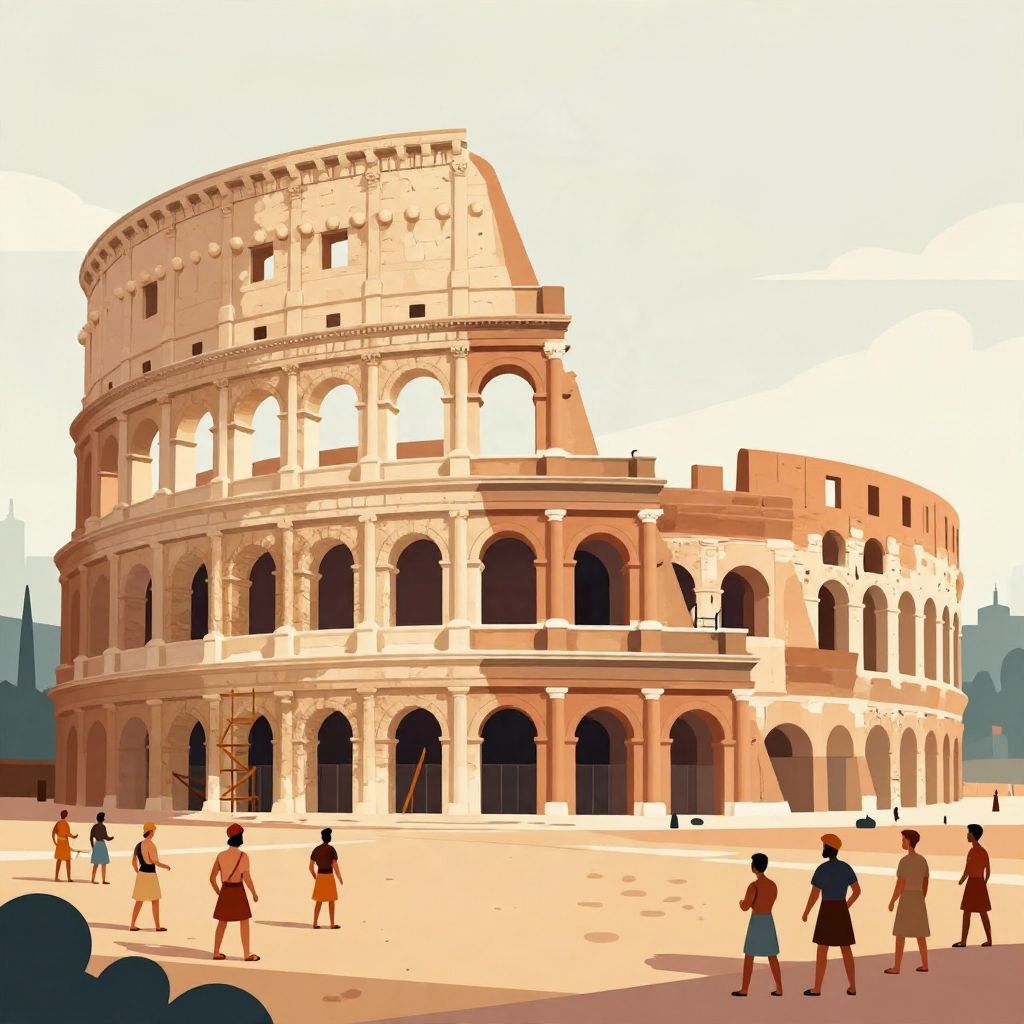
How old is the Colosseum? The short answer is that Rome’s Colosseum is nearly 2,000 years old. Construction began under the Flavian emperors in 72 CE, and the amphitheater was inaugurated in 80 CE, making it about 1,945 years old in 2026.
Its age matters because the Colosseum is more than a famous ruin: it is one of the clearest surviving symbols of imperial Rome, public spectacle, and ancient engineering. To understand how old it is, it helps to look at when it was built, how long it was used, and how it changed over time.
How old is the Colosseum?
The Colosseum is about 1,945 years old, counting from its inauguration in 80 CE. If you count from the start of construction in 72 CE, it is about 1,953 years old. Historians usually give both dates because the building was not completed and opened all at once.
When was the Colosseum built?
The Colosseum was built in the 1st century CE in ancient Rome. Emperor Vespasian ordered construction around 72 CE, and his son Titus opened the amphitheater in 80 CE. Later, Emperor Domitian added further modifications in the years after that.
Why was it built?
The amphitheater was part of the Flavian emperors’ effort to strengthen their rule after a period of civil war and instability. Building a massive public entertainment venue in the center of Rome was a political statement as much as an architectural one. It helped present the new dynasty as generous, powerful, and committed to the Roman people.
What stood there before?
The Colosseum was built on land that had been associated with Nero’s Golden House, a lavish imperial complex. After Nero’s death, the Flavians reclaimed this area for public use. That choice was symbolic: instead of a private palace and ornamental lake, the site became a place for Roman crowds.
What does the Colosseum’s timeline look like?
The Colosseum’s history stretches far beyond its original construction. It was used for centuries, then gradually fell into disrepair, and later became a monument studied and preserved by modern Italy. A simple timeline shows how its age is tied to changing uses over time.
- 72 CE — Construction begins under Vespasian.
- 80 CE — Titus inaugurates the amphitheater with public games.
- 81–96 CE — Domitian makes additions and improvements.
- 2nd–5th centuries CE — The building remains a major venue for spectacles, though its use changes over time.
- Late antiquity and early medieval period — Earthquakes, neglect, and reuse of materials contribute to decline.
- Middle Ages — The structure is adapted for other purposes and quarried for stone.
- 19th–21st centuries — Archaeological study and restoration turn it into one of the world’s best-known heritage sites.
How long was the Colosseum used?
The Colosseum was not only built in antiquity; it was actively used for a long time. Public games and spectacles continued for centuries, though the exact end date is debated because different kinds of events declined at different times. By the later Roman Empire, its role had clearly diminished, and major use had ended by late antiquity.
What kinds of events happened there?
People often associate the Colosseum with gladiator fights, and those did take place there. But the arena also hosted animal hunts, executions, and staged spectacles. Some events were highly elaborate, involving scenery, machinery, and large crowds. The building was designed to impress as well as entertain.
Was it used for Christian martyrdoms?
This is a common popular belief, but the historical evidence is limited and often overstated. Christians certainly suffered persecution in the Roman world, and some may have died in or near the arena. However, the Colosseum’s reputation as a primary martyrdom site is more a product of later tradition than firm documentation.
How has the Colosseum survived for so long?
The Colosseum has survived because it was built with durable Roman concrete, brick, and stone, but also because later generations kept reusing and repairing parts of it. Even so, it has been damaged repeatedly by earthquakes, fires, neglect, and stone removal. What remains today is only part of the original structure.
Why is it not intact?
After the fall of the Western Roman Empire, the amphitheater lost its original function. Stone was taken for other buildings, metal clamps were stripped out, and sections collapsed in earthquakes. In the medieval period, the Colosseum was treated less as a sacred monument and more as a convenient source of building material.
What parts still survive?
Visitors can still see much of the outer shell, the seating structure, and the complex interior layout. But the arena floor is mostly gone, revealing the hypogeum, the underground system of corridors and chambers that supported the shows. This exposed interior is one reason the Colosseum is so useful for understanding Roman spectacle.
Why do historians care about the Colosseum’s age?
The Colosseum’s age helps historians place it within a specific moment in Roman history: the early Flavian dynasty. That was a time of political recovery after civil war, and the amphitheater reflects the emperors’ desire to project order, generosity, and Roman identity. It is not just old; it is historically revealing.
What does it tell us about Roman society?
The building shows that Rome could mobilize enormous resources for public entertainment. It also reveals how emperors used architecture to shape public life. The Colosseum was a place where social hierarchy was visible: seating arrangements reflected rank, and the spectacle reinforced ideas about power, empire, and citizenship.
What does it tell us about Roman engineering?
The Colosseum demonstrates advanced Roman design. Its arches, vaults, circulation systems, and crowd management features allowed tens of thousands of people to enter and leave efficiently. The structure was not only large; it was carefully planned for function. That is one reason it remains a landmark in the history of architecture.
How old is the Colosseum compared with other ancient monuments?
At nearly two millennia old, the Colosseum is ancient even by Roman standards. It is younger than some Egyptian pyramids and older than most surviving buildings in Europe and the Americas. Its age places it among the most famous and best-preserved large structures from the classical world.
- Colosseum: built in the 1st century CE
- Parthenon: much older, built in the 5th century BCE
- Great Pyramid of Giza: older still, built around 2600 BCE
- Many medieval cathedrals: often 1,000 to 800 years old
What is the best way to think about the Colosseum’s age?
The best answer is that the Colosseum is about 1,945 years old, if measured from its opening in 80 CE, and about 1,953 years old if measured from the start of construction in 72 CE. Both figures are useful, but the inauguration date is usually the clearest historical benchmark.
Its age is only part of its significance. The Colosseum is a surviving witness to Roman politics, entertainment, engineering, and urban life. For readers interested in the wider world of ancient Rome, a good next step is to explore the Roman Forum, the civic center that stood at the heart of the same imperial city.