
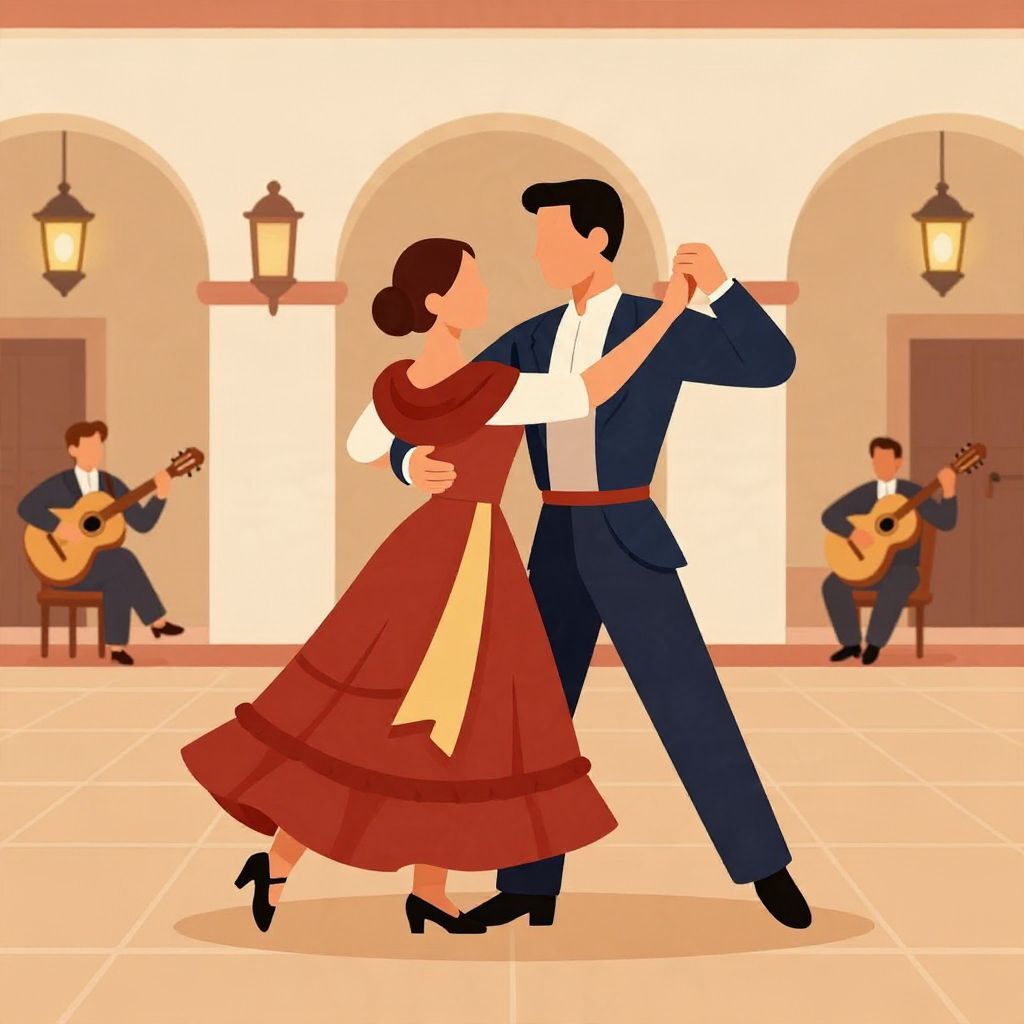
Is bolero a dance? The short answer is yes—but the word bolero does not point to just one single tradition. It can refer to a Spanish dance and song form, a later Latin American genre, and, in some contexts, a ballroom dance style that developed from those earlier roots.
Because the term traveled across countries and centuries, people sometimes use it to mean slightly different things. To understand bolero historically, it helps to separate the Spanish origin from the Cuban and broader Latin American developments that followed.
Is Bolero A Dance?
Yes. Bolero is historically a dance, but it is also a musical form closely tied to singing and accompaniment. Its meaning changed over time: the earliest bolero was a Spanish dance from the late 18th century, while the better-known Latin American bolero became a romantic song genre that was often danced to rather than performed as a fixed choreographed dance.
The Spanish Bolero: where the dance began
The bolero first emerged in Spain in the late 1700s, usually associated with theatrical and social dancing. It was a graceful, measured dance in triple meter, often performed by a solo dancer or a pair, and it belonged to the wider world of Spanish dance traditions rather than to court ballet alone.
How the Spanish bolero looked and sounded
Historical descriptions present the bolero as lively but controlled, with elegant arm movements, turns, and rhythmic footwork. It was often accompanied by guitar and singing, though the exact musical style could vary by region and performance setting. Unlike some folk dances that remained local, bolero quickly became known in stage and salon culture.
The Spanish bolero was not a static form. Choreographers and performers adapted it, and over time it influenced other Spanish dances and musical pieces. In this sense, bolero became both a specific dance and a broader artistic style associated with Spanish identity.
Why the Spanish bolero mattered
During the 19th century, European audiences often associated bolero with Spain itself, much as they associated the waltz with Austria or the polonaise with Poland. It became part of the international image of Spanish dance, appearing in theaters, salons, and later in concert music inspired by Spanish themes.
How bolero changed in Latin America
In Latin America, especially Cuba, the word bolero came to mean something different. By the late 19th century, bolero referred mainly to a slow, lyrical song genre centered on love, longing, and emotional expression. It was not simply a dance step pattern but a musical style that people often danced to in social settings.
The Cuban bolero and its spread
The Cuban bolero is generally traced to the late 1800s, with Pepe Sánchez often credited as an early composer associated with the genre. From Cuba, bolero spread widely across Latin America and the Spanish-speaking world, where it developed local variations in Mexico, Puerto Rico, the Dominican Republic, and beyond.
Here the historical shift is important: the bolero became less of a formal dance style and more of a song form with danceable rhythm. In many places, people still danced boleros in pairs, but the genre’s fame rested increasingly on its music and lyrics.
Bolero as dance and as song
This dual identity explains much of the confusion around the question “Is bolero a dance?” Historically, yes, but not always in the same way. In Spain, bolero was distinctly a dance. In Cuba and later Latin America, bolero was primarily a musical genre that could be accompanied by dancing, often in a close partner style.
That is why some modern listeners think of bolero as a romantic slow dance, while historians may describe it more carefully as a song tradition with dance roots.
Bolero in social life and performance
Bolero mattered because it moved between elite and popular culture. In Spain, it appeared on stage and in fashionable settings. In Latin America, it became part of urban nightlife, radio culture, and domestic music-making. Its emotional style made it especially suited to performances about love, heartbreak, and memory.
Common features of bolero performance
- Rhythm: often slow or moderate, with a smooth, flowing feel
- Theme: romantic lyrics and emotional storytelling in the Latin American tradition
- Dance style: partner-based movement or elegant stage choreography, depending on place and period
- Setting: theaters, salons, dance halls, radio, and family gatherings
Because bolero was adaptable, it could survive in changing cultural environments. A dance that began in late-18th-century Spain could later become a sentimental song genre in the Caribbean and the Americas without losing its historical connection to movement and performance.
Bolero in the wider history of dance
Bolero belongs to a long history in which dances travel, change, and acquire new meanings. Many historical dances do this. A form may begin as a local social dance, become theatrical, and then evolve into a musical genre or ballroom style. Bolero is a good example of that process.
Relationship to other dance traditions
Bolero should not be confused with every slow Latin dance or every Spanish-style performance. It is related to broader Iberian and Afro-Caribbean musical worlds, but it has its own history. In some modern dance settings, “bolero” may refer to a ballroom or social dance interpretation shaped by later teaching traditions rather than by the original Spanish form.
This is why historians and dance scholars usually avoid giving a single oversimplified definition. The word has layered meanings, and those meanings depend on time and place.
What historians can say with confidence
There is solid historical evidence that bolero began as a Spanish dance in the late 18th century and later became an important Latin American musical genre, especially in Cuba. It is also clear that the term has been used differently in different regions, which is why modern definitions can seem inconsistent.
What is less certain or more variable
Some details about the earliest bolero are harder to pin down precisely, because dance history often relies on descriptions, sheet music, stage accounts, and later recollections rather than complete choreographic records. The exact steps, regional variants, and the transition from dance to song were not identical everywhere.
So, when answering whether bolero is a dance, the most accurate historical response is: yes, but the term has never meant only one thing. It began as a dance, transformed into a musical genre, and continued to live on in both dance and song traditions.
Why the question still matters today
People still ask “Is bolero a dance?” because the word appears in music history, dance history, and popular culture. Understanding the answer shows how cultural forms travel across the Atlantic, adapt to new audiences, and keep older meanings even as they change.
Bolero is a reminder that history is often layered rather than neat. A single term can carry the memory of Spanish stage dance, Cuban romantic song, and modern social dancing all at once. For readers interested in related cultural traditions, you might also enjoy what is a Brazilian carnival? and what is capoeira?