
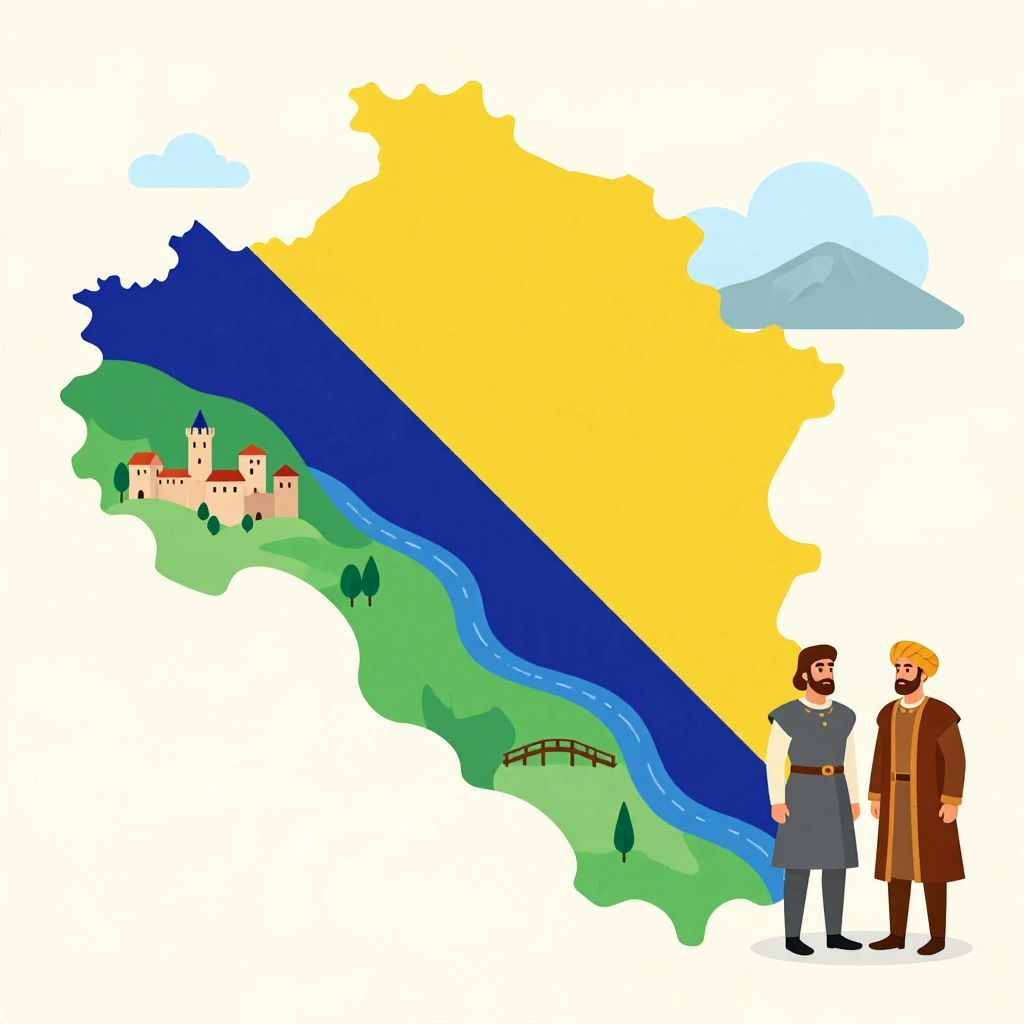
Why is it called Bosnia and Herzegovina? The short answer is that the modern state takes its name from two historic regions that developed under different local and political traditions: Bosnia, the larger central area, and Herzegovina, the southern region whose name appeared much later. Together, the names reflect centuries of shifting borders, medieval lordship, Ottoman administration, and modern state-building.
The name is not a single ancient label preserved unchanged through time. Instead, it is the result of layered history, with each part of the country’s title pointing to a different regional identity that became politically important in the 19th and 20th centuries.
Why is it called Bosnia and Herzegovina?
It is called Bosnia and Herzegovina because the country combines two historically distinct regions. Bosnia is the older and broader name, attested in medieval sources, while Herzegovina comes from the title of a 15th-century nobleman, Stjepan Vukčić Kosača, who styled himself “herceg” or duke. The modern state adopted both names to reflect its historical geography and political unity.
The older name: Bosnia
Bosnia is the older of the two names and appears in medieval Latin, Byzantine, and Slavic sources. Historians generally trace it to the river Bosna, which runs through the region. The exact linguistic origin of the river’s name is debated, but the link between the river and the region is well established.
From river to region
In many parts of Europe, regions were named after major rivers, valleys, or fortified centers. Bosnia followed that pattern. By the early Middle Ages, “Bosnia” referred to a political and geographic area in the central Balkans. Over time, it became associated with a medieval banate and later a kingdom, giving the name strong historical continuity.
Medieval Bosnia was not a fixed modern-style state with precise borders. Its territory changed as local rulers, neighboring kingdoms, and empires competed for control. Still, the name “Bosnia” remained central because it described the core inland region around the Bosna River and the political community that formed there.
Medieval Bosnia and its identity
By the 12th and 13th centuries, Bosnia had emerged as a recognizable political unit under local rulers known as bans. Later, in 1377, Tvrtko I was crowned king, and the Kingdom of Bosnia became an important South Slavic state. This medieval kingdom helped закрепить, or fix, Bosnia as a lasting historical name even after the kingdom fell to the Ottomans in 1463.
Under Ottoman rule, Bosnia did not disappear as a regional identity. Instead, it survived as an administrative and cultural term, even as borders and institutions changed. That continuity is one reason the name Bosnia remained the foundation of the country’s modern title.
Where does Herzegovina come from?
Herzegovina is a later name and literally means “the land of the herceg,” or duke. It comes from the title adopted by Stjepan Vukčić Kosača, a powerful 15th-century nobleman who controlled much of the southern part of today’s country. He used the German-derived title herceg, and the region associated with his rule gradually became known by that name.
A title becomes a place name
Stjepan Vukčić Kosača was one of the most influential regional lords in the late medieval Balkans. In the 1440s, he styled himself “herceg of Saint Sava,” and his lands in the south began to be identified with his title. Foreign observers and later Ottoman administrators helped spread the name. Over time, “Herzegovina” became the standard designation for the southern region.
This is an example of a common historical process: a ruler’s title or estate name becomes attached to a territory. Similar patterns can be found elsewhere in Europe, where dynastic or noble titles shaped regional names. In this case, the word did not come from an ancient tribe or a classical province, but from a medieval political title.
Why the name stuck
After the Ottoman conquest, the southern area retained a distinct regional identity. The Ottomans organized the territory into administrative units, but the older local name persisted. By the early modern period, “Herzegovina” had become widely used in maps, documents, and everyday speech to describe the area south of Bosnia proper.
That name endured because it captured a real historical distinction. Bosnia and Herzegovina were connected, but they were not identical in medieval political development, geography, or local elite power. The combined modern name acknowledges both regions rather than replacing one with the other.
How the two names came together
The pairing “Bosnia and Herzegovina” became especially important in the 19th century, when imperial administration and modern nationalism reshaped the Balkans. Under Austro-Hungarian rule after 1878, the two regions were governed together as a single administrative unit: Bosnia and Herzegovina. That official usage helped make the combined name standard in international politics.
Ottoman background
Before Austro-Hungarian occupation, the area had been under Ottoman rule for centuries. The Ottomans did not create a modern nation-state, but they did maintain administrative divisions that made Bosnia and Herzegovina function together in practice. This encouraged the idea that the two regions belonged in one broader political framework, even if local identities remained varied.
During Ottoman times, Bosnia was often treated as a major province, while Herzegovina was recognized as a distinct but related area. The interplay between the two names reflected both geography and administration. Bosnia was the older core; Herzegovina was the southern extension with its own historical memory.
Austro-Hungarian administration
After the Congress of Berlin in 1878, Austria-Hungary occupied Bosnia and Herzegovina and later formally annexed them in 1908. The Habsburg authorities administered the territory as a single unit, which reinforced the compound name in official usage. This was not just a geographical label; it became a political designation in imperial governance.
The modern state’s name therefore owes much to this period. International diplomacy, censuses, maps, and bureaucratic practice all helped standardize “Bosnia and Herzegovina” as the official title for the territory.
Why not just Bosnia?
One might ask why the larger and older name was not used alone. The answer lies in regional history and identity. By the 19th century, Herzegovina was no longer a minor footnote; it had become a recognized historical region with a name deeply rooted in local memory. Leaving it out would have erased an important part of the territory’s past.
Political balance and regional identity
Using both names also helped avoid implying that the southern region was merely an appendage of Bosnia. The compound name recognized the fact that the territory had two historically meaningful parts. In modern state formation, such naming choices often matter because they signal inclusion and balance among regions with different historical experiences.
This was especially important in a land where identities were shaped by religion, empire, language, and local allegiance as much as by modern nationalism. The name “Bosnia and Herzegovina” offered a way to unite the territory without erasing its internal diversity.
What the name does not mean
It is worth separating history from myth. Herzegovina does not mean the region was founded by a “Herzeg” in the sense of a sovereign king, nor does Bosnia refer to a single ancient ethnic group with a simple uninterrupted line to the present. These names are historical and political labels that changed meaning over time.
Likewise, the modern country’s name should not be read as proof that Bosnia and Herzegovina were always separate states. They were often parts of larger empires or kingdoms. The combined title reflects historical regions, not independent medieval countries joined by treaty.
Language and historical memory
Both names show how language preserves layers of the past. Bosnia preserves an older regional core tied to geography and medieval statehood. Herzegovina preserves the memory of a late medieval noble title that became a place-name. Together, they tell a story of continuity, conquest, and adaptation across centuries.
From empire to modern state
In the 20th century, the name continued through the Yugoslav period and into the post-Yugoslav era. After the breakup of Yugoslavia and the war of the 1990s, the internationally recognized independent state retained the historical compound name. That decision reflected both continuity and the reality that the country’s identity had long been built from more than one regional tradition.
The name therefore carries more than geography. It also conveys the long historical process through which a medieval inland region and a later southern lordship became part of one political unit. The modern state’s title preserves that layered past.
The historical meaning of the name today
Today, Bosnia and Herzegovina is not just a formal label. It is a reminder that the country’s history cannot be reduced to a single origin story. Bosnia gives the state its older core identity, while Herzegovina adds the memory of a later regional formation shaped by medieval nobility and Ottoman-era persistence.
So, why is it called Bosnia and Herzegovina? Because the name records two separate but connected historical regions that came together in modern political usage. It is a compound name rooted in medieval geography, noble titles, imperial administration, and the long survival of regional identities. That layered history is exactly what makes the name meaningful.