
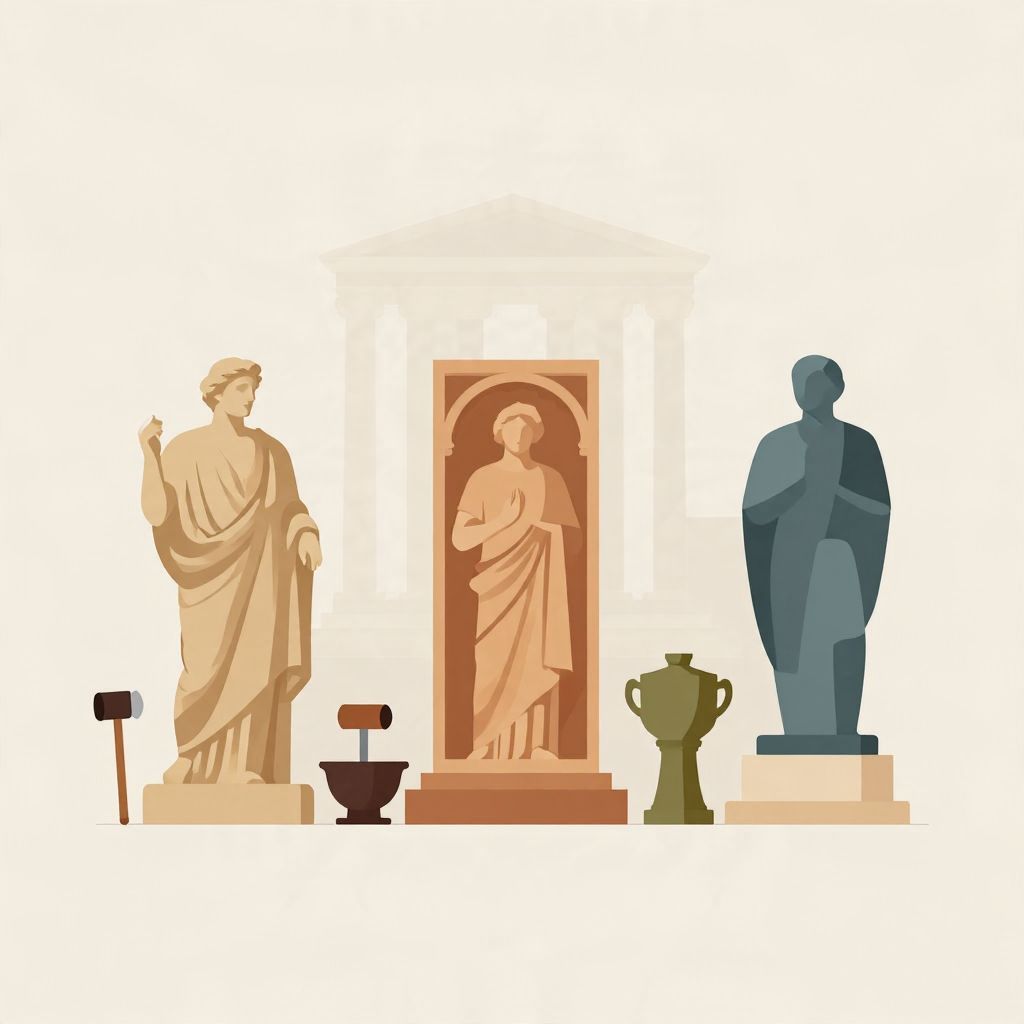
What is the role of sculpture in history? Sculpture has been one of humanity’s oldest visual languages, used to honor gods, rulers, ancestors, and ideals, while also recording changing beliefs about power, beauty, memory, and identity. From prehistoric figurines to modern public monuments, it has helped societies make ideas visible in durable form.
Its history is not just about art. Sculpture has served religion, politics, commemoration, propaganda, architecture, and everyday civic life. Because it survives well in stone, metal, and clay, it also gives historians direct evidence about cultures that left few written records.
What Is the Role of Sculpture in History?
Sculpture has played a central historical role as a physical record of belief, authority, and social values. It has been used to worship deities, legitimize rulers, commemorate the dead, decorate sacred and public spaces, and shape collective memory. In many periods, sculpture was both art and evidence of how a society understood itself.
Why Sculpture Matters to Historians
Sculpture matters because it preserves information that texts alone cannot. It reveals clothing, posture, tools, symbols, religious practices, and political messages. Even when a sculpture’s original meaning is partly lost, its style, material, scale, and location can help historians reconstruct the world that made it.
Material evidence from the past
Unlike many organic materials, sculpture often survives for centuries or millennia. Stone, bronze, terracotta, ivory, wood, and plaster can endure long after buildings and manuscripts disappear. This makes sculpture especially valuable for studying ancient societies such as Egypt, Mesopotamia, Greece, Rome, India, China, Mesoamerica, and parts of Africa and Europe.
Images as historical sources
Sculpture can function like a visual document. A royal statue may show how a ruler wanted to be seen; a funerary monument may reveal beliefs about the afterlife; a temple relief may depict rituals, offerings, or military victories. Historians use such works carefully, because they are often idealized rather than neutral.
Origins of Sculpture in Early Human History
The origins of sculpture go back deep into prehistory, long before writing. Small carved figures, engraved objects, and modeled clay forms appear in Ice Age contexts, though their exact meanings are uncertain. These early works suggest that people were already using three-dimensional images for symbolic, ritual, or social purposes.
Prehistoric figurines and ritual meaning
Among the best-known early examples are Upper Paleolithic figurines, including the so-called “Venus” figures found across parts of Europe and Eurasia, dating broadly to around 30,000 to 20,000 years ago. Scholars disagree about their precise purpose: they may have been linked to fertility, identity, teaching, or ritual, but no single interpretation is certain.
From portable objects to monumental forms
As settled agriculture developed, sculpture became larger and more public. Communities began making statues, reliefs, and architectural decoration for temples, tombs, and civic centers. This shift reflected more complex social hierarchies, organized religion, and the desire to display power in durable, visible form.
Sculpture in Ancient Civilizations
In the ancient world, sculpture became one of the main ways states and religions expressed authority. Its role varied by region, but it commonly linked the human and divine worlds, marked elite status, and helped organize public space.
Egypt: permanence, kingship, and the afterlife
Ancient Egyptian sculpture emphasized stability and continuity. Statues of pharaohs, gods, and officials were placed in temples and tombs, where they could serve religious and funerary functions. The idealized, frontal style conveyed order and permanence, matching Egyptian ideas about kingship and the afterlife.
Mesopotamia: devotion and royal power
In Mesopotamia, sculpture appeared in votive figures, temple reliefs, and royal monuments. It often depicted worshippers, deities, and military triumphs. Rulers used carved stone stelae and reliefs to publicize victories and divine favor, showing that sculpture could be a tool of statecraft as well as devotion.
Greece: the human body and civic identity
Greek sculpture, especially from the Archaic and Classical periods, transformed the representation of the human body. Statues of athletes, gods, and citizens reflected changing ideas about proportion, movement, and ideal beauty. Sculpture also filled sanctuaries and public spaces, helping Greek city-states express civic pride, religious devotion, and cultural competition.
Rome: portraits, propaganda, and empire
Roman sculpture expanded the political uses of the medium. Portrait busts, triumphal arches, reliefs, and imperial statues celebrated emperors, military conquest, and family lineage. Romans valued realism in portraiture more than many earlier cultures, though even these works could be highly selective in what they emphasized. Sculpture helped make empire visible across a vast territory.
Religious Roles of Sculpture Across History
One of sculpture’s most enduring roles has been religious. In many societies, sculpted images were not merely decorative; they were believed to house divine presence, support ritual, or make sacred stories accessible to worshippers. This function appears in many traditions, though beliefs about images varied widely.
Temples, shrines, and sacred images
In Hindu, Buddhist, Greco-Roman, Egyptian, Christian, and many indigenous contexts, sculpture has been central to worship and ritual practice. Some traditions treated images as vessels of presence, while others used them as aids to devotion or teaching. The meaning of sacred sculpture depended on theology, local custom, and historical period.
Iconoclasm and the destruction of images
Because sculpture could be powerful, it was also vulnerable. Periodic waves of iconoclasm—the rejection or destruction of religious images—show how strongly people felt about the role of sculpture in worship and authority. Such acts were not simply artistic disputes; they were struggles over doctrine, memory, and control of sacred space.
Sculpture as Political Power and Public Memory
Throughout history, rulers and states have used sculpture to shape public memory. Monuments, statues, and reliefs can glorify victories, legitimize regimes, mourn the dead, or define national identity. Their placement in plazas, tombs, roads, and government centers makes them part of everyday political life.
Monuments and legitimacy
A statue of a king or emperor does more than portray a face. It sends a message about continuity, authority, and rightful rule. In many empires, monumental sculpture was installed in strategic places so that subjects would repeatedly encounter the ruler’s image. This visual repetition helped reinforce political order.
Commemoration and selective memory
Later societies have used sculpture to remember wars, revolutions, founders, and victims. Yet monuments rarely present the whole past. They usually highlight some events and silence others. For that reason, historians study not only what a monument says, but also who commissioned it, when it was built, and what it left out.
How Sculpture Changed in the Middle Ages and Early Modern Period
In the medieval world, sculpture remained important in churches, cathedrals, mosques, palaces, and tombs, though its forms and meanings differed by region and religion. It often served architectural and devotional purposes rather than standing alone as an independent art form.
Medieval sacred architecture
Romanesque and Gothic churches in Europe used sculpture on portals, capitals, façades, and tombs to teach biblical stories and shape religious experience. In many cases, these images helped communicate doctrine to audiences with limited literacy, though they also served elite patrons and liturgical settings.
Renaissance revival and naturalism
During the Renaissance, especially in Italy from the 14th to 16th centuries, sculptors revived classical forms while developing new interest in anatomy, perspective, and individual expression. Sculpture became a major medium for elite patronage, civic identity, and artistic innovation. It also gained greater independence from architecture.
Baroque drama and emotion
In the 17th century, Baroque sculpture used movement, texture, and theatrical composition to create emotional intensity. Churches and courts employed sculpture to inspire devotion and project magnificence. This period shows how sculpture could be both spiritual and political, often at the same time.
Modern Sculpture and New Historical Meanings
From the 18th century onward, sculpture took on new roles in public life, museums, and modern nation-states. Industrial materials, global exchange, and changing artistic styles expanded what sculpture could be and whom it served. At the same time, public monuments became increasingly contested.
Nationalism and civic monuments
In the 19th century, many countries used sculpture to build national identity. Statues of heroes, generals, writers, and political leaders appeared in squares and capitals. These works helped teach history in visual form and made nations feel older, more unified, and more permanent than they often were.
Modernism and abstraction
In the 20th century, sculptors increasingly moved away from strict realism. Abstract and experimental forms challenged older expectations that sculpture should imitate the body or commemorate a single figure. This shift reflected broader changes in philosophy, technology, and the experience of modern life.
Public debate and changing values
Today, sculptures and monuments are often debated for what they represent. Some are celebrated as heritage; others are criticized for honoring colonialism, slavery, war, or exclusion. These debates show that sculpture remains historically active: it is not only a remnant of the past, but also a site where societies argue over the past’s meaning.
Key Facts About Sculpture in History
- Sculpture predates writing and belongs to the deepest layers of human cultural history.
- It has been used in religion, politics, funerary practice, education, and public commemoration.
- Its survival in durable materials makes it a major source for historians of ancient and medieval societies.
- Sculpture often reflects power: rulers, priests, and elites frequently controlled what was made and where it was displayed.
- Its meaning can change over time, especially when later societies reinterpret, damage, move, or remove monuments.
Conclusion: Why Sculpture Still Matters in Historical Study
Sculpture’s role in history is to make values visible. It has preserved belief, authority, memory, and identity in forms that outlast the people who created them. For historians, sculpture is both evidence and argument: evidence of how past societies lived, and an argument about what they thought deserved to endure. For related reading, see more history articles.