
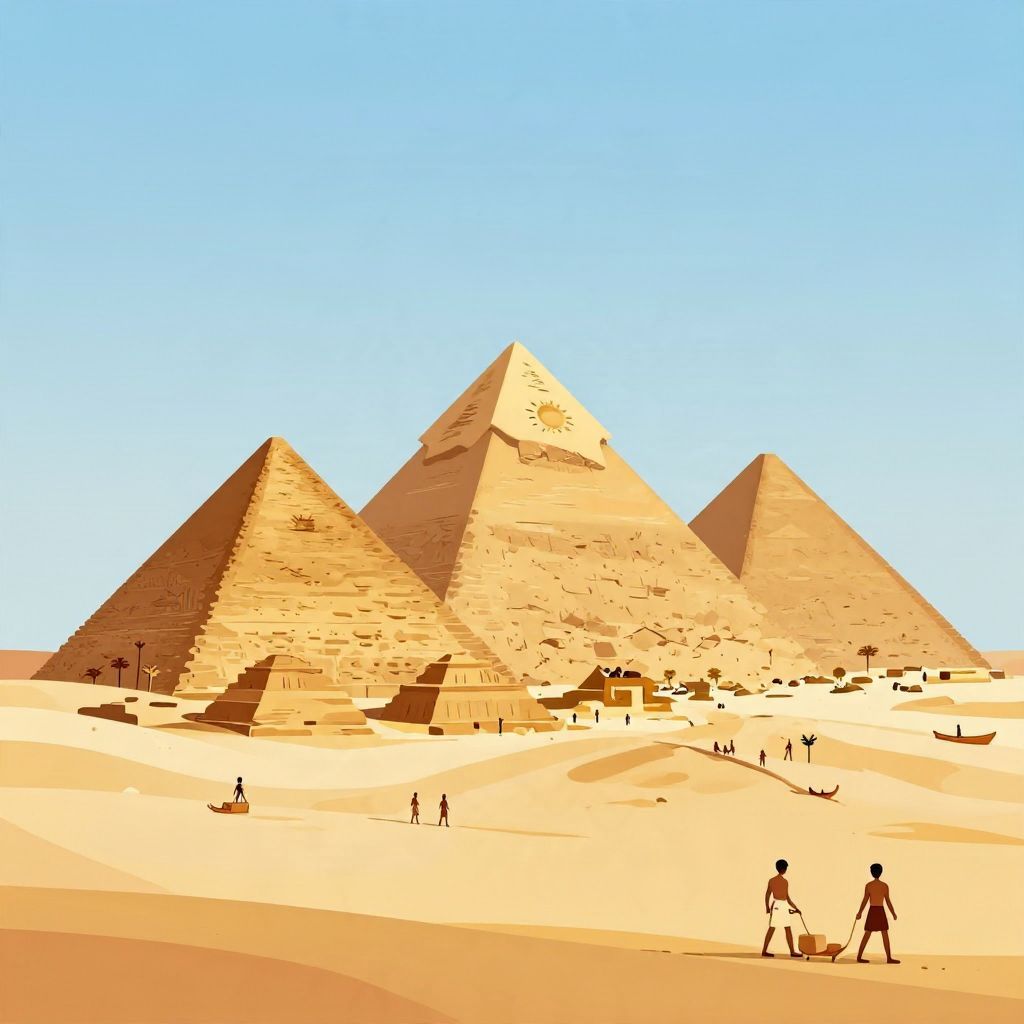
When were the Pyramids of Giza built? The short answer is that they were built during Egypt’s Fourth Dynasty, roughly between 2600 and 2500 BCE, with the Great Pyramid of Khufu usually dated to around 2580–2560 BCE. These monuments were not raised all at once, but over several decades, as part of a royal burial complex on the Giza plateau near ancient Memphis.
The pyramids are among the most famous works of the ancient world, but their dates are known through archaeology, inscriptions, and the broader chronology of Old Kingdom Egypt. The story behind them is not just about stone and engineering; it is also about kingship, religion, labor, and the political power of the pharaohs.
When were the Pyramids of Giza built?
The three main pyramids at Giza were built in the Fourth Dynasty of ancient Egypt, approximately between 2600 and 2500 BCE. The best-known one, the Great Pyramid of Khufu, is generally dated to the 26th century BCE, with most scholars placing its construction around 2580–2560 BCE. The pyramids of Khafre and Menkaure followed later in the same dynasty.
The usual timeline at a glance
- Khufu’s Great Pyramid: c. 2580–2560 BCE
- Khafre’s Pyramid: c. 2550 BCE
- Menkaure’s Pyramid: c. 2510–2490 BCE
These dates are approximate, not exact to a single year. Ancient Egyptian chronology is reconstructed from king lists, inscriptions, archaeological evidence, and astronomical clues, so scholars can place the pyramids confidently within a century range, but not with modern precision.
Why the exact date is not perfectly fixed
Unlike a modern building project with contracts and calendars, the pyramids were constructed in a world where records were limited and survival of evidence is uneven. Historians and archaeologists rely on indirect evidence, so the dates are best understood as scholarly estimates rather than stamped construction dates.
How historians date the pyramids
Several kinds of evidence help establish the chronology:
- King lists and dynastic order: The pyramids belong to the Fourth Dynasty, a period whose rulers are well known in sequence.
- Archaeological context: The pyramids fit into the development of earlier pyramid forms at Saqqara and Dahshur.
- Inscriptions and quarry marks: Workers’ marks and inscriptions inside the pyramids help identify Khufu’s reign and later activity.
- Radiocarbon dating: Scientific dating has broadly supported an Old Kingdom construction date, though it does not always match traditional chronology exactly.
There is some debate over the precise years because different dating methods can produce slightly different results. Still, the overall historical picture is secure: the Giza pyramids were built in the mid-third millennium BCE, during a time when the Egyptian state had extraordinary resources and centralized authority.
Who built the Pyramids of Giza?
The pyramids were commissioned by three Fourth Dynasty pharaohs: Khufu, Khafre, and Menkaure. They were built by organized teams of skilled workers, laborers, and specialists under royal administration. The popular image of enslaved masses is not supported by the best evidence for the Giza construction workforce.
The three royal pyramids
Each pyramid was part of a larger funerary complex designed to support the king’s journey into the afterlife:
- Khufu built the largest pyramid, later called the Great Pyramid.
- Khafre built the second pyramid, which appears taller from some angles because of its higher bedrock and steeper slope.
- Menkaure built the smallest of the three main pyramids, though it was still an impressive royal monument.
These kings were not merely tomb owners. In ancient Egyptian thought, the pharaoh was a divine or semi-divine ruler whose burial monument expressed political power, religious duty, and cosmic order. Building a pyramid was therefore both a practical and symbolic act.
How long did it take to build the pyramids?
Most scholars think the Great Pyramid took about 20 years to complete, though that figure is an estimate based on the likely length of Khufu’s reign and the scale of the project. The other pyramids were also multi-year undertakings. The construction process likely involved planning, quarrying, transport, ramp systems, and finishing work over many seasons.
Why construction took so long
Building a pyramid required more than stacking stones. Workers had to:
- Quarry limestone and granite blocks.
- Transport materials by boat and overland routes.
- Raise and position huge blocks with engineering systems.
- Line the structure with fine casing stones.
- Construct temples, causeways, and subsidiary tombs around it.
The project was likely organized in stages, with labor shifting according to the agricultural calendar. When the Nile flooded fields, many workers may have been available for state projects. This helps explain how Egypt could sustain such a massive building program without modern machinery.
What was happening in Egypt at the time?
The pyramids were built during the Old Kingdom, often called the “Age of the Pyramids.” This was a period of strong centralized government, expanding bureaucracy, and major state-sponsored building projects. The capital and administrative center was associated with Memphis, near the pyramid fields of Giza and Saqqara.
The Fourth Dynasty context
The Fourth Dynasty was especially important because it marked a peak in royal monument building. Earlier rulers had already experimented with mastabas and step pyramids, and Khufu’s pyramid represented a dramatic leap in scale and ambition. The Giza complex reflects a mature state that could mobilize labor, materials, and expertise on a vast scale.
This was also a period when the afterlife beliefs of Egyptian kingship were deeply tied to monumental architecture. The pyramid was not just a tomb in the modern sense; it was a sacred machine for preserving the king’s body, name, and divine status.
Were the pyramids built all at once?
No. The Giza pyramids were built over multiple reigns, and the site developed gradually. Khufu’s pyramid came first, followed by Khafre’s and then Menkaure’s. Around them grew temples, boat pits, subsidiary pyramids, cemeteries for officials, and the Sphinx complex, creating a larger sacred landscape rather than a single isolated monument.
The pyramid complex, not just the pyramid
What people often call “the pyramids” were actually part of a much broader funerary system. A royal pyramid complex usually included:
- a valley temple near the Nile
- a causeway leading to the pyramid
- a mortuary temple beside the pyramid
- smaller pyramids for queens or royal relatives
- mastaba tombs for officials and family members
At Giza, these elements reveal the social world of the Old Kingdom. The pyramids were not only royal monuments; they also anchored a landscape of administration, ritual, and elite burial.
How did the pyramids fit into earlier Egyptian building history?
The Giza pyramids did not appear suddenly. They were the result of a long architectural evolution. Before Giza, Egyptian rulers built mastabas, then stepped structures, and then true pyramids. The most famous predecessor is the Step Pyramid of Djoser at Saqqara, built about a century earlier in the Third Dynasty.
From mastaba to true pyramid
The development of pyramid architecture can be summarized simply:
- Mastabas: flat-roofed rectangular tombs used by elites.
- Step Pyramid: an early monumental tomb with stacked levels.
- True pyramids: smooth-sided royal monuments perfected by the Fourth Dynasty.
Khufu’s pyramid was not the first pyramid ever built in Egypt, but it was the most ambitious expression of the form. It represented a culmination of architectural experimentation and state power.
What do the pyramids tell us about ancient Egypt?
The pyramids show that Old Kingdom Egypt had a highly organized state, capable of directing labor, resources, and religious ideology on a monumental scale. They also show that architecture in ancient Egypt was inseparable from politics and belief. The pharaoh’s tomb was a public statement about order, eternity, and divine rule.
Lasting historical significance
The Giza pyramids became enduring symbols of ancient Egypt itself. They influenced later Egyptian building traditions, fascinated Greek and Roman writers, and continue to shape modern ideas about the ancient world. They also remain valuable evidence for historians studying labor organization, engineering, religion, and state formation.
Importantly, the pyramids are not mysterious in the sense of being unknowable. Archaeology has clarified much about how and when they were built, even if some details remain debated. Their real wonder lies not in fantasy, but in the extraordinary human effort and political organization behind them.
Common myths about when the pyramids were built
Because the pyramids are so old and famous, they have attracted many myths. Some claims place them in fantastically remote ages or connect them to lost civilizations. These ideas are not supported by mainstream historical or archaeological evidence.
What historians do not accept
- They were not built by aliens.
- They were not built in biblical times. They are far older than the biblical period.
- They were not built by slaves in the Hollywood sense. The evidence points to organized labor, likely including skilled workers and conscripted seasonal laborers.
- They were not built in one giant burst. Construction unfolded over decades.
Separating myth from evidence matters because the pyramids are impressive enough without embellishment. Their true history is rooted in the achievements of ancient Egyptian society.
So, when were the Pyramids of Giza built?
The Pyramids of Giza were built in the Fourth Dynasty of ancient Egypt, roughly between 2600 and 2500 BCE. The Great Pyramid of Khufu is usually dated to around 2580–2560 BCE, with the pyramids of Khafre and Menkaure following later. Their construction reflects the power of Old Kingdom Egypt at its height, and their survival makes them one of history’s most remarkable architectural achievements.
If you want to explore the broader meaning of these monuments, you may also enjoy reading about architectural history and the role of cultural preservation in architecture.