
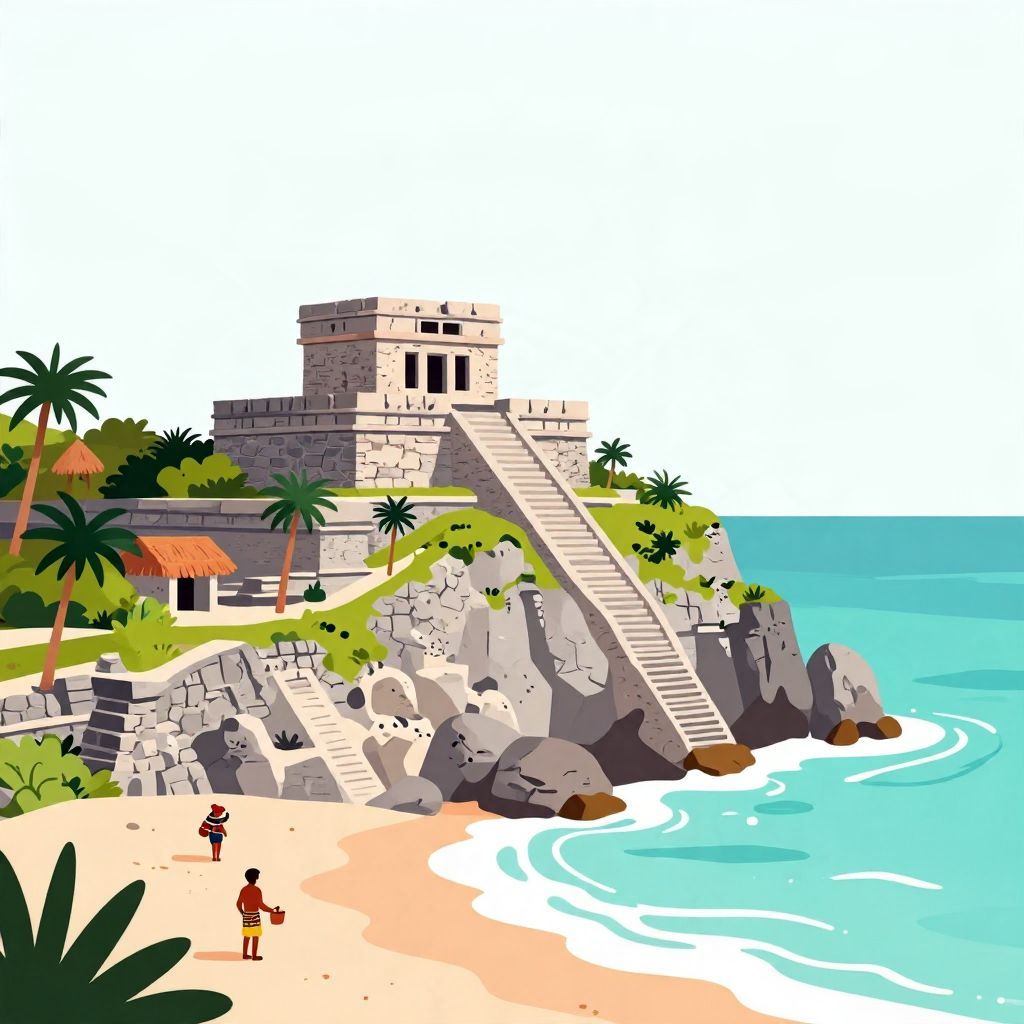
What is Tulum? In the historical sense, Tulum is best known as a late Maya city on the Caribbean coast of present-day Quintana Roo, Mexico. It was an important fortified port and ceremonial center during the Postclassic period, long after the great Classic-era Maya cities had declined.
Today, the name also refers to the modern town and tourist destination nearby, but the original Tulum was a pre-Columbian settlement with a distinct political, economic, and ritual role in the Maya world.
What Is Tulum?
Tulum was a walled Maya city on the Yucatán Peninsula, occupied mainly from about the 13th to the 16th centuries CE. It served as a coastal trading center, a religious site, and a defensive stronghold overlooking the Caribbean Sea. The ruins visible today belong to that late Maya settlement, not to a single empire or a modern resort town.
Where Was Tulum, and Why Was It Important?
Tulum is located on the eastern coast of the Yucatán Peninsula in what is now Mexico. Its position gave it access to sea routes along the Caribbean, making it valuable for trade in goods such as salt, cotton, obsidian, ceramics, and perhaps cacao and other luxury items. Its cliffside location also made it easier to defend than many inland settlements.
The city was part of a broader network of Maya communities that remained politically active after the collapse of many southern lowland centers. Rather than being a single centralized kingdom, the Postclassic Maya world was made up of competing polities, alliances, and trading relationships. Tulum fit into that world as a coastal node with both economic and religious significance.
The Origins of Tulum in the Maya World
Tulum’s origins are tied to the later history of Maya civilization. The great cities of the Classic period, such as Tikal and Palenque, had largely declined by around the 9th century CE, but Maya society did not disappear. Populations shifted, political systems changed, and new centers rose in different regions. Tulum emerged during this later phase, probably reaching prominence between the 1200s and 1400s.
Archaeologists generally date the main occupation of Tulum to the Postclassic period, especially the Late Postclassic era. The exact beginning of settlement is not known with precision, and different structures may have been built or expanded at different times. What is clear is that Tulum was flourishing when Europeans first reached the region in the early 16th century.
Why a Walled City?
The most striking feature of Tulum is its defensive wall. In Maya cities, walls were not universal, so Tulum’s fortifications stand out. The wall enclosed the core ceremonial and elite area, suggesting concern for security in a time of regional competition and maritime exchange. The walls also created a symbolic boundary around a sacred and political space.
That said, Tulum was not a massive military fortress in the modern sense. It was a settlement where defense, trade, and ritual life overlapped. The wall tells us that security mattered, but it does not mean the city was constantly under siege.
What Did Tulum Look Like in Its Heyday?
The ruins at Tulum are relatively compact compared with some larger Maya sites, but they are architecturally important. The city includes temples, administrative buildings, residential structures, and a prominent structure often called El Castillo, which sits dramatically above the sea. The layout reflects both practical use and ceremonial planning.
Several buildings show the characteristic Maya use of stone construction, stucco, and painted decoration. Some structures were likely used by elites and religious specialists, while others served more ordinary civic or residential functions. The site’s coastal setting would have made it visually impressive to visitors arriving by land or sea.
Key Features of the Site
- The defensive wall that enclosed much of the central area.
- El Castillo, the most famous temple structure, positioned near the cliff edge.
- The Temple of the Frescoes, known for surviving mural art and religious imagery.
- Access to the sea, which supported trade and communication along the coast.
What Was Tulum Used For?
Tulum was not just a city in the everyday sense; it was a place where commerce, religion, and authority came together. Coastal trade was central to its importance. Canoes could move goods between settlements up and down the Caribbean coast, and Tulum likely benefited from this maritime traffic.
Religious life was also essential. Maya cities commonly linked political power to sacred authority, and Tulum was no exception. Temples and murals suggest that ritual practices played a major role in the city’s identity. The site’s sacred architecture indicates that it was a place where elites and priests may have performed ceremonies tied to cosmology, rulership, and community life.
Trade and the Coastal Economy
Because Tulum sat on the coast, it had advantages that inland cities did not. Maritime transport could be faster and more efficient for certain goods than overland travel through dense forest and rough terrain. Salt, in particular, was a valuable commodity in Mesoamerica, and coastal production and exchange were economically important.
Trade also connected Tulum to wider Maya networks. Even though the city was not among the largest Maya centers, it was part of a regional system that depended on movement, exchange, and communication. Its prosperity likely depended on that connectivity.
Who Built Tulum?
Tulum was built by the Maya, one of the major Indigenous civilizations of ancient Mesoamerica. The Maya were not a single unified empire but a diverse set of peoples sharing related languages, religious traditions, and cultural practices. Over centuries, they created cities, calendars, writing systems, monumental architecture, and long-distance trade networks.
By the time Tulum rose to prominence, Maya society had already undergone major changes from the earlier Classic period. Tulum reflects this later Maya world: smaller in scale than some earlier ceremonial capitals, but still sophisticated, organized, and deeply connected to regional exchange and ritual life.
What Happened to Tulum After the Spanish Arrival?
Spanish contact transformed the Maya world dramatically. When Europeans arrived in the early 1500s, Tulum was still occupied. Spanish accounts from the period describe coastal settlements in the region, and Tulum was among the places that came into contact with the new colonial order.
Like many Indigenous centers in the Americas, Tulum did not survive as an independent city-state. Disease, warfare, forced labor systems, missionization, and colonial disruption all contributed to the decline of many Maya communities. The exact sequence of Tulum’s abandonment is not fully documented, but its political and urban life faded in the centuries after contact.
Did Tulum Fall in a Single Event?
No single dramatic “fall” explains Tulum’s end. Historical change in the Maya region was gradual and uneven. Some settlements persisted longer than others, and Indigenous communities adapted in different ways under colonial rule. Tulum’s abandonment was part of this broader process rather than the result of one decisive battle or conquest.
How Do Historians and Archaeologists Understand Tulum?
Our knowledge of Tulum comes from archaeology, architectural study, epigraphy where available, and comparison with other Maya sites and colonial-era accounts. Because the site is later than many famous Classic Maya centers, it helps historians understand how Maya society changed over time rather than simply how it “collapsed.”
Scholars see Tulum as evidence that Maya civilization remained dynamic after the Classic period. It shows adaptation to changing political conditions, new patterns of trade, and continued religious and artistic traditions. The site is especially valuable because it preserves a coastal urban form that differs from the inland jungle cities often associated with the Maya.
What Tulum Does and Does Not Prove
- It does show that the Maya built important coastal centers in the Postclassic era.
- It does show that trade and defense were closely linked in late Maya society.
- It does not prove that all Maya cities were the same or ruled by one empire.
- It does not represent the whole history of the Maya, only one late regional center.
Tulum as a Modern Place
In modern usage, Tulum refers not only to the archaeological site but also to the nearby town and municipality. The area has become a major tourist destination, known for beaches, hotels, cenotes, and access to the ruins. This modern identity is very different from the ancient city, though the name connects the present to the past.
That popularity has created both opportunities and pressures. Tourism brings income and international attention, but it also raises questions about conservation, development, and the protection of archaeological heritage. The ancient site remains a cultural landmark, while the surrounding region continues to change rapidly.
Why Tulum Still Matters
Tulum matters because it helps explain the resilience and diversity of Maya civilization. It shows that the Maya story did not end with the decline of the great Classic cities. Instead, communities adapted, traded, built, and worshiped in new ways along the coast and elsewhere in Mesoamerica.
For visitors, Tulum is often admired for its scenic ruins. For historians, it is more than a picturesque site: it is evidence of a late Maya world shaped by commerce, defense, religion, and regional change. If you want to explore more historical context, you may also be interested in where regional origins and place names come from and how Mexican cultural traditions developed over time.