
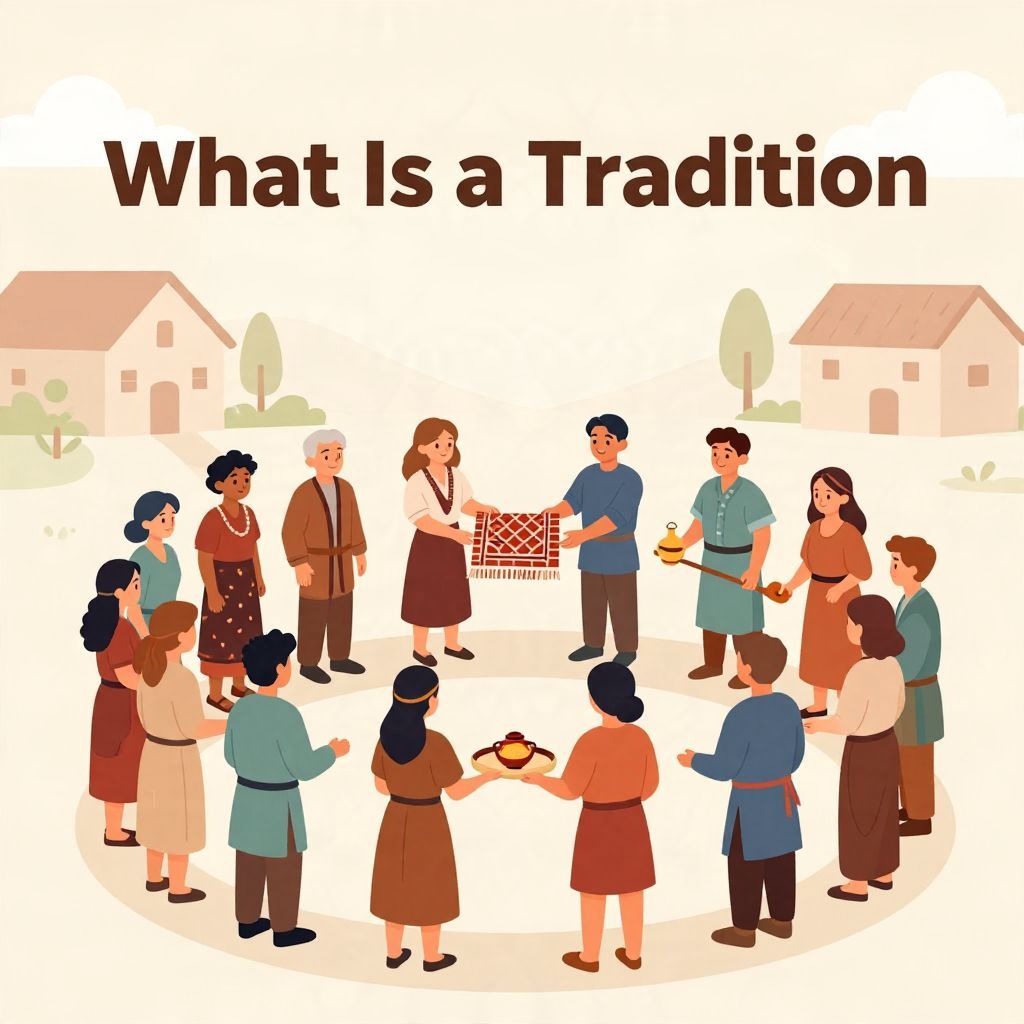
What is a tradition? In history, a tradition is a practice, belief, story, or custom passed from one generation to the next. Traditions can be religious, family-based, national, or local, and they often help communities preserve identity, memory, and social order.
Traditions are not fixed relics of the past. They change over time, sometimes slowly and sometimes dramatically, as people adapt older customs to new circumstances. That is why historians study traditions not only as inherited habits, but also as evidence of how societies remember, reinterpret, and reinvent themselves.
What Is A Tradition?
A tradition is a repeated cultural practice or belief handed down across generations. It may include rituals, holidays, songs, clothing, greetings, foodways, or stories. Historians see traditions as both continuity and change: they preserve the past, but they are often reshaped by religion, politics, migration, and everyday life.
Where Did Traditions Come From?
Traditions did not begin at one single moment in history. Human groups have always repeated useful or meaningful behaviors, especially in families, villages, and religious communities. Over time, some repeated practices became recognizable traditions because they were remembered, taught, and symbolically valued.
Early human societies and shared customs
In ancient societies, traditions helped people mark seasons, honor ancestors, explain the world, and organize communal life. Oral storytelling, burial customs, festivals, and rites of passage were especially important in societies without widespread writing. These practices created continuity between generations and reinforced group identity.
Written records and the preservation of tradition
Once writing developed in places such as Mesopotamia, Egypt, China, and the Mediterranean world, traditions could be recorded more formally. Laws, religious texts, genealogies, and ceremonial instructions helped preserve customs over longer periods. But even then, written tradition was not static; scribes, priests, and rulers often adapted it to new political or religious needs.
How Do Historians Understand Tradition?
Historians usually treat tradition as something inherited, but not necessarily unchanged. A tradition may be ancient in origin, yet the version people practice today may be much newer than they realize. In many cases, communities preserve the meaning of a tradition while altering its form, language, or setting.
Tradition as memory
Traditions often work as social memory. They tell people who they are, where they belong, and what their community values. This is why traditions can be powerful in times of crisis, migration, or political change: they offer a sense of stability and connection to the past.
Tradition as adaptation
Traditions also survive because they adapt. A festival may change its date, a religious ceremony may be translated into a new language, or a family custom may be simplified for modern life. Historians pay close attention to these changes because they reveal how people negotiate continuity and innovation.
Tradition in Ancient and Medieval History
In ancient and medieval societies, traditions played a central role in religion, governance, and daily life. They helped legitimize authority, define moral expectations, and create shared social rhythms. Many of the traditions still recognized today were shaped in these periods, even if their modern forms are different.
Religious traditions
Religious traditions are among the most durable in history. Ritual calendars, sacred narratives, pilgrimages, dietary rules, and ceremonial dress often developed over centuries. In Judaism, Christianity, Islam, Hinduism, Buddhism, and other faiths, traditions have linked believers to sacred history and to one another across generations.
Political and royal traditions
Rulers also used tradition to strengthen authority. Coronation rituals, court ceremonies, and symbols of office made power appear legitimate and continuous. In many kingdoms and empires, political traditions were carefully staged to show that the ruler stood within an inherited order rather than as a mere individual claimant to power.
Family and local customs
Not all traditions were grand or official. Family meals, naming patterns, wedding customs, mourning practices, and local festivals shaped ordinary life. These customs could vary widely from one region to another, even within the same kingdom or empire, creating a rich patchwork of local identities.
Why Do Traditions Matter?
Traditions matter because they help people make meaning out of time. They connect the present to the past, teach values, and create a sense of belonging. They can also support social cohesion by giving communities shared practices that are recognized and repeated.
Identity and belonging
For many people, traditions are a key part of identity. They may signal religion, ethnicity, nationality, region, or family background. A tradition can make a person feel part of something larger than themselves, especially when it is shared publicly through festivals, ceremonies, or commemorations.
Authority and legitimacy
Traditions can also support authority. Governments, churches, and community leaders often appeal to tradition to justify rules or customs. This does not mean tradition is always conservative, but it does mean that inherited practice can become a source of legitimacy in public life.
Continuity through change
When societies face war, migration, industrialization, or colonization, traditions often help people maintain continuity. At the same time, these pressures can transform traditions or create new ones. Historians therefore study tradition as a living process rather than a museum piece.
Are Traditions Always Ancient?
No. One of the most important historical facts about tradition is that many traditions are newer than they appear. Some customs that seem timeless were created, standardized, or revived in the modern era. This does not make them false; it simply means tradition is often a product of historical change.
Invented or revived traditions
Scholars sometimes use the phrase “invented tradition” to describe practices that are presented as old but were shaped recently for social or political purposes. This can happen when nations build symbols of identity, when institutions formalize ceremonies, or when communities revive older customs in new forms. The key point is that traditions can be consciously constructed as well as inherited.
Examples of changing customs
Holiday celebrations, national anthems, school rituals, and public commemorations often evolve over time. A tradition may begin as a local event, become standardized by the state or church, and later spread more widely through print, education, media, or migration. What appears ancient may actually be the result of relatively recent consolidation.
Tradition, Culture, and Custom: What Is the Difference?
These words overlap, but they are not identical. Culture is the broadest term: it includes language, beliefs, art, laws, and everyday behavior. A custom is a common practice in a particular group. A tradition is a custom or belief that has been passed down and given historical significance.
Simple distinctions
- Culture: the full way of life of a group.
- Custom: a usual or accepted practice.
- Tradition: a custom, belief, or story handed down over time.
In practice, people often use these words loosely. Historians, however, try to be precise because the differences matter when studying how societies remember and change.
How Traditions Spread Across Borders
Traditions do not stay in one place forever. Trade, conquest, migration, empire, and religion have all carried traditions across regions and continents. As traditions move, they are often translated into new languages and adapted to local conditions, producing hybrid forms.
Migration and diaspora
When communities move, they often preserve traditions to maintain a sense of home. Food, holidays, dress, and religious rituals can become especially important in diaspora communities. At the same time, these traditions may blend with local customs, creating new cultural forms.
Empire and exchange
Empires have historically been major channels for the movement of traditions. Administrative systems, religious practices, artistic styles, and court rituals often traveled along imperial routes. Yet empire also involved power imbalance, so traditions could be imposed, suppressed, or transformed under pressure.
Traditions in the Modern World
Modern life has not ended tradition. Instead, it has multiplied the ways traditions are preserved, adapted, and shared. Print culture, schools, mass media, tourism, and the internet have made traditions more visible, but also more open to reinterpretation.
National traditions
Modern states often promote national traditions to create unity among diverse populations. Public holidays, flags, anthems, memorial days, and civic ceremonies can become powerful symbols of national belonging. These traditions may feel timeless, but many were formalized in the nineteenth and twentieth centuries.
Family traditions today
Family traditions remain deeply meaningful in modern societies. Birthdays, holiday meals, storytelling, and annual gatherings can connect younger generations to older ones. Even when families are geographically dispersed, they often preserve traditions through travel, digital communication, and reunion rituals.
Globalization and change
Globalization has made traditions more visible across national boundaries. People now encounter unfamiliar customs through travel, media, and online platforms. This can encourage appreciation, but it can also lead to simplification or commercialization. Some traditions are celebrated widely, while others are debated over issues of authenticity, ownership, or cultural appropriation.
Key Facts About Tradition
- Tradition means a practice, belief, or story passed from one generation to another.
- Traditions can be religious, social, political, or family-based.
- They help communities preserve memory, identity, and continuity.
- Traditions change over time and are often adapted to new circumstances.
- Some traditions are ancient; others are relatively recent or revived.
- Historians study traditions as evidence of how societies remember and reinvent the past.
Conclusion: Why Tradition Still Matters
Tradition is one of history’s most enduring ideas because it links people to the past while still allowing change. It can preserve memory, strengthen identity, and give meaning to everyday life, but it can also be reshaped by new social realities. To understand tradition is to understand how societies carry history forward.
If you want to explore related ideas, see what a cultural script is and how cultural divergence develops.