
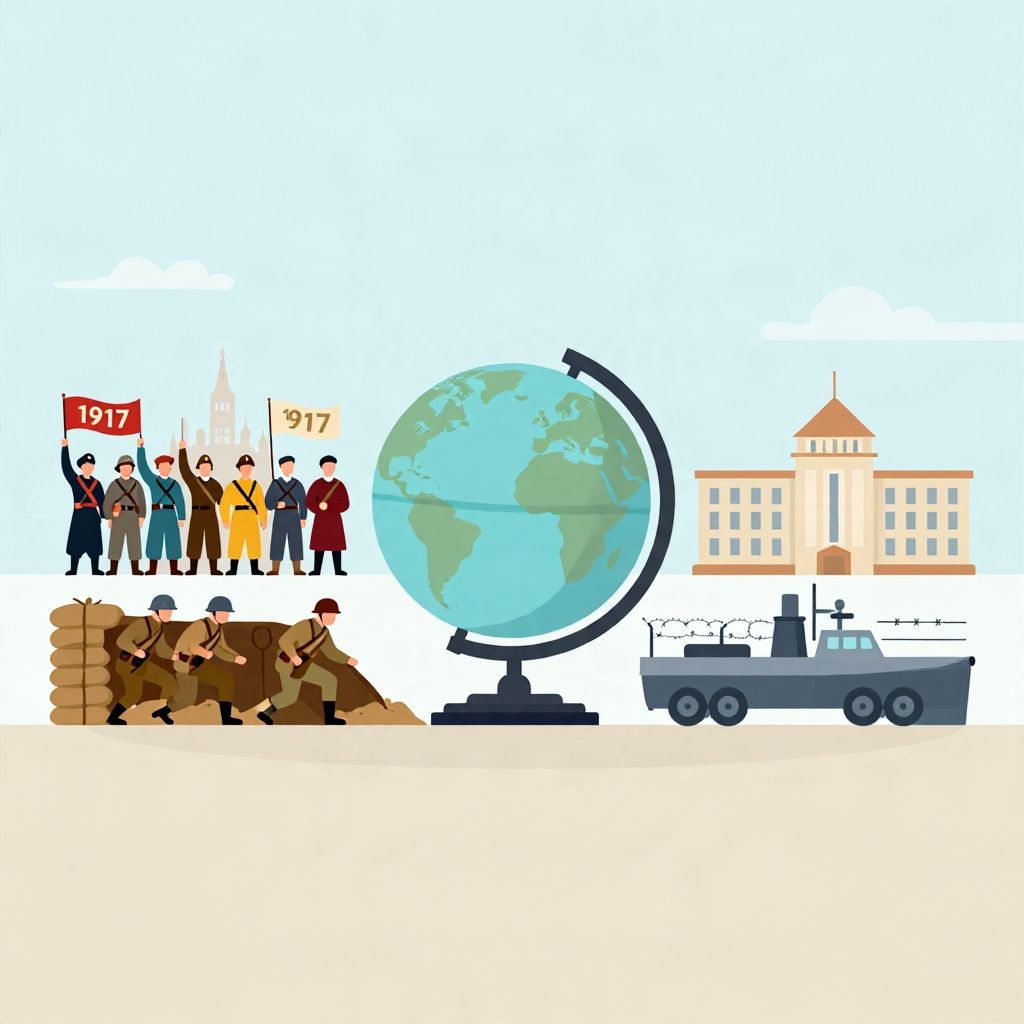
What happened in 1917? It was one of the most consequential years of the 20th century, shaped above all by World War I, revolution in Russia, and major political and social change across the world. The year did not simply add another chapter to history; it helped redirect the course of the century.
In 1917, old empires cracked under the strain of war, new governments rose, and millions of people experienced hunger, violence, displacement, and political upheaval. The events of that year helped set the stage for the Russian Revolution, the entry of the United States into World War I, and the long aftermath of modern warfare and revolution.
What happened in 1917?
In 1917, the world was transformed by war and revolution. The most important developments were the United States entering World War I, the collapse of tsarist rule in Russia, the Bolshevik seizure of power later that year, and deepening instability in Europe, the Middle East, and colonial empires. The year marked a turning point from wartime crisis to a new global order.
1917 in context: a world under pressure
By 1917, World War I had already been raging for more than two years. The conflict had exhausted armies, economies, and civilian populations. Trench warfare on the Western Front, naval blockades, and mass conscription created shortages and suffering far beyond the battlefield. Governments faced rising unrest at home as people demanded food, peace, and political reform.
This pressure mattered because 1917 was not an isolated year of dramatic events. It was the year when the strains of total war became unbearable in several places at once, exposing the weakness of old political systems and opening the door to revolution and realignment.
Major events of 1917
The United States enters World War I
On April 6, 1917, the United States declared war on Germany and entered World War I. President Woodrow Wilson had tried to keep the country neutral, but German unrestricted submarine warfare and the Zimmermann Telegram helped push public opinion toward intervention. The American entry gave the Allies a major economic and military boost, though U.S. forces would take time to arrive in large numbers.
The decision changed the balance of the war. It also marked a shift in American foreign policy, as the United States moved from relative isolation toward a more active role in world affairs.
The Russian Revolution begins
Russia experienced two revolutions in 1917. The first, often called the February Revolution because Russia still used the Julian calendar, began in March by the modern calendar. Strikes, bread shortages, and protests in Petrograd led to the collapse of Tsar Nicholas II’s rule. He abdicated, ending centuries of Romanov autocracy.
A Provisional Government took power, but it faced immediate problems: the war continued, land reform was delayed, and authority was divided with the soviets, or councils of workers and soldiers. This unstable dual power arrangement made it difficult to govern effectively.
The Bolsheviks seize power
In November 1917 by the Gregorian calendar, the Bolsheviks, led by Vladimir Lenin, overthrew the Provisional Government in the October Revolution. The Bolsheviks promised “peace, land, and bread,” appealing to war-weary soldiers, peasants, and urban workers. Their seizure of power led to the creation of a communist government and eventually the Russian Civil War.
This was one of the most important political turning points of the century. The Bolshevik Revolution inspired communist movements around the world and alarmed governments that feared similar uprisings at home.
War expands beyond Europe
1917 also brought major developments in the wider war. In the Middle East, British forces advanced against the Ottoman Empire, and the Balfour Declaration of November 1917 expressed British support for a “national home for the Jewish people” in Palestine, while also raising long-term political tensions in the region. In Africa and Asia, colonial troops and resources continued to be drawn into the war effort.
These events mattered because World War I was not only a European war. It reshaped imperial politics, intensified nationalist movements, and helped redraw borders and expectations in several regions.
Social unrest and hardship across Europe
Food shortages, inflation, labor strikes, and war fatigue spread across much of Europe in 1917. Civilians faced rationing and hardship, while soldiers endured brutal conditions at the front. In some countries, governments tightened control; in others, unrest grew into open political crisis. The year revealed how deeply modern war affected entire societies, not just armies.
A timeline of key events in 1917
- January 1917: Germany resumes unrestricted submarine warfare.
- March 1917: The Russian Tsar Nicholas II abdicates after the February Revolution.
- April 6, 1917: The United States declares war on Germany.
- Summer 1917: Fighting continues on the Western Front; unrest grows in Russia.
- November 1917: The Bolsheviks seize power in Petrograd.
- Late 1917: The new Soviet government begins seeking peace and consolidating rule.
Why 1917 mattered so much
1917 mattered because it changed the direction of the war and the political future of several major powers. The United States’ entry helped ensure that Germany would face overwhelming Allied strength. Russia’s revolutions removed one of the largest empires from the war and replaced it with a radical new state that would shape global politics for decades.
It was also a year when the idea of government itself seemed in flux. Monarchies, empires, and liberal ministries all faced crisis. In their place came new claims about democracy, nationalism, socialism, and self-determination. Some of those ideas would inspire reform; others would fuel conflict.
The aftermath of 1917
World War I moves toward its end
The events of 1917 did not end World War I immediately, but they made its outcome increasingly clear. American manpower and resources would strengthen the Allies in 1918. Meanwhile, Russia’s withdrawal from the war after the Bolshevik takeover allowed Germany to shift troops westward temporarily, even though it could not achieve final victory.
The war ended in November 1918, but 1917 had already set the decisive conditions for that outcome.
The Russian Civil War and the Soviet state
After the Bolshevik Revolution, Russia descended into civil war between the Red Army, anti-Bolshevik forces, and other regional and political groups. The conflict was brutal and chaotic. Out of that struggle emerged the Soviet Union, officially founded in 1922. The revolution of 1917 therefore became the starting point of a new political system that would dominate Russian and Soviet history for most of the 20th century.
A new international order begins to form
The upheavals of 1917 helped undermine the old European imperial order. The collapse of the Russian Empire and the weakening of other empires encouraged nationalist movements and diplomatic rearrangements after the war. The peace settlements that followed were shaped by the year’s upheavals, even when they did not fully resolve the tensions that 1917 exposed.
How historians view 1917
Historians generally see 1917 as a watershed year, but they do not interpret it in exactly the same way. Some emphasize the Russian Revolution as the defining event, while others stress the broader wartime crisis that made revolution possible. Many also highlight 1917 as the year when modern mass politics, state power, and ideological conflict became even more visible and intense.
What is clear is that 1917 was not just a year of events; it was a year of transformation. War, revolution, and social breakdown combined to alter the political map of the world and the lives of millions of ordinary people.
In short, 1917 was the year when World War I reached a decisive stage, the Russian Empire fell, the Bolsheviks took power, and the modern world began to take a more recognizable shape. If you want to compare it with later turning points, you may also find what happened in 1924 and what happened in 1961 useful for understanding how the century continued to unfold.