
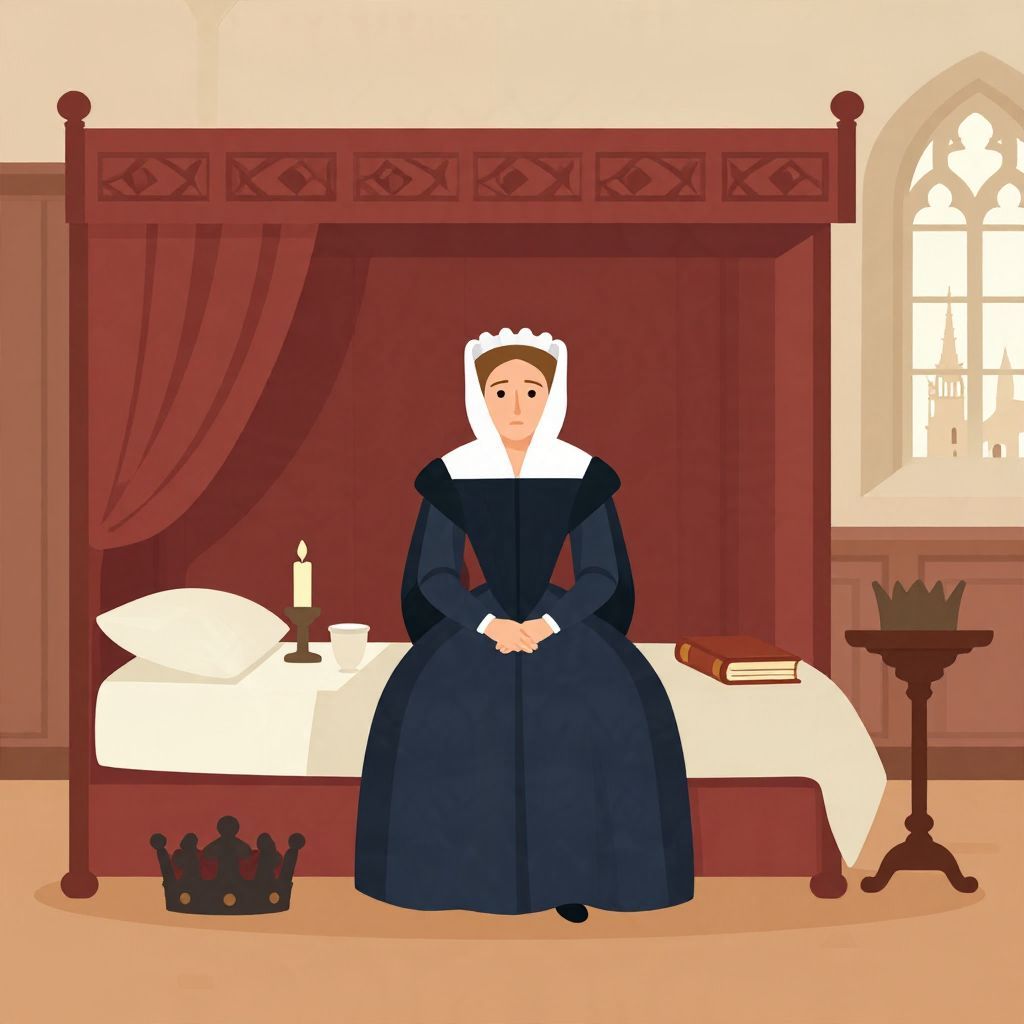
“Bloody Mary” was Mary I of England, and she died on 17 November 1558 after a short illness at St James’s Palace in London. The exact cause was not recorded in modern medical terms, but historians generally agree she likely died from a combination of illness and long-term health problems, possibly including a uterine or abdominal disorder. She was 42 years old and had no surviving child.
Her death ended the Catholic restoration in England and opened the way for her half-sister Elizabeth I, whose long reign would reshape the English church and state. That is why the question of how Mary died matters: it is not only a medical puzzle, but a turning point in Tudor history.
How did Bloody Mary die?
Bloody Mary died on 17 November 1558 at St James’s Palace, probably from illness complicated by chronic reproductive or abdominal disease. Contemporary sources do not give a modern diagnosis. She had been unwell for some time, and her final sickness came after years of declining health, repeated false pregnancies, and intense political strain.
What is known about Mary I’s final illness?
Mary I’s last months were marked by weakness, melancholy, and physical decline. By 1558 she was in poor health and increasingly unable to carry out public duties. Reports from the period suggest she suffered from swelling, pain, and a lingering illness that worsened in the autumn. She died at St James’s Palace, not in battle, not by execution, and not in a dramatic public crisis, but in bed after a period of deterioration.
Why historians avoid a single certain diagnosis
Sixteenth-century physicians did not diagnose illness the way modern medicine does. Records are incomplete, and symptoms were described in broad terms. As a result, historians can identify likely causes and patterns, but not prove one exact disease with certainty. Some scholars have suggested ovarian cancer, uterine cancer, or another gynecological disorder; others think she may have suffered from complications related to stress, fluid retention, or a chronic systemic illness. The evidence supports uncertainty.
The role of false pregnancies
Mary’s health was deeply affected by her repeated belief that she was pregnant. In 1554 and again in 1555, she appeared to show the signs of pregnancy, but no child was born. Modern historians usually interpret these episodes as false pregnancies or as illnesses mistaken for pregnancy. Either way, the disappointment was severe. Because Mary had no heir, every failed pregnancy intensified anxiety about the Tudor succession and likely worsened her emotional and physical condition.
Why was Mary I called “Bloody Mary”?
The nickname “Bloody Mary” comes from her persecution of Protestants during her reign, especially the burnings of more than 280 people for heresy between 1555 and 1558. The label was popularized by Protestant writers after her death and became a lasting part of her reputation. It is not a neutral contemporary title, but a hostile historical judgment.
Understanding her death therefore requires understanding her reign. Mary was the daughter of Henry VIII and Catherine of Aragon, and she came to the throne in 1553 after the collapse of the short reign of Lady Jane Grey. She was England’s first crowned queen regnant. Her goal was to restore Roman Catholicism after the Protestant reforms of her father and brother, Edward VI.
Religious conflict and political pressure
Mary’s reign was shaped by religious division. Her government reversed Protestant legislation, restored papal authority, and punished prominent Protestant leaders. This made her deeply unpopular with many later English writers, especially after Elizabeth I established Protestantism as the national settlement. The cruelty of the burnings overshadowed other parts of her rule, including administrative efforts and her marriage alliance with Philip of Spain.
Her political position was also fragile. She married Philip in 1554, hoping for a Catholic heir and stronger international support, but the marriage was unpopular in England. When no child arrived, the succession problem remained unresolved. By the time Mary died, many in England expected a change of regime.
What happened in the days before she died?
In the final weeks of 1558, Mary’s condition worsened. She was likely already weakened by a long illness and by the emotional burden of failing health, loss of authority, and uncertainty about the succession. Elizabeth, her Protestant half-sister, was the obvious heir, though Mary had once tried to limit or complicate that outcome.
Mary died at St James’s Palace on 17 November 1558. Her death was followed quickly by the accession of Elizabeth I, who was proclaimed queen soon afterward. The speed of the transition helped prevent major instability, though the religious settlement of England remained unsettled and would be contested for years.
Was Mary poisoned?
There is no solid evidence that Mary I was poisoned. Poison rumors often attached themselves to Tudor courts because succession politics were dangerous and mysterious deaths were common enough to inspire suspicion. In Mary’s case, however, the historical record does not support a poisoning theory. Her illness had been developing over time, which fits a natural death far better than an assassination.
How old was Bloody Mary when she died?
Mary I was 42 years old when she died. By the standards of the sixteenth century, that was not exceptionally old, but it was old enough for chronic illness to have taken a serious toll. Her relatively young age also made her death feel abrupt to contemporaries, especially because it came after years of uncertainty over whether she would produce an heir.
What were the immediate consequences of her death?
Mary’s death changed English history almost immediately. The crown passed to Elizabeth I, and with it came a major shift in religion and politics. Elizabeth restored Protestantism in a more moderate form than the earlier Edwardian reforms, creating the Elizabethan Religious Settlement.
The consequences of Mary’s death included:
- the end of the Marian Catholic restoration;
- the accession of Elizabeth I in November 1558;
- the re-establishment of Protestant worship in England;
- a lasting reshaping of how English history remembered Mary;
- the strengthening of the Tudor dynasty through Elizabeth’s long reign.
Mary’s failure to produce an heir mattered as much as her death itself. Had she left a living Catholic child, English religious history might have taken a very different path. Instead, her death removed the last major obstacle to Elizabeth’s rule.
How did Mary I’s death affect her reputation?
Mary’s death sealed a posthumous image that Protestant England was eager to promote. Because Elizabeth’s reign became associated with national stability, naval success, and Protestant identity, Mary was often cast as the failed, cruel predecessor. The label “Bloody Mary” became a shorthand for religious persecution and political failure.
Modern historians have tried to place her in a fuller context. Mary was not simply a villain; she was a determined monarch trying to reverse what she saw as dangerous religious error and to secure the succession of her realm. Her methods were harsh and left a grim legacy, but her life cannot be reduced to the nickname alone. Her death marked the end of her project, not the end of debate about her rule.
Why her death still matters
Mary I’s death matters because it marked a decisive break in English history. It ended the first serious attempt to restore Catholicism after Henry VIII’s break with Rome and cleared the path for the Elizabethan era. It also shows how dynastic politics, religion, and personal health could combine to shape the fate of a kingdom.
In that sense, asking how Bloody Mary died is really asking how one queen’s illness, childlessness, and political failure helped redirect the course of the English Reformation. Her death was quiet, but its consequences were enormous.
Mary I died of illness in 1558, probably after a long period of declining health and possible gynecological disease, at a moment when England was poised for another major religious transformation. If you want to explore the wider Tudor context, you may also be interested in the reign of Elizabeth I and Henry VIII and the English Reformation.