
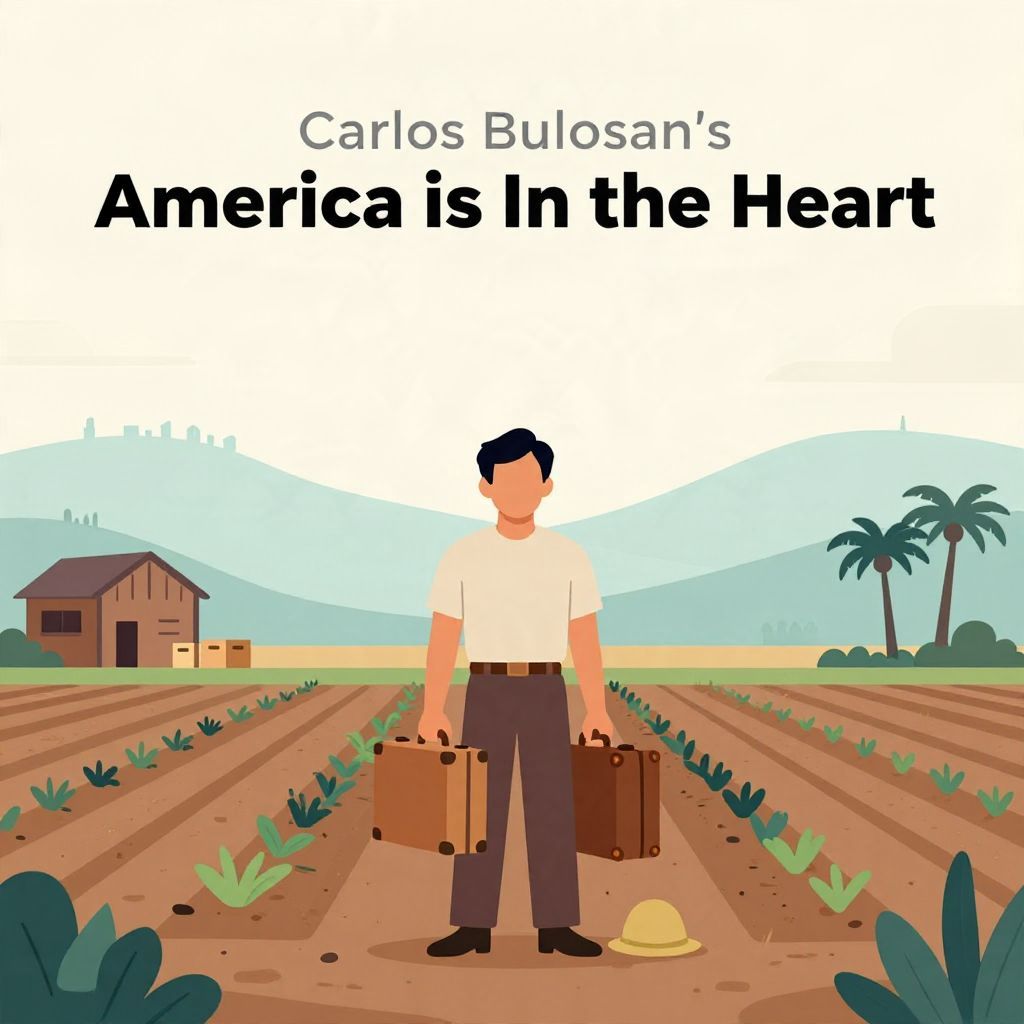
America Is in the Heart is best known as a landmark Filipino American memoir by Carlos Bulosan, first published in 1946. It tells the story of migration, labor exploitation, racism, and political awakening in the United States during the early 20th century. The book is both a personal narrative and a historical document of Filipino life in America.
For readers asking what the title means, the answer is both literal and symbolic: Bulosan wrote about his own life in the United States, but he also used his experience to speak for a larger immigrant and working-class struggle. The book remains one of the most important texts in Asian American literature.
What is America Is in the Heart?
America Is in the Heart is an autobiographical novel by Carlos Bulosan that traces his journey from the Philippines to the United States and his years of hardship as a migrant laborer. Published in 1946, it combines memoir, social protest, and literary reflection to show how race, class, and migration shaped Filipino American history.
Who was Carlos Bulosan?
Carlos Bulosan was a Filipino writer, labor activist, and migrant worker born in the Philippines in 1911. He came to the United States in 1930, part of a generation of Filipinos who migrated during the American colonial period in the Philippines and the labor demands of the U.S. West Coast.
Like many Filipino migrants of his era, Bulosan arrived with hopes of work and opportunity. Instead, he encountered low wages, unstable employment, and widespread discrimination. His writing later transformed those experiences into a powerful critique of American inequality.
Why Bulosan’s life mattered historically
Bulosan’s life reflected a broader pattern in 20th-century migration. Many Filipinos, especially young men, traveled to the continental United States to work in agriculture, canneries, hotels, and service jobs. They were legally allowed to enter because the Philippines was then an American territory, but they were often treated as outsiders in everyday life.
That contradiction lies at the center of Bulosan’s work: the United States promised freedom and democracy, yet many migrants experienced exclusion, violence, and exploitation.
What is the history behind the book?
America Is in the Heart grew out of the social and political world of the 1930s and 1940s. Bulosan wrote during the Great Depression, a time when migrant laborers in California and the Pacific Northwest faced job insecurity, anti-Asian racism, and harsh living conditions. His book also reflects the rise of labor organizing and left-wing politics among workers.
Although the memoir is based on Bulosan’s life, it is not a simple diary. Scholars generally read it as a literary autobiography shaped by memory, political purpose, and storytelling. Some scenes are difficult to verify in exact detail, but the larger historical setting is well established.
The Filipino migration context
Filipino migration to the United States increased after the U.S. acquired the Philippines following the Spanish-American War of 1898. Because Filipinos were colonial subjects, not immigrants from an independent nation, their legal status was unusual. They could travel more freely than many other Asian groups, but they still faced racial hostility and exclusion.
By the 1920s and 1930s, Filipino workers were concentrated in agricultural labor, fish canneries, and service jobs on the West Coast. They often lived in segregated housing and were vulnerable to wage theft, violence, and anti-miscegenation laws that restricted relationships across racial lines.
What does the title mean?
The title America Is in the Heart suggests that America is not just a place on a map. For Bulosan, it is an idea, a conflict, and a moral question. The phrase can be read in two ways: as a statement of belonging and as an indictment of a nation that failed to live up to its ideals.
Bulosan’s America is both cruel and hopeful. It includes exploitation, racism, labor struggle, and loneliness, but also friendship, solidarity, reading, and the possibility of justice. The title captures that tension.
Symbolic meaning in the memoir
- Belonging: Bulosan insists that Filipinos and other migrants are part of American history.
- Critique: He exposes the gap between democratic ideals and lived reality.
- Memory: The “heart” suggests emotion, identity, and survival rather than geography alone.
What happens in the book?
The memoir follows Bulosan from his childhood in the Philippines to his arrival in the United States and his years of labor and struggle. It describes his experiences in California and the Pacific Northwest, where he worked in farms, canneries, and other seasonal jobs. He also recounts periods of illness, homelessness, and police harassment.
Along the way, Bulosan discovers literature, political ideas, and the power of collective action. Reading becomes a way to imagine a more just world. The book ends not with easy triumph, but with a broader vision of solidarity across race and class lines.
Major themes in the memoir
- Migration and displacement — leaving home and struggling to find a place in a new country.
- Labor exploitation — the harsh realities of migrant work and economic inequality.
- Racism and exclusion — anti-Filipino prejudice and violence in the United States.
- Education and self-making — books, language, and political awareness as tools of survival.
- Solidarity — the possibility of alliances among workers and oppressed people.
Why was the book important in American history?
America Is in the Heart is important because it documents a neglected part of U.S. history: the experiences of Filipino migrants during the first half of the 20th century. It also helped establish Filipino American literature as a serious field of study and gave later generations a powerful account of race and labor in America.
The book is often taught alongside other works of immigrant and minority literature because it shows how national identity is shaped by people who are frequently left out of mainstream histories. It is not only a memoir; it is also a historical witness to the unequal realities of American expansion and labor capitalism.
Its place in Asian American literature
Bulosan’s memoir is widely regarded as a foundational text in Asian American writing. Before the rise of ethnic studies programs in the late 1960s and 1970s, many such stories were overlooked. The book helped later readers understand that Asian American history includes labor migration, colonialism, exclusion laws, and community resistance.
Its influence extends beyond literature. Historians, educators, and activists have used it to discuss the Filipino American experience, especially the struggles of farmworkers and the politics of belonging in the United States.
How accurate is America Is in the Heart?
The memoir is historically valuable, but readers should understand it as a literary autobiography rather than a strictly documentary record. Bulosan wrote from memory and shaped his life story to express broader truths about oppression and resilience. Some details may be compressed, dramatized, or difficult to confirm independently.
That does not make the book unreliable in a historical sense. Instead, it means the work should be read with care: as a personal testimony grounded in real historical conditions, even when its narrative form is artistic.
What historians generally agree on
- Bulosan was a Filipino migrant who lived and worked in the United States.
- Filipino workers in the early 20th century faced discrimination and exploitation.
- The Great Depression intensified competition for jobs and racial hostility.
- The memoir reflects real labor and racial conflicts of the period.
Why does the book still matter today?
The book remains relevant because it speaks to enduring questions about immigration, labor rights, identity, and who gets included in national history. Its message is not limited to one ethnic group or one era. It asks how a country defines itself when many of its workers are treated as disposable.
For modern readers, the memoir offers both historical knowledge and moral perspective. It reminds us that American history has always been shaped by migrants whose labor built communities, farms, railroads, and cities, even when their contributions were ignored.
Key historical facts about America Is in the Heart
- Author: Carlos Bulosan
- Publication date: 1946
- Genre: Autobiographical novel / memoir
- Historical setting: Filipino migration to the United States in the early 20th century
- Main themes: labor, racism, migration, identity, solidarity
- Historical significance: foundational work in Filipino American and Asian American literature
Conclusion
America Is in the Heart is more than a book title: it is a historical statement about belonging, suffering, and the unfinished promise of democracy. Carlos Bulosan turned his own life into a record of Filipino migration and American inequality, creating a work that still helps readers understand the human cost of exclusion and the power of solidarity. For related reading, you may also want to explore what cultural divergence means or visit the main history site for more historical topics.