
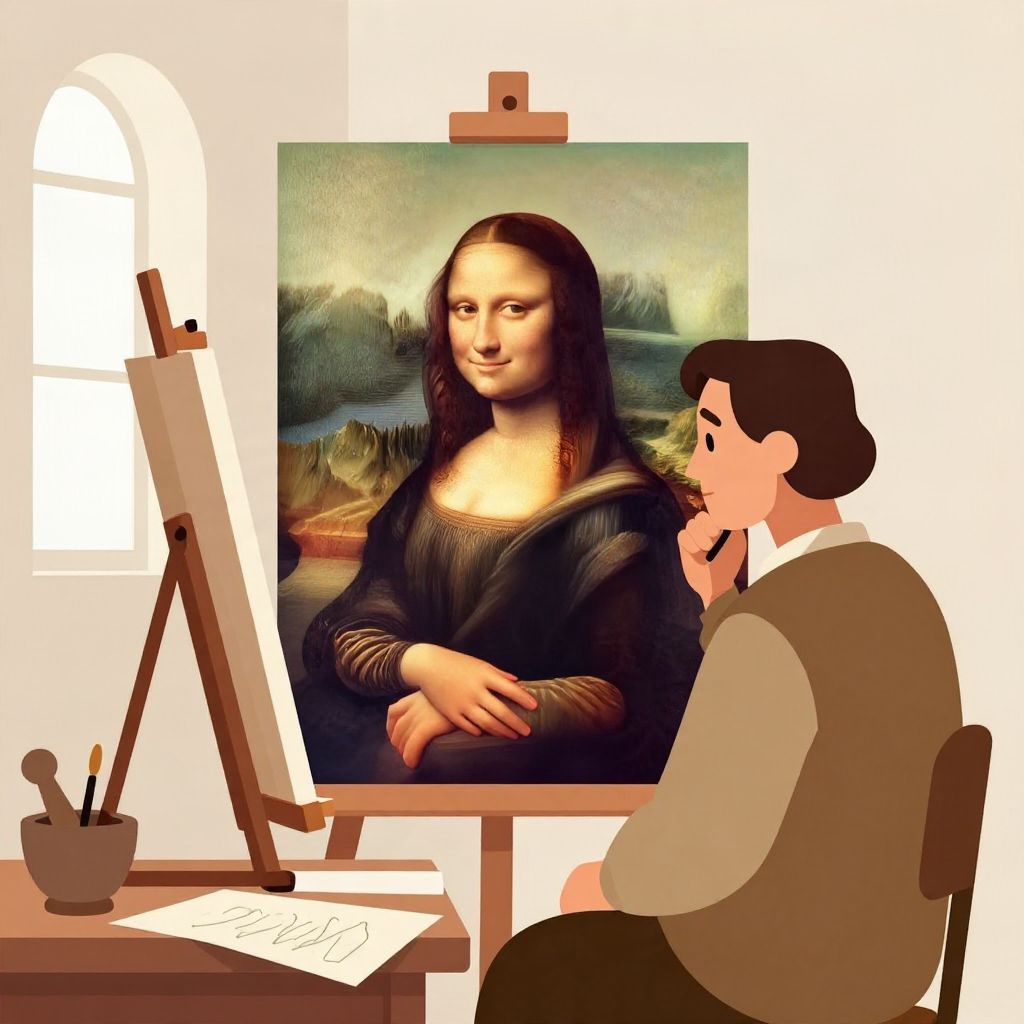
How did Leonardo da Vinci create a mood in the Mona Lisa? He did it by combining subtle technique with careful observation: soft transitions of light and shadow, a hazy landscape, a restrained pose, and an enigmatic expression that seems to shift as you look at it. The result is not a dramatic scene, but a quiet psychological presence.
Painted in the early 1500s, the portrait became famous because it feels alive without showing obvious action. Leonardo made mood itself part of the subject, turning a simple seated figure into one of the most discussed images in Western art.
How did Da Vinci create a mood in the Mona Lisa?
Leonardo created mood in the Mona Lisa through sfumato, gentle lighting, a balanced composition, and a landscape that feels both real and dreamlike. He avoided sharp outlines and theatrical gestures, which makes the woman seem calm, mysterious, and psychologically complex rather than formally posed.
The painting’s historical setting
The Mona Lisa was painted during the Italian High Renaissance, probably beginning around 1503 and continuing for several years. Leonardo da Vinci was working in Florence and later elsewhere in Italy during a period when artists were increasingly interested in nature, anatomy, perspective, and the inner life of their subjects.
Portraits in this era often showed status, wealth, and identity. Leonardo went further. Instead of presenting Lisa Gherardini, the woman commonly identified as the sitter, as a rigid symbol of rank, he made her appear thoughtful and self-contained. That shift is central to the painting’s mood.
The main techniques Leonardo used
Sfumato: soft edges and atmospheric shadow
The most famous element is sfumato, a painting technique that blends tones so smoothly that edges seem to dissolve into smoke or mist. Leonardo used this to soften the face, hands, and clothing. Because no line is abrupt, the viewer does not read the figure as fixed or hard-edged. Instead, the image feels living and changeable.
This soft modeling is especially important around the mouth and eyes. Small tonal shifts make the expression seem ambiguous. Depending on where you look, she may seem amused, reserved, or distant. That uncertainty is a major part of the mood.
Light and shadow that suggest inner life
Leonardo was deeply interested in how light reveals form. In the Mona Lisa, light falls gently across the face and hands, while shadows shape the cheeks and the folds of the dress. The effect is not dramatic contrast, as in later Baroque painting, but a quiet transition from brightness to darkness.
This restrained lighting gives the portrait a contemplative atmosphere. It suggests that the sitter is not performing for the viewer; she is simply present, thinking. That sense of inwardness was unusual and helped make the painting feel emotionally rich.
A pose that feels stable but not stiff
The sitter’s pose also helps create mood. She sits upright with her hands folded, but the body is turned slightly, and the head is angled toward the viewer. This creates balance without rigidity. Her posture communicates calm self-possession rather than social display.
Leonardo avoided busy accessories or elaborate storytelling. The plain arrangement keeps attention on the face and hands, which are the main carriers of expression. The simplicity is deliberate: it gives the portrait a quiet, meditative tone.
The landscape as emotional atmosphere
Behind the figure is a strange, winding landscape with distant roads, water, and mountains. It is not a precise real place, and its scale seems unstable. The horizon lines do not match perfectly on both sides, which adds to the dreamlike feeling.
The background matters because it expands the mood beyond the sitter. The landscape is not just scenery; it creates a sense of vastness, solitude, and mystery. The woman appears connected to a world that is both natural and slightly unreal, which deepens the portrait’s emotional effect.
An expression that resists easy reading
Perhaps the most discussed feature of the painting is the smile. It is subtle enough to be uncertain, and Leonardo’s soft technique makes it difficult to pin down. The mouth appears to change as the viewer shifts position, and the eyes seem to follow the viewer in a similarly elusive way.
That ambiguity is not accidental. Leonardo was interested in the mechanics of perception, and he understood that a face can seem different depending on angle, light, and attention. The mood of the Mona Lisa comes partly from this instability: she is present, but not fully knowable.
Why the painting feels so different from earlier portraits
Earlier Renaissance portraits often emphasized profile views, clear identity, and social rank. Leonardo’s portrait breaks from that tradition by presenting a three-quarter view and focusing on psychological atmosphere. Rather than asking the viewer to admire costume or lineage, it invites prolonged looking.
That was a major artistic innovation. Leonardo made the portrait less about outward appearance and more about inward presence. The mood is therefore not decorative; it is the subject itself.
What scholars think the mood means
Art historians generally agree that Leonardo’s methods produce a mood of calm mystery, but they do not all interpret that mood in the same way. Some emphasize the sitter’s dignity and composure. Others focus on the painting’s ambiguity and the viewer’s uncertainty. Both readings are supported by the work itself.
It is important not to overstate what can be proven. We know Leonardo used specific visual techniques. We cannot know with certainty exactly what emotional response he intended in every detail, or whether the sitter herself approved of the final effect. What we can say is that the painting was designed to hold attention through subtlety rather than spectacle.
Why Leonardo’s method mattered
Leonardo’s approach mattered because it helped redefine portrait painting in Europe. By showing that mood, personality, and atmosphere could be conveyed through composition and technique, he influenced later artists who wanted to paint more than a likeness.
The Mona Lisa also became famous because it rewards repeated viewing. The expression never settles into one meaning, and the painting seems to change with the viewer’s distance, mood, and angle. That interactive quality is one reason it has remained so compelling for centuries.
How the painting’s mood shaped its legacy
Over time, the Mona Lisa became one of the most recognized artworks in the world, partly because its mood is so hard to exhaust. Reproductions, theft in 1911, and endless commentary helped turn it into a cultural icon, but its lasting power begins with Leonardo’s original visual choices.
The painting’s quietness is what makes it unforgettable. It does not announce itself loudly. Instead, it draws viewers into a space of uncertainty, intimacy, and reflection. That is why the mood feels modern even though the work was created more than five centuries ago.
In short: how Da Vinci created the mood
Leonardo da Vinci created the mood in the Mona Lisa by blending soft shadows, subtle facial expression, calm posture, and a mysterious landscape into a unified whole. The painting feels alive because it avoids sharp definition and easy explanation. Its emotional power comes from restraint, not drama.
That is why the Mona Lisa remains so influential: it shows how painting can suggest a mind, not just a body. For more on Leonardo’s world and artistic breakthroughs, see related history articles on the Renaissance and Leonardo da Vinci’s life and work.