
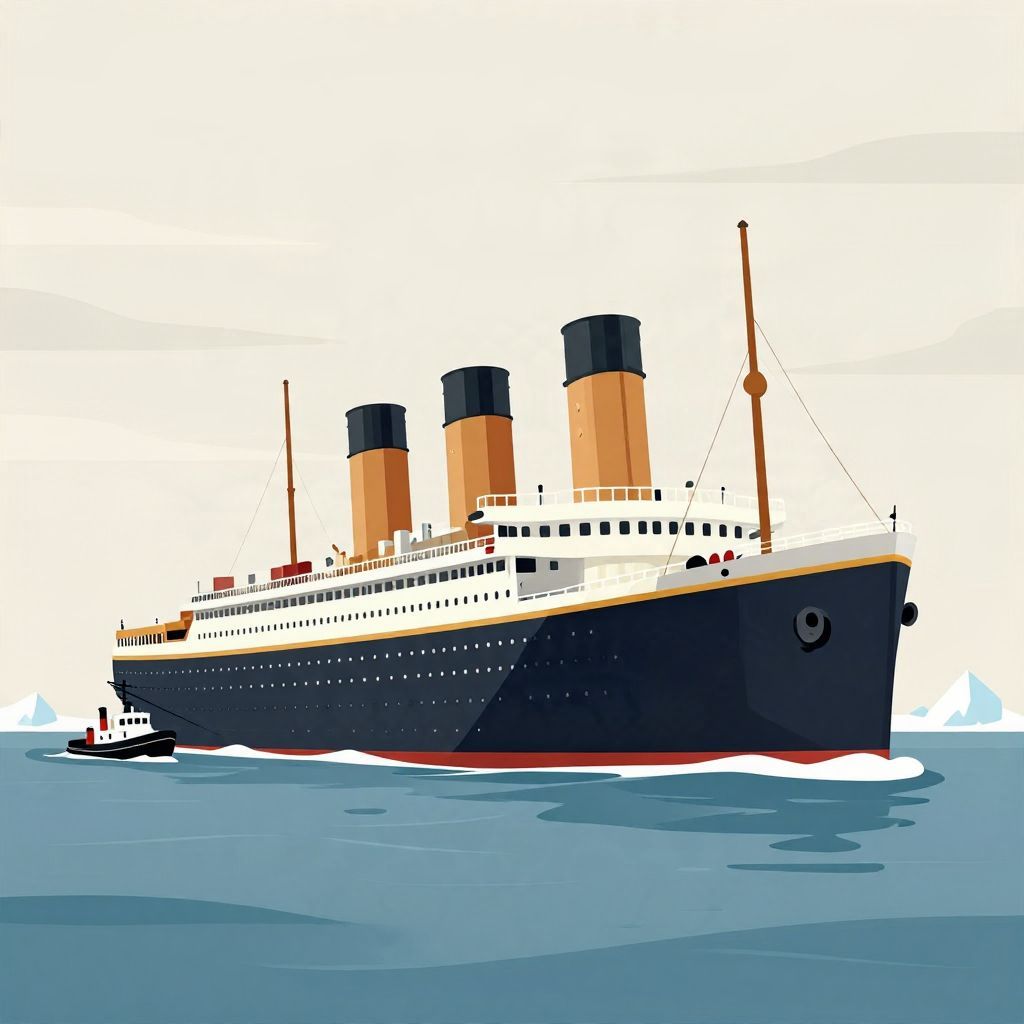
The Titanic is usually remembered for its length, luxury, and tragic sinking, but many people also ask a simpler question: how tall was the Titanic? The answer depends on what “tall” means for a ship, because ocean liners were measured by height from the keel to the top of the funnels, not like a building. Still, we can give a clear historical answer using the ship’s known dimensions.
At the time of her launch in 1911, RMS Titanic stood about 175 feet 6 inches tall from the bottom of the keel to the top of her funnels, with the funnels themselves rising roughly 64 feet above the boat deck. That made her an immense vessel for her era, though her most famous measurement was actually her length: 882 feet 9 inches.
How tall was the Titanic?
The Titanic was about 175 feet 6 inches from keel to the top of her funnels. In everyday terms, that is roughly the height of a 16-story building, though ship measurements do not map perfectly onto buildings because much of the ship sat below the waterline and much of her height came from funnels, masts, and deck structures.
What “height” means on a ship
When historians and naval architects describe a ship’s height, they usually mean the vertical distance from the keel, the ship’s lowest structural backbone, to the highest fixed point above the hull. For Titanic, that highest fixed point was one of her four funnels. This is different from “draft,” which measures how deep the ship sits in the water.
Why ship height can be confusing
People often picture a ship as if it were a standing object like a tower. In reality, a large liner’s visible height above the sea was only part of the story. Titanic’s hull plunged far below the surface, and her upper decks, funnels, masts, and bridge gave her a towering profile. So the answer changes depending on whether you mean total structural height, visible height above water, or funnel height alone.
Titanic’s main dimensions at a glance
To understand how tall the ship was, it helps to place that measurement alongside her other dimensions. Titanic was designed to be one of the largest passenger ships in the world, and her scale was part of what made her so impressive in the early 20th century.
- Length: 882 feet 9 inches
- Beam (width): 92 feet 6 inches
- Height from keel to funnel tops: about 175 feet 6 inches
- Funnels: 4 total, though the fourth was partly for ventilation and appearance
- Decks: multiple passenger and working decks stacked above the hull
Why Titanic looked so tall and imposing
Titanic’s height was not just a technical detail. It was part of the ship’s image as a modern marvel. Built by Harland and Wolff in Belfast for the White Star Line, Titanic was designed to project safety, luxury, and power. Her towering funnels, long rows of portholes, and many decks made her seem almost like a floating city.
The funnels were a major part of the silhouette
Titanic had four funnels, and they were among the most recognizable features of the ship. The first three were functional, carrying smoke and exhaust from the boilers. The fourth was mainly for ventilation and to improve the ship’s appearance. Because the funnels rose so high above the deck, they strongly influenced how tall the Titanic seemed from shore or from another vessel.
The superstructure added to the ship’s height
Above the main hull sat the superstructure, which included passenger decks, the bridge, boat deck, and promenade areas. This upper section gave Titanic a layered profile. Even though the hull itself was massive, the stacked decks and elevated structures made the liner appear taller than many earlier ships.
How Titanic’s height compared with other ships of her era
In 1912, Titanic was not the tallest ship ever built, but she was among the largest and most impressive. Her height was part of a broader competition among transatlantic liners, where shipping companies tried to outdo one another in size, speed, comfort, and prestige.
Compared with many earlier ocean liners, Titanic was enormous in every dimension. Her height of about 175 feet 6 inches placed her well above the scale of most merchant ships of the late 19th century. What made her remarkable was not only that she was tall, but that she combined that height with unprecedented length, luxury, and engineering ambition.
Height versus tonnage
Modern readers sometimes assume that the “biggest” ship must also be the tallest. But ships are usually judged by tonnage, displacement, length, and passenger capacity rather than height alone. Titanic’s gross tonnage was about 46,000 tons, a far more important measure of her size than her vertical measurement. Her height mattered visually and structurally, but it was not the main way shipbuilders compared vessels.
How much of Titanic was above the water?
Only part of Titanic’s total height was visible above the sea. Her draft was about 34 feet 7 inches, meaning that a substantial portion of the hull sat below the waterline. The visible part of the ship included the upper hull, decks, bridge, and funnels, which gave her the dramatic appearance people associated with the “unsinkable” liner.
This distinction matters because a ship’s “height” on paper can be misleading. Titanic was not 175 feet tall above the ocean. That figure includes the submerged part of the hull. The visible height above water was much less, though still striking enough to make the liner seem gigantic in ports and harbors.
Did Titanic’s height affect the sinking?
Titanic’s height did not cause the disaster, but her size and structure did influence how the ship behaved after striking the iceberg on the night of 14–15 April 1912. The ship’s internal compartments were designed to improve safety, yet the damage extended across several watertight sections. Once water entered too many compartments, the ship’s balance changed and the bow sank deeper.
The ship’s angle increased as the bow went down
As Titanic settled by the bow, the stern rose higher and higher out of the water. In the final minutes before the ship broke apart, the vessel’s vertical angle became extreme. At that point, the ship’s enormous height became part of the visual drama of the sinking, as the stern lifted into the air before the hull failed under the stress.
Why the funnels mattered during the sinking
The funnels were not just decorative. As the ship listed and tilted, they became vulnerable to structural stress. One funnel collapsed during the sinking, and the others were lost as the ship broke apart and descended. Their height and placement made them prominent features during the disaster, both in eyewitness memory and in later depictions.
What happened to Titanic’s height after the wreck?
After Titanic sank, her height as a ship ceased to matter in the ordinary sense, but the wreck itself became a subject of exploration and study. The ship now lies on the seabed in two main sections, with debris scattered around them. The wreck is no longer a single tall structure; instead, it is a collapsed archaeological site resting nearly 12,500 feet below the surface.
Over time, corrosion, pressure, and biological activity have continued to alter the wreck. The once-towering liner has become a fragile historical site. What survives today is not the full vertical presence of the ship, but the evidence of how massive and ambitious she once was.
Why people still ask how tall the Titanic was
The question remains popular because Titanic’s scale is hard to imagine from photographs alone. Her length gets the most attention, but height helps explain the ship’s visual impact. A vessel that rose more than 175 feet from keel to funnel top was extraordinary for the early 1900s, and that vertical scale contributed to the sense that Titanic represented the peak of modern engineering.
It also helps explain why the ship became such a lasting symbol. Titanic was not merely a passenger liner; she was a statement of industrial confidence. Her size, including her height, reflected the era’s belief that engineering could conquer distance, weather, and even the Atlantic itself.
Quick answer: how tall was the Titanic?
Titanic was about 175 feet 6 inches tall from the keel to the top of her funnels. If you mean only the visible part above the water, the height was much less. In historical terms, though, that full measurement best captures the ship’s true scale and the reason she seemed so immense in 1912.
Titanic’s height was only one part of her story, but it helps explain why she inspired awe before the disaster and fascination ever since. For readers interested in the ship’s final moments and structural failure, see also how the Titanic broke in half.