
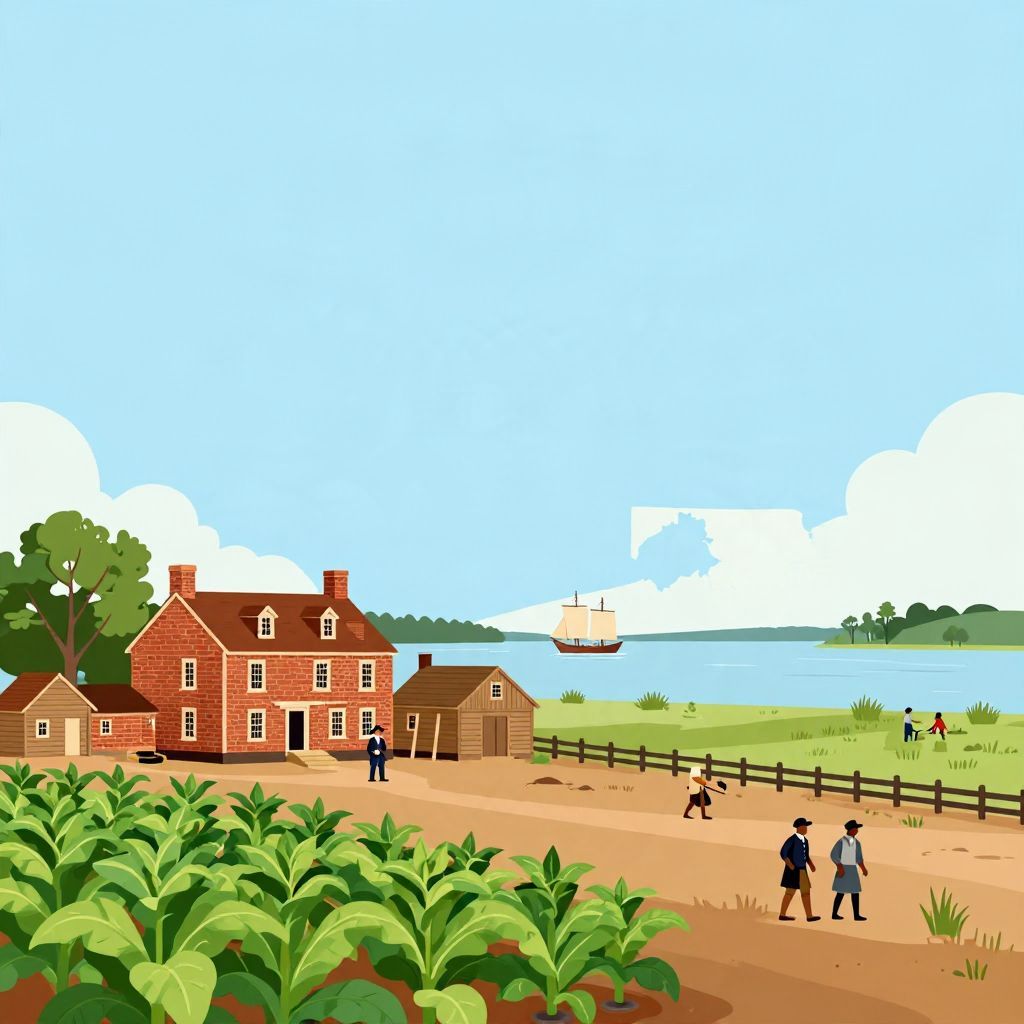
Was Maryland a Southern colony? The short answer is yes—Maryland is usually classified as one of the Southern Colonies in British North America. But that label can be misleading if taken too literally, because Maryland also had strong ties to the Chesapeake region and shared features with both the Middle Colonies and the broader Atlantic world.
To understand why historians place Maryland in the South, it helps to look at when the colony was founded, how its economy developed, and how slavery, religion, and plantation agriculture shaped its society over time.
Is Maryland a Southern Colony?
Yes. In the standard colonial classification used in U.S. history, Maryland was one of the Southern Colonies. Founded in 1634 as a proprietary colony under the Calvert family, it developed a plantation economy centered on tobacco, relied heavily on enslaved labor, and shared many social and political traits with Virginia and the rest of the Chesapeake South.
Why Maryland Is Usually Counted as a Southern Colony
Geography and regional patterns
Maryland sat in the Chesapeake region, between Virginia to the south and Pennsylvania to the north. That location mattered, but geography alone did not determine its colonial identity. Over time, Maryland’s climate, waterways, and fertile coastal plain encouraged tobacco farming, which tied the colony economically and socially to the plantation South.
The tobacco economy
Tobacco became Maryland’s most important export in the seventeenth century. Like Virginia, Maryland depended on large plantations rather than compact towns or diversified farming. This created a hierarchy of wealthy landowners, small farmers, indentured servants, and, increasingly, enslaved Africans. That labor system is one of the main reasons historians classify Maryland as southern.
Slavery and plantation society
By the late seventeenth and early eighteenth centuries, slavery had become central to Maryland’s economy. The colony’s reliance on enslaved labor, especially on tobacco plantations, aligned it with the social structure of the southern colonies. While slavery existed throughout British North America, it became especially defining in Maryland, Virginia, the Carolinas, and Georgia.
Maryland’s Founding and Early Colonial Identity
A proprietary colony with a religious purpose
Maryland was founded in 1634 under a charter granted to Cecilius Calvert, the second Lord Baltimore. The colony was intended partly as a refuge for English Catholics, though Catholics never became the majority. This religious mission makes Maryland somewhat distinctive, especially compared with colonies founded primarily for commerce or Puritan settlement.
Religious pluralism, not a purely southern stereotype
Maryland’s early history included efforts at toleration, most famously the Act Concerning Religion of 1649, which aimed to protect Christians from persecution. That policy was limited by modern standards, but it was notable in its time. This religious diversity sometimes makes Maryland seem less “southern” than Virginia or South Carolina, yet its economy and labor system still tied it to the South.
How Maryland Compared with Other Colonial Regions
Compared with the Chesapeake South
Maryland shared the most with Virginia. Both colonies were shaped by tobacco, dispersed plantations, a landed elite, and the growth of slavery. Both also had relatively weak urban development in the colonial period. Because of these similarities, Maryland is often grouped with Virginia as part of the Chesapeake colonies, which are usually considered southern.
Compared with the Middle Colonies
Maryland also had some features that resembled the Middle Colonies, especially in its religious diversity and its position as a borderland. Later, parts of Maryland’s economy included grain farming, trade, and port activity around Baltimore. Still, the colony’s early and defining pattern was southern rather than middle-colony in character.
Why the borders are not always neat
Colonial regions were historical categories, not fixed natural divisions. Maryland sat at a crossroads, and its identity changed over time. A colony can share traits with more than one region. Even so, when historians ask whether Maryland was a southern colony, the answer is generally yes because its core colonial development followed the southern plantation model.
Key Features That Made Maryland Southern
- Founded in 1634 as an English proprietary colony.
- Economy based on tobacco, especially in the seventeenth century.
- Large plantations rather than dense towns dominated settlement patterns.
- Heavy use of enslaved labor, especially after the late seventeenth century.
- Social hierarchy led by wealthy planters and landowners.
- Chesapeake location linked it closely to Virginia and the southern plantation world.
Maryland in the Colonial South: A More Detailed Look
From indentured servitude to racial slavery
In Maryland’s early decades, many laborers were indentured servants from England and Ireland. Over time, however, plantation owners increasingly turned to enslaved Africans. This shift was part of a wider transformation in English America, but in Maryland it became especially important because tobacco production demanded a large, controlled labor force.
Politics and power
Maryland’s political life also reflected plantation society. Wealthy landowners held disproportionate influence in colonial government. Like other southern colonies, Maryland developed a political order in which elite planters shaped laws, controlled land, and dominated local institutions. This was not identical to Virginia, but it was similar enough to fit the southern pattern.
Ports, trade, and change
Maryland was not frozen in one economic form. Baltimore grew into an important port, and commerce expanded over time. These developments made the colony more complex than a simple plantation stereotype. Still, the colonial period as a whole was shaped most strongly by tobacco and slavery, not by manufacturing or urban trade.
Why Some People Question the Label
Maryland was a border colony
Because Maryland lay between North and South, people sometimes hesitate to call it southern. Its location near Pennsylvania and the Delaware Valley gave it access to different cultural and commercial influences. Later American history, especially during the Civil War, also made Maryland’s identity more complicated because it was a slave state that did not secede.
Later history should not be confused with colonial history
It is important not to project nineteenth-century politics backward too simply. Maryland’s role in the Civil War does not determine its colonial classification. In the colonial era, the state’s defining characteristics were tobacco, plantation agriculture, and slavery, which place it firmly in the southern colonial world.
Different historians use categories differently
Some historians emphasize regional overlap and prefer to describe Maryland as a Chesapeake colony rather than only a southern one. That is a useful refinement. But in the standard three-region framework—New England, Middle, and Southern Colonies—Maryland belongs in the South.
Simple Chronology of Maryland’s Colonial Development
- 1634 — English settlers arrive and establish Maryland under the Calvert family.
- 1649 — The colony passes a religious toleration law for Christians.
- Late 1600s — Tobacco expands as the main export, and slavery becomes increasingly important.
- Early 1700s — Plantation society deepens, with elite planters dominating land and politics.
- Colonial period overall — Maryland develops as part of the southern Chesapeake plantation system.
What Maryland’s Classification Means Today
Calling Maryland a southern colony helps explain its economy, labor system, and social structure in the colonial era. It also shows why the colony shared so much with Virginia and the broader plantation South. At the same time, Maryland’s Catholic origins, religious diversity, and borderland position make it more historically interesting than a simple label suggests.
So, is Maryland a southern colony? Yes—historically, it is best understood as one of the Southern Colonies, especially because of tobacco cultivation, plantation life, and slavery. But it was also a colony with distinctive religious and regional features, which is why it often appears at the boundary between colonial categories. For related context, you may also want to read about the Stono Rebellion and the Commercial Revolution.