
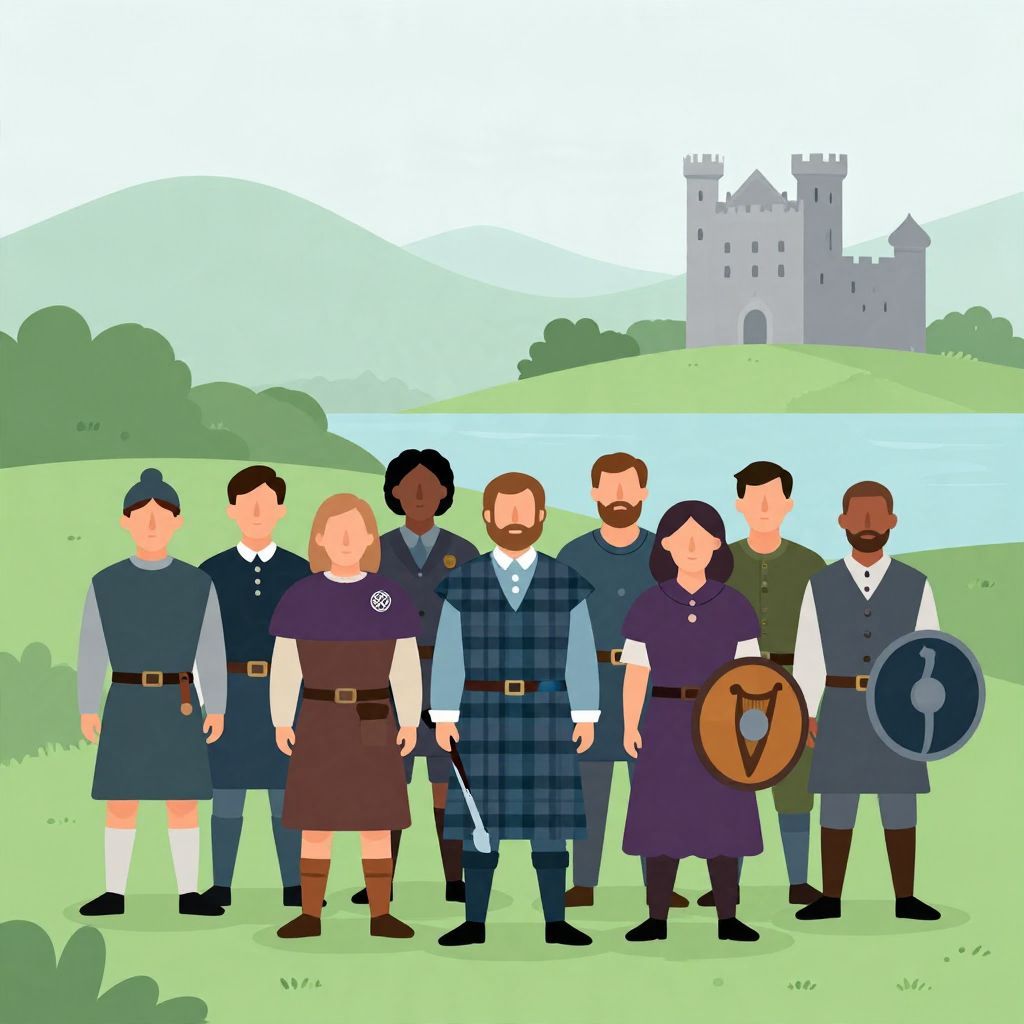
What do Scottish people look like? The short answer is that there is no single “Scottish look.” Scotland has always been a place of migration, intermarriage, and regional variation, so Scottish people have a wide range of hair colors, eye colors, skin tones, and facial features.
Historically, any attempt to define one typical appearance says as much about stereotypes as it does about Scotland itself. The country’s population has been shaped by ancient Celtic and Norse influences, later British and European movement, and modern global migration, making physical appearance diverse rather than uniform.
What Do Scottish People Look Like?
Scottish people do not share one fixed appearance. Some have fair skin, light eyes, and red or brown hair, while others have darker hair, olive or brown complexions, or features common across the British Isles and northern Europe. Regional history, family ancestry, and individual variation matter far more than any single “Scottish type.”
Why There Is No Single Scottish Appearance
Scotland has never been genetically or culturally isolated. Over centuries, its people came from multiple sources: ancient hunter-gatherers, Celtic-speaking communities, Norse settlers, Anglo-Saxons, Normans, Irish migrants, and later arrivals from across Europe and beyond. That long history produced diversity, not uniformity.
Ancient settlement and early mixing
The earliest inhabitants of what is now Scotland lived thousands of years before written records. Later, Iron Age and early medieval populations mixed through trade, warfare, marriage, and movement across the North Sea and Irish Sea. Because of that, modern Scottish appearance reflects layered ancestry rather than one origin.
Regional differences within Scotland
Appearance has also varied by region. The Highlands, Lowlands, islands, and border areas all experienced different historical connections. For example, the Northern Isles had strong Norse influence, while the southwest had long-standing links with Ireland and northern England. These patterns helped shape local family lines and visible traits over time.
Common Features People Often Associate with Scots
When people ask what Scottish people look like, they are often thinking of traits that are statistically common in parts of Scotland, not universal. Fair skin, freckles, red or light brown hair, and blue or green eyes are often associated with Scotland, but many Scots do not have these features.
Hair color
Red hair is one of the best-known stereotypes linked to Scotland. Scotland does have one of the higher proportions of red-haired people in Europe, but red hair is still a minority trait. Brown and dark hair are also very common, and many Scottish families have mixed hair colors across generations.
Eye color
Blue and green eyes are often mentioned in descriptions of Scottish appearance, especially in older popular writing. In reality, eye color in Scotland varies widely, with brown eyes also present in many families. Like hair color, eye color is shaped by inherited variation rather than national identity alone.
Skin tone and freckles
Fair skin and freckles are frequently associated with Scotland, partly because of northern European ancestry and the climate-related visibility of these traits. But Scottish people can have a broad range of skin tones. Historical movement, marriage patterns, and modern immigration have all added to that diversity.
How History Shaped Scottish Physical Diversity
Scotland’s appearance cannot be separated from its history. The island’s position on the edge of the Atlantic world made it a crossroads rather than a closed community. Over time, invasions, settlements, trade, and labor migration all influenced the population and the way Scots looked.
Celtic, Roman, and early medieval Scotland
In Roman times, Scotland was home to several peoples, including the Picts, Gaels, and others whose identities were shaped by language and politics more than modern race categories. The spread of Gaelic culture from Ireland and the growth of early kingdoms such as Alba helped create new identities through both conquest and assimilation.
Norse influence in the north and west
From the late 8th century onward, Norse settlers and raiders left a deep mark on parts of Scotland, especially the Northern Isles, the Hebrides, and coastal areas. This did not create a separate “Viking look,” but it did contribute to the genetic and cultural mix of some communities. Place names and family histories still reflect that legacy.
Medieval and early modern movement
During the Middle Ages and early modern period, Scotland saw movement of merchants, soldiers, clergy, and laborers from England, France, the Low Countries, and Ireland. The Scottish Reformation, the Union of the Crowns in 1603, and later political union with England in 1707 increased cross-border contact and migration, further blending populations.
Stereotypes Versus Historical Reality
Popular images of Scots often simplify a complex population. Highland dress, tartan, and clan symbolism may be strongly associated with Scottish identity, but they are cultural markers, not physical ones. Likewise, the “red-haired Scot” is a recognizable stereotype, not a reliable historical rule.
The danger of fixed ethnic labels
Older writers sometimes described peoples as if they had permanent physical types. Modern history and genetics show that this is misleading. Human populations change through migration and intermarriage, and identities also shift over time. A person could be culturally Scottish without fitting any expected physical stereotype.
Why stereotypes became popular
Travel writing, portraiture, and later photography often highlighted distinctive-looking individuals because they were memorable. In the 18th and 19th centuries, when national identities were being romanticized, writers and artists sometimes exaggerated features they thought represented Scotland. Those images survived in popular culture long after they stopped being useful as history.
Scottish Identity Is Cultural, Not Just Physical
To understand what Scottish people look like, it helps to remember that “Scottish” has always meant more than appearance. Language, birthplace, family ties, religion, politics, and shared history have all mattered. A person may look very different from another Scot and still belong fully to Scottish history and culture.
Highland and Lowland identities
For much of history, the Highlands and Lowlands differed in language, economy, and social structure. Gaelic remained strong in the Highlands and islands for centuries, while Scots and English were more common in the Lowlands. These divisions were cultural and political, not racial, but they influenced how outsiders described Scots.
Modern Scotland
Today, Scotland is even more diverse than in the past because of migration from South Asia, Africa, the Caribbean, Eastern Europe, and elsewhere. Modern Scottish identity includes people of many appearances and backgrounds. This makes any single visual description of Scots increasingly inaccurate.
What Genetics Can and Cannot Tell Us
Genetics helps explain why certain traits appear more often in some populations, but it does not create neat national categories. Traits such as hair color, eye color, and skin tone are influenced by many genes, and they do not map perfectly onto countries or ethnic labels. Scotland’s history of mixing makes broad generalizations especially unreliable.
Useful patterns, limited conclusions
Researchers can identify regional ancestry patterns, but those patterns do not define how an individual “should” look. A Scottish person may resemble people from Ireland, England, Scandinavia, or elsewhere in Europe. Others may reflect more recent global ancestry. Physical appearance alone cannot prove nationality or heritage.
Why this matters historically
In the past, people often used appearance to make assumptions about class, origin, or loyalty. Those assumptions were frequently wrong and sometimes harmful. A more accurate historical view recognizes that Scotland’s population has always been shaped by movement and exchange, not by isolation or purity.
So, What Do Scottish People Look Like in Historical Terms?
Historically speaking, Scottish people have looked like a diverse northern European population shaped by centuries of settlement, migration, and intermarriage. Some Scots have the fair skin, light eyes, and red hair often associated with the country, but many do not. There is no single authentic Scottish face.
The best historical answer is that Scottish appearance has always been varied, and that variety is part of Scotland’s story. If you want to understand Scottish identity more deeply, it helps to look beyond stereotypes and explore the country’s languages, clans, migrations, and regional histories. For related reading, you might next explore the history of Scottish clans or the Highland Clearances.