
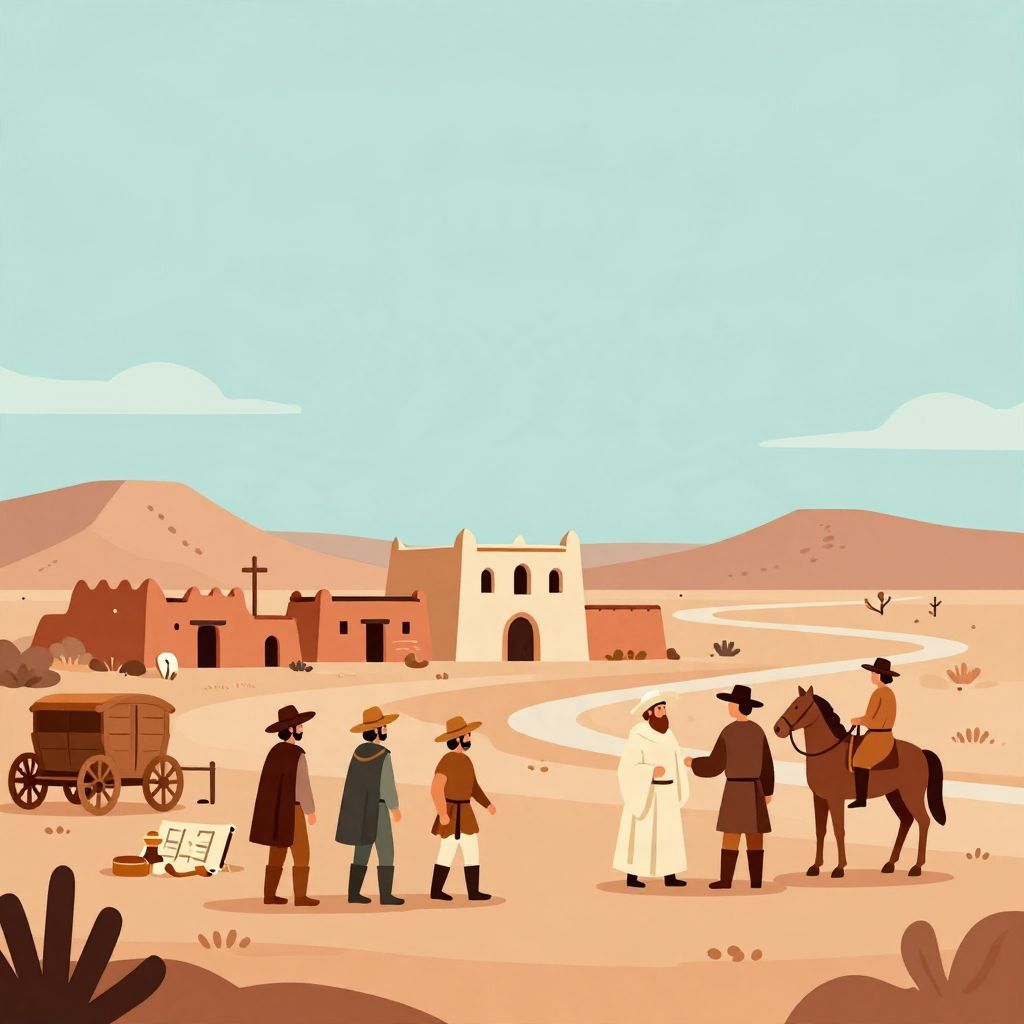
When was New Mexico founded? The shortest careful answer is that New Mexico was first founded as a Spanish colonial province in 1598, when Juan de Oñate led settlers north from New Spain and established the colony. But if you mean the modern U.S. state, New Mexico was founded much later, becoming a territory in 1850 and a state in 1912.
The answer depends on which “New Mexico” you mean: the Spanish colonial province, the U.S. territory, or the present-day state. Each stage had a different legal and political beginning, and each shaped the region in a different way.
When Was New Mexico Founded?
New Mexico was first founded in 1598 as a Spanish colony, when Juan de Oñate formally established the province of Nuevo México near the Rio Grande. If you are asking about the modern political entity, it became a U.S. territory in 1850 and a state on January 6, 1912.
The Spanish Founding of New Mexico in 1598
The founding date most historians use is 1598. In that year, Oñate led an expedition from what is now Mexico into the northern frontier of the Spanish empire. He claimed the region for Spain and founded a colonial settlement system that became known as Nuevo México.
This was not the founding of a city in the modern sense, nor was it the beginning of permanent human life in the region. Indigenous peoples had lived in the area for centuries, and in some cases for far longer. The 1598 date marks the beginning of formal Spanish rule and colonization.
Why Spain called it “New Mexico”
The name “New Mexico” came from Spanish imperial geography. Explorers often named new lands by linking them to places in the wider Spanish world or to places they hoped to resemble in wealth and significance. “Nuevo México” reflected Spanish hopes that the region might contain valuable resources and become an important northern extension of New Spain.
Those hopes were only partly fulfilled. The colony was remote, difficult to supply, and often unstable. Yet the name endured, and it became one of the most lasting legacies of Spanish expansion in North America.
What Oñate actually founded
Oñate did not “found” New Mexico in the sense of creating a blank slate. He established a Spanish colonial province in a region already home to Pueblo communities and other Indigenous peoples. The Spanish brought settlers, soldiers, missionaries, livestock, and a new political order centered on colonial authority and Catholic conversion.
The first Spanish settlement at San Juan de los Caballeros is often associated with this founding period. From there, Spanish power spread unevenly through the region, depending on alliances, conflict, and the labor of Indigenous communities.
New Mexico Before the Spanish Arrival
Long before 1598, the area that is now New Mexico had a deep and complex history. Pueblo peoples built villages, developed irrigation agriculture, and maintained trade networks across the Southwest. Other Indigenous groups, including Apache and Navajo peoples, also shaped the region’s history over time.
So while 1598 is the founding date of Spanish New Mexico, it is not the beginning of New Mexico’s human history. A more accurate way to think about it is that 1598 marks a colonial beginning, not an original one.
The Pueblo world
The Pueblo peoples were central to the region’s history before and after Spanish arrival. Their communities were organized around farming, religion, kinship, and local governance. Spanish colonization disrupted these systems, but it never erased them.
One of the most important moments in this history was the Pueblo Revolt of 1680, when Pueblo peoples drove the Spanish out of the region for more than a decade. That revolt is a reminder that New Mexico’s founding was contested from the start.
How Spanish New Mexico Developed After 1598
Spanish control in New Mexico was fragile. The colony was geographically isolated, thinly settled, and often short on supplies. Missions, presidios, and civil settlements developed slowly, and Spanish authority depended on negotiation as much as force.
In 1610, the Spanish established Santa Fe as the capital of the province, giving New Mexico a more durable administrative center. Santa Fe became one of the oldest continuously inhabited European-founded capitals in what is now the United States.
Key early milestones
- 1598 — Juan de Oñate establishes Spanish New Mexico.
- 1610 — Santa Fe is founded as the provincial capital.
- 1680 — The Pueblo Revolt expels the Spanish from New Mexico.
- 1692 — Diego de Vargas leads the Spanish reconquest.
These dates matter because they show that New Mexico was not founded once and for all in a single moment. Its history unfolded through colonization, resistance, reconquest, and long-term cultural blending.
Was New Mexico Founded in 1610 Instead?
Some people associate New Mexico’s founding with 1610 because that is when Santa Fe was established as the capital. But 1610 is not the founding date of New Mexico itself. It is the founding date of its capital under Spanish rule.
The distinction matters. A capital city can be founded after a province or colony already exists. In New Mexico’s case, the colony began in 1598, and Santa Fe followed 12 years later as the administrative center.
From Spanish Province to U.S. Territory
New Mexico’s political identity changed dramatically in the 19th century. After Mexico won independence from Spain in 1821, New Mexico became part of Mexico rather than Spain. Then, during the Mexican-American War, the United States occupied the region and later annexed it.
In 1850, Congress organized New Mexico as a U.S. territory. This is another possible “founding” date, especially if the question is about the American political entity rather than the Spanish colony.
Why 1850 is sometimes treated as a founding date
For many modern institutions, 1850 is important because it marks the beginning of New Mexico under U.S. territorial government. That meant new laws, new administrative boundaries, and a different relationship to Washington, D.C.
Still, 1850 did not erase earlier history. Territorial New Mexico inherited Spanish, Mexican, and Indigenous legacies that continued to shape law, land use, language, and culture.
When Did New Mexico Become a State?
New Mexico became the 47th U.S. state on January 6, 1912. This is the date most relevant if someone asks when New Mexico “officially” joined the United States as a state.
Statehood came after a long territorial period and years of debate in Congress. New Mexico’s population, geography, and political status made the path to statehood slower than for some other western territories.
Why statehood took so long
Several factors delayed statehood: distance from federal power, debates over language and culture, the territory’s large Hispanic population, and political concerns in Congress. New Mexico’s history did not fit a simple east-to-west expansion narrative.
When statehood finally arrived, it reflected both local persistence and national change. By 1912, the region had become a recognized part of the American political map, though its cultural identity remained distinct.
Why the Question Has More Than One Answer
The phrase “When was New Mexico founded?” can mean different things depending on context. Historians usually answer by clarifying which founding is being asked about:
- 1598 — Spanish colonial founding of New Mexico.
- 1610 — Founding of Santa Fe as capital.
- 1850 — Creation of New Mexico Territory under the United States.
- 1912 — New Mexico becomes a U.S. state.
If you want the oldest and most historically grounded answer, 1598 is the founding date of New Mexico as a named colonial province. If you want the modern legal identity, 1912 is the statehood date.
The Lasting Significance of New Mexico’s Founding
New Mexico’s founding matters because it helps explain the state’s unusually layered history. Spanish colonization, Indigenous resistance, Mexican rule, and U.S. expansion all left lasting marks on the region’s culture, architecture, language, and land use.
That is why New Mexico often feels different from states founded solely through U.S. settlement. Its history is not just one of American expansion, but of older colonial and Indigenous worlds meeting, clashing, and adapting over centuries.
Conclusion
So, when was New Mexico founded? The best historical answer is 1598, when Spain established New Mexico as a colony under Juan de Oñate. But if you mean the modern U.S. state, the key dates are 1850 for territorial status and 1912 for statehood. For more on early American places and expansion, see what is the oldest city in America and what is American imperialism.