
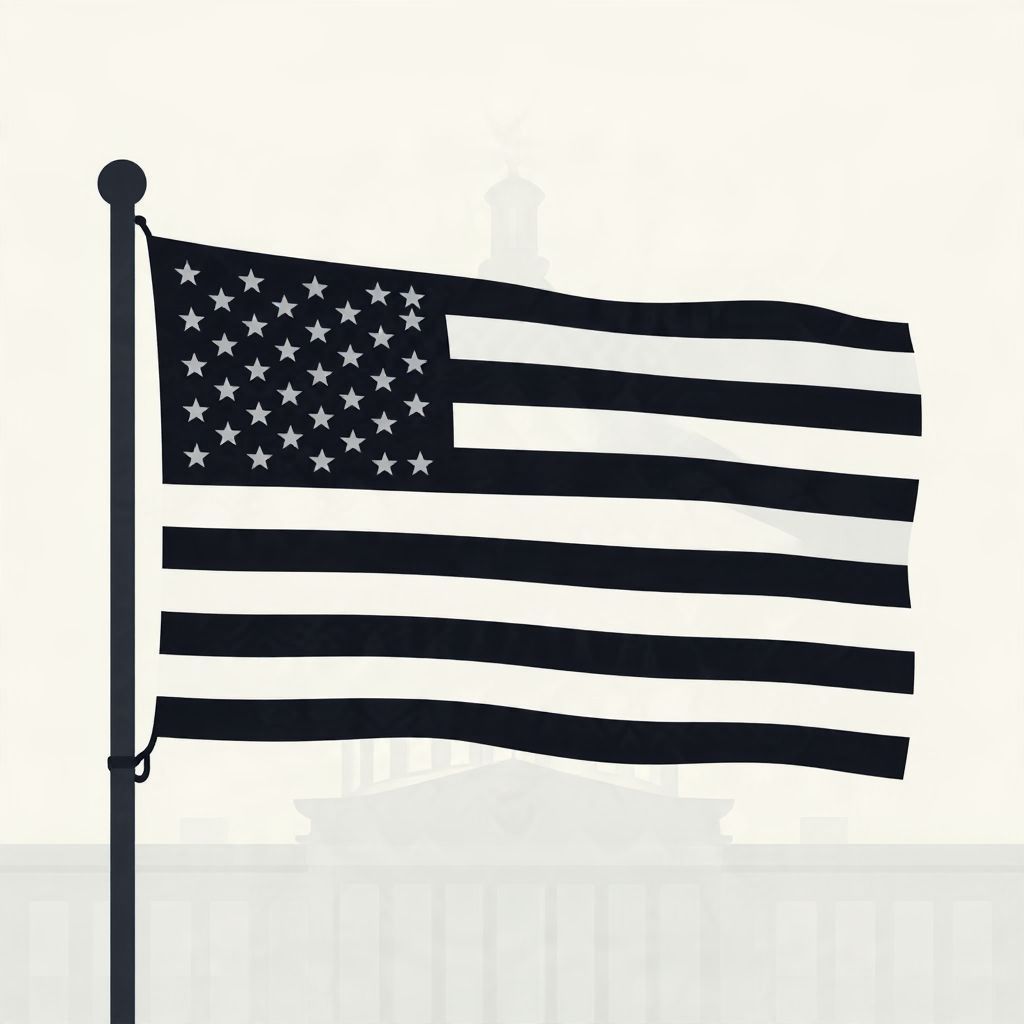
What does an all black American flag mean? The short answer is that it is not an official U.S. flag, but a modern symbolic variation. In most cases, it represents mourning, remembrance, defiance, or a “no quarter” attitude associated with military and tactical culture. Its meaning depends on context, because black American flags have been used by different groups for different purposes.
To understand it historically, you need to separate the official flag of the United States from later informal versions. The all-black flag became popular in recent decades as a visual symbol, especially online and in military, law enforcement, activist, and fashion settings.
What does an all black American flag mean?
An all black American flag usually symbolizes mourning, resistance, or a refusal to surrender. It is not a standard government flag. In modern use, it can express grief for the nation, support for a cause, tactical identity, or a “no quarter” message, depending on who is displaying it and why.
Where did the black American flag come from?
The all-black American flag is a modern adaptation rather than a historical national flag. The United States has long used the stars and stripes in red, white, and blue, but black versions emerged later as symbolic variants. Their meaning grew from military customs, protest culture, and contemporary graphic design rather than from the founding era.
There is no single moment when the black American flag was officially created. Instead, different black flags appeared in different contexts over time. Some were used in war-related settings, others in political protest, and still others as decorative or fashion items. Because of that, the symbol does not have one fixed meaning.
Black flags in older history
Black flags have a long history in many cultures. They have often been associated with danger, rebellion, piracy, mourning, or revolutionary movements. That broader history helped shape how people interpret black American flags today, even though the U.S. version is a much more recent symbol.
In military history, black has often suggested concealment, seriousness, or the absence of surrender. In political history, black banners have sometimes been used by anarchists, insurgents, and other dissenting groups. These older associations made black a powerful color for later American symbolic use.
What are the most common meanings of a black American flag?
The meaning depends on the setting, but the most common interpretations are mourning, solidarity, defiance, and tactical identity. In some cases, people use it to show respect for fallen service members or national tragedy. In others, it signals resistance or a hard-edged political stance.
Mourning and remembrance
One of the most widespread meanings is mourning. A blacked-out American flag can represent grief over deaths, disasters, or national loss. This use fits a long human tradition in which black is associated with sorrow and memorialization. In this sense, the flag is less about politics than about loss.
Defiance or protest
Some people display an all-black American flag to express anger, protest, or rejection of the status quo. This can be a statement of disagreement with government policy, social conditions, or perceived national decline. In this use, the flag is deliberately stark and confrontational.
“No quarter” or tactical symbolism
In military and tactical circles, a black flag can suggest “no quarter,” meaning no mercy or no surrender. Historically, “no quarter” has referred to a refusal to take prisoners in combat, though the exact phrase has varied in use over time. Modern users sometimes borrow that harsh symbolism for unit identity or style.
Support for law enforcement or the military
Some black American flags are used to show solidarity with police, soldiers, firefighters, or other service communities. In these cases, the black-and-white design can be a visual sign of seriousness, sacrifice, or respect. This usage became especially visible in the twenty-first century.
Is the all black American flag an official flag?
No. The all-black American flag is not an official flag of the United States. The official national flag remains the red, white, and blue Stars and Stripes established by law and modified over time as states were added. Black versions are unofficial symbolic adaptations.
That distinction matters historically. Official flags are defined by law and state authority. Symbolic flags, by contrast, are created by public use, subcultures, or movements. The black American flag belongs to the second category. Its meaning comes from cultural adoption, not from federal designation.
- Official U.S. flag: red, white, and blue national flag used by the government.
- Black American flag: unofficial variant used for symbolic purposes.
- Meaning: varies by context, from mourning to protest to tactical identity.
How did the black American flag become popular?
The black American flag became more visible in the late twentieth and early twenty-first centuries, especially through military culture, political imagery, and internet sharing. As with many modern symbols, its spread was accelerated by mass media, merchandise, and social platforms rather than by formal institutions.
Several trends helped it spread. First, black-and-white graphics are visually striking and easy to reproduce on clothing, patches, decals, and digital images. Second, Americans increasingly used flags as personal expression, not just as official emblems. Third, online culture made symbolic designs travel quickly across different communities.
Military and veteran culture
Black flag imagery has often appeared in military-adjacent settings, where it can suggest resilience, sacrifice, or a hardened identity. Some people see it as a tribute to those who served; others read it as an aggressive or uncompromising symbol. The same image can carry different meanings within and outside those circles.
Protest and political identity
In protest culture, the black American flag can function as a visual shorthand for discontent. It may be used by people on the right or the left, depending on the issue and the group. That flexibility is one reason the symbol can be confusing: it is not tied to a single ideology.
Does the black American flag mean disrespect?
Not necessarily. Many people who display a black American flag intend respect, mourning, or solidarity rather than disrespect. However, some viewers do interpret it as hostile because black flags can imply rejection, anger, or a break from normal civic symbolism. Meaning is shaped by context and audience.
For example, a black flag displayed after a tragedy may be understood as a memorial gesture. The same design on a protest banner may be read as anti-government. A blacked-out flag on tactical gear may suggest military identity. Because the symbol is ambiguous, it can create misunderstanding.
Why context matters
To interpret the flag historically, ask where it is shown, who is using it, and what message is attached to it. A flag patch on a uniform, a decal on a truck, and a banner at a rally do not automatically mean the same thing. The surrounding setting is part of the symbol itself.
How is it different from the Thin Blue Line flag?
The black American flag is often confused with the Thin Blue Line flag, but they are not identical. The Thin Blue Line flag usually features a single blue stripe on a black-and-white American flag background and is commonly associated with support for police. The plain black version is broader and less specific.
The Thin Blue Line design developed as a distinct symbol of police solidarity in the late twentieth and early twenty-first centuries. The all-black version can overlap with that meaning, but it is also used for mourning, military imagery, or general defiance. That makes it more open-ended.
What should you know before using or displaying one?
If you plan to display an all-black American flag, it helps to know that people may read it in different ways. Some will see mourning or patriotism; others may see protest or aggression. Because the symbol lacks one official meaning, its message is highly dependent on audience and setting.
- Decide what message you want to send.
- Consider whether a black flag could be misunderstood.
- Use accompanying context, such as a caption or event theme, if clarity matters.
- Remember that the symbol is unofficial and culturally flexible.
The historical takeaway
The all black American flag is best understood as a modern symbolic variation, not an official national emblem. Historically, it has been used to express mourning, resistance, military identity, and sometimes a harsh “no quarter” attitude. Its meaning is real, but it is not fixed. If you want to explore related symbols, see what a black American flag means and what the black flag means.