
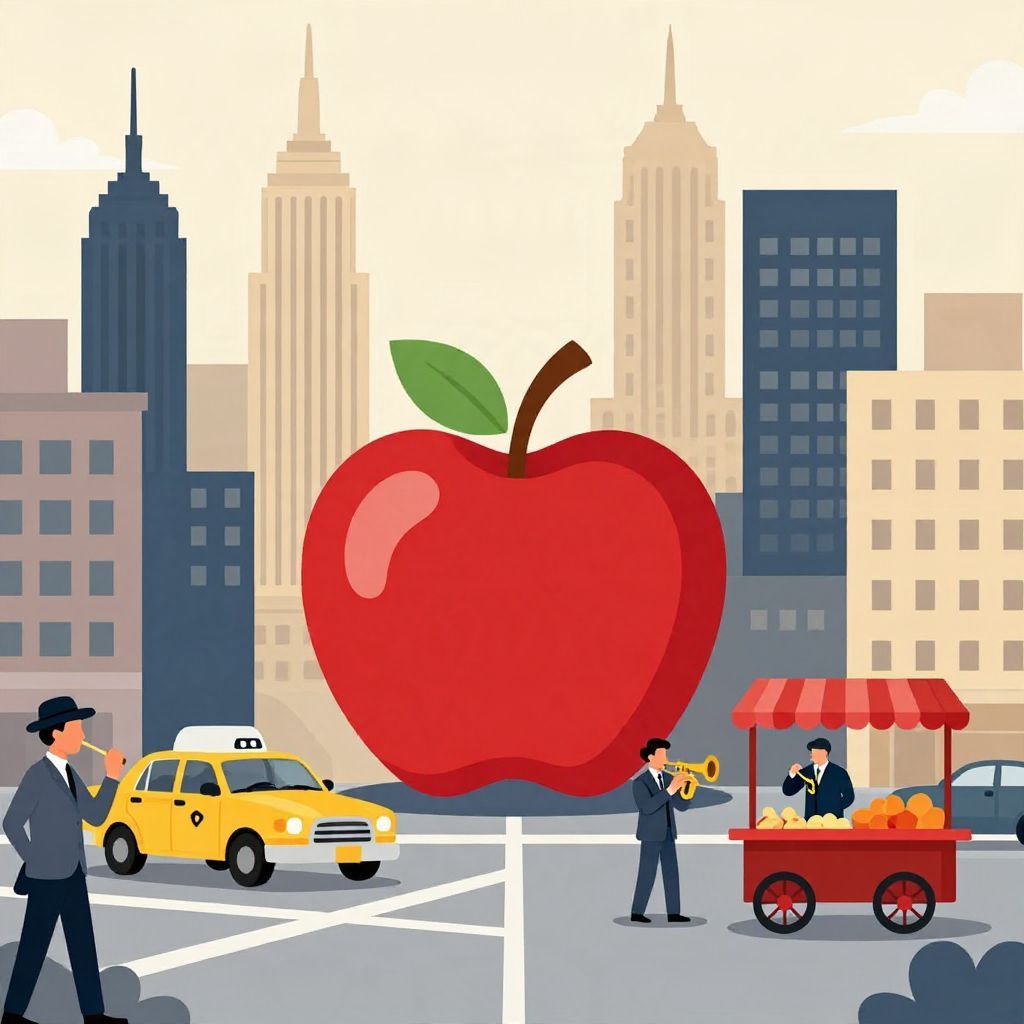
Why do they call New York the Big Apple? The nickname did not begin as a grand civic slogan or a tourism campaign. It emerged gradually in the early 20th century, especially through horse-racing slang and later jazz and newspaper culture, before becoming widely associated with New York City in the 1970s.
Today, “the Big Apple” suggests ambition, opportunity, and scale. But its history is messier and more interesting than the polished image would suggest, with competing explanations, a few false starts, and a long path from slang to official nickname.
Why Do They Call New York the Big Apple?
New York is called the Big Apple because the phrase became a popular nickname for the city in the 20th century, first in sporting slang and then through journalism and entertainment. It likely referred to New York as the biggest, most desirable prize or destination, especially in horse racing, before becoming a city-wide emblem.
The earliest roots of the nickname
Horse racing and the “big apple” prize
The strongest historical evidence points to the world of horse racing in the 1920s and 1930s. In that setting, “the Big Apple” appears to have referred to New York’s racetracks as the biggest prize or most important place to compete. For jockeys, trainers, and racing fans, New York represented the top level of the sport.
One common explanation is that the phrase came from African American stable workers and horsemen in the South and Midwest, where “apple” could mean a prize or something especially desirable. In this interpretation, New York was the “big apple” because it was the largest and best-paying target in racing. The exact origin is still debated, but the racing connection is the most historically grounded.
John J. Fitz Gerald and the newspaper spread
The nickname gained visibility through sports columnist John J. Fitz Gerald of the New York Morning Telegraph. In the 1920s, he wrote about horse racing and used “the Big Apple” in reference to New York’s racing scene. His columns helped move the phrase from specialized slang into print, where a larger audience could encounter it.
Fitz Gerald did not invent the phrase out of nowhere, but he was crucial in popularizing it. Because newspapers shaped urban slang in the early 20th century, a phrase used in a niche sporting world could quickly travel into broader public speech. That process is one reason the nickname survived while many other local expressions disappeared.
How the nickname changed meaning over time
From racing slang to city identity
At first, “the Big Apple” was not a general nickname for New York City in the way it is today. It was tied more narrowly to the city’s racing circuit and to the idea of New York as the biggest stage. Over time, however, people began using it more broadly to describe the city itself: its size, its energy, and its status as a place where big things happen.
This shift matters historically because nicknames often change meaning as they move between communities. A phrase that begins in one subculture can be adopted by another, then detached from its original context. That is what happened here. By the mid-20th century, many people used “Big Apple” without knowing anything about horse racing.
Jazz musicians and the language of success
Another important layer in the nickname’s history comes from jazz culture. In the 1930s and 1940s, musicians used “the Big Apple” to mean New York as the leading place for performance and opportunity. For touring bands, getting to New York could be a major career milestone. The phrase fit the city’s image as the center of entertainment, recording, and nightlife.
This association helped broaden the nickname beyond racetracks. New York was not just a place where horses competed; it was the place where artists, performers, and ambitious newcomers hoped to make it. The nickname’s appeal lay in that blend of aspiration and scale.
Popular myths and mistaken explanations
Was it about apple orchards?
One of the most persistent myths is that New York was called the Big Apple because of apple orchards or agricultural abundance. That explanation is appealing, but it does not fit the historical evidence well. The nickname’s documented rise comes from urban sporting and entertainment circles, not from farming or fruit markets.
New York State did have agricultural regions, of course, but the city nickname does not appear to have grown from them. The phrase “Big Apple” was not a straightforward reference to literal apples; it was slang, and likely metaphorical from the start.
Did the city invent the nickname as a slogan?
Another common misconception is that New York’s government or tourism industry created the nickname as a branding campaign. In fact, the city embraced the phrase much later than it emerged. By the 1970s, New York officials and marketers recognized its value and helped turn it into a civic brand, but they did not originate it.
This distinction is important. Many famous city nicknames begin informally and are later adopted officially. “The Big Apple” followed that pattern. Its power came from being rooted in everyday speech before it was polished into a public identity.
Why the nickname stuck
It matched New York’s image
The phrase endured because it fit New York remarkably well. The city has long been associated with scale: tall buildings, crowded streets, immigrant neighborhoods, financial power, and cultural influence. “Big Apple” suggests something large, attractive, and a little irresistible. It captures both the city’s size and its promise.
Unlike more formal names, the nickname had personality. It was vivid, easy to remember, and flexible enough to suit sports, music, journalism, and tourism. That versatility helped it survive changes in language and fashion.
The 1970s revival
The nickname became especially prominent in the 1970s, when New York City was facing fiscal crisis, rising crime, and a damaged national reputation. City leaders and advertisers looked for ways to reshape public perception. The “Big Apple” offered a positive, memorable image that contrasted with the city’s troubles.
That revival did not create the nickname, but it gave it new life. Once the phrase was used in campaigns, souvenirs, and media, it became firmly associated with New York in the public imagination. For many people, this was the moment the nickname turned from old slang into a lasting symbol.
What the nickname reveals about New York history
A city built on opportunity and competition
The history of “the Big Apple” reflects a larger truth about New York: the city has often been seen as the place where the biggest opportunities are found and the toughest competition unfolds. That was true in horse racing, in entertainment, in finance, and in migration. People came to New York because it was the biggest stage.
The nickname also shows how urban identity is made. Cities are not only shaped by buildings and institutions, but by language, reputation, and stories people repeat about them. A phrase born in specialized slang can become part of a city’s global image if it captures something enduring about that place.
From local slang to global brand
By the late 20th century, “the Big Apple” had become one of the world’s most recognizable city nicknames. It appears in travel writing, film, song, and advertising because it conveys more than geography. It suggests ambition, glamour, and the idea that New York is where the largest prizes are won.
At the same time, the nickname’s history reminds us that cultural symbols often have humble, uneven beginnings. What sounds timeless may actually be the product of newspapers, subcultures, and later reinvention.
The short answer
New York is called the Big Apple because the nickname likely began in horse-racing slang for the city’s biggest prize or most important racing destination, was popularized by journalists like John J. Fitz Gerald, and was later broadened by jazz culture and revived in the 1970s as a civic brand. It is a nickname with real historical roots, not a myth about apples or orchards.
In other words, “the Big Apple” became New York’s nickname because it captured the city’s long-standing role as a place of scale, competition, and opportunity. If you want to compare how other city nicknames took shape, you might also enjoy reading about why New Orleans is called the Big Easy or what SoHo stands for in NYC.