
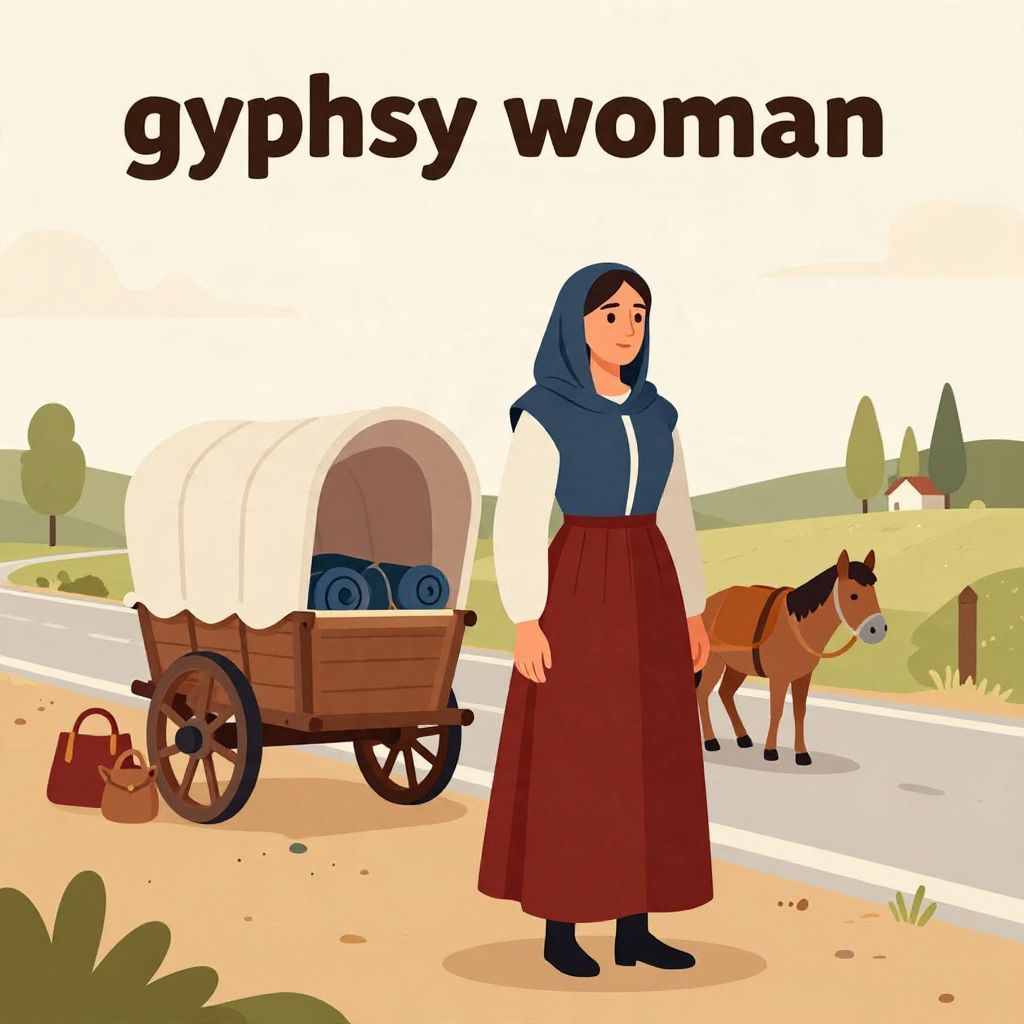
What is a gypsy woman? The short historical answer is that the phrase has usually referred to a woman from the Romani people, a diasporic ethnic group that originated in northern India and spread across Europe and beyond from the Middle Ages onward. But the term “gypsy” is often considered offensive today, and its history is bound up with misunderstanding, stereotyping, and discrimination.
To answer the question well, it helps to separate identity from label. A “gypsy woman” was never a single type of person or a fixed historical role; she could be a mother, trader, musician, craftworker, traveler, or settled community member, depending on place and time. The meaning of the phrase has changed over centuries, shaped as much by outsiders’ ideas as by Romani self-understanding.
What Is a Gypsy Woman?
A “gypsy woman” is a historical label, usually applied to a Romani woman or, more loosely, to a woman thought to belong to a traveling community. Historically, the word carried strong stereotypes about mobility, fortune-telling, music, and marginality. In modern historical writing, “Romani woman” is the more accurate and respectful term.
The Origins of the Term and the People It Described
The Romani are believed to have roots in northwestern India, with linguistic and genetic evidence pointing to migration westward beginning around the early medieval period, likely by the first millennium CE. By the 14th and 15th centuries, Romani groups were appearing in parts of the Byzantine world and then in much of Europe. The English word “gypsy” came from the mistaken belief that they were from Egypt.
Why the name is misleading
When Romani groups reached western Europe, many outsiders assumed they were pilgrims from “Little Egypt,” a phrase that helped produce the English term “gypsy.” The label was therefore based on error, not origin. In many languages, similar words developed from the same misunderstanding. Over time, the term became loaded with prejudice, even when used casually.
Romani identity is not one single lifestyle
It is also important to note that Romani people have never all lived the same way. Some groups were mobile at certain times; others were settled. Some maintained distinct languages and customs; others blended into local societies while preserving family and community ties. So a “gypsy woman” could mean very different things in different historical settings.
How European Societies Viewed Gypsy Women
From the late medieval period onward, many European states and local communities treated Romani people as outsiders. Women were especially vulnerable to suspicion because they often appeared in public as sellers, entertainers, healers, or travelers, roles that made them visible and therefore easy to stereotype. The image of the “gypsy woman” became a cultural figure in art and literature, not just a social reality.
Common stereotypes and their consequences
- Fortune-teller: A popular image in folklore and fiction, though not representative of all Romani women.
- Wanderer: Linked to mobility, even when many Romani families were settled.
- Exotic outsider: Romanticized in art while still being excluded in law and daily life.
- Suspect figure: Often associated by authorities with vagrancy, theft, or disorder without evidence.
These stereotypes had real effects. In many places, Romani people faced expulsion, forced assimilation, restrictions on movement, and violence. Women could be targeted for their dress, speech, or economic activities, and they were often judged by standards that did not apply equally to non-Romani women.
What Was Life Like for Romani Women Historically?
There was no single Romani female experience. A woman’s life depended on region, religion, class, family occupation, and whether her community was mobile or settled. Still, some broad patterns appear across history: strong family networks, economic participation, and persistent pressure from surrounding societies.
Work and family roles
Romani women historically contributed to household survival in many ways. They might trade goods, mend clothing, work as seasonal laborers, perform music, tell fortunes, or manage domestic life. In some communities, women’s earnings were essential to family mobility and independence. Their work was often informal or outside guild systems, which made it both flexible and vulnerable.
Marriage, kinship, and community
Family and kinship have often been central in Romani communities, though customs vary widely. Marriage patterns, age at marriage, and expectations for women differed by region and era. Outsiders frequently misunderstood these practices or treated them as proof of separateness. In reality, many customs reflected practical strategies for survival in hostile environments.
Religion and adaptation
Romani women historically lived within many religious worlds: Christian, Muslim, and others, depending on where they lived. They often adapted to local religious norms while keeping distinct community identities. This flexibility helped some families navigate persecution, but it also led outsiders to accuse them of being untrustworthy or secretive.
Gypsy Women in Folklore, Art, and Popular Culture
The “gypsy woman” became a powerful figure in European imagination. Writers, painters, and later filmmakers used her to symbolize freedom, danger, sensuality, mystery, or fate. These images were influential, but they were usually created by outsiders and often said more about majority anxieties than about Romani women themselves.
The romantic image
In 18th- and 19th-century Europe, Romantic artists often portrayed gypsy women as free spirits living outside social rules. This image could seem flattering, but it also reduced real women to symbols. It turned a living people into a fantasy of wildness and emotional intensity, obscuring their actual history of labor, family life, and exclusion.
The negative image
At the same time, other portrayals cast gypsy women as deceptive, immoral, or criminal. Such depictions reinforced legal discrimination and social fear. In many cases, the same society that admired the “mysterious gypsy” in art also supported policies that restricted Romani movement and employment.
Why these images matter
These cultural images shaped public attitudes for centuries. They influenced literature, opera, song, and everyday speech, and they helped normalize the use of a stereotype in place of historical understanding. For that reason, historians now treat the phrase “gypsy woman” with caution, even when studying older sources that used it routinely.
Discrimination, Law, and Survival
Romani women lived under legal and social pressures that varied by country and period. In parts of Europe, governments tried to control, expel, enslave, or forcibly settle Romani populations. Women often bore the burden of these policies in the form of family separation, poverty, and restricted movement.
Examples of historical pressure
- Expulsion laws: Some states ordered Romani groups to leave or prohibited them from entering.
- Forced settlement: Authorities tried to turn mobile communities into fixed populations.
- Labor restrictions: Access to guild work, land, or public trade was often limited.
- Violence and harassment: Women were especially exposed to abuse because of their visibility in public life.
Despite this, Romani women and families adapted in many ways. They negotiated with local authorities, formed alliances, changed occupations, and moved when necessary. Their history is not only one of victimhood but also of resilience and practical intelligence.
Modern Meaning: Why the Term Is Contested Today
Today, “gypsy” is widely recognized as a problematic term because it has been used by outsiders in a dismissive or racist way. Many Romani people prefer “Romani,” “Roma,” or specific community names. In some contexts, people may still use “gypsy” in a self-identifying or cultural sense, but historians and educators usually avoid it unless discussing historical usage.
Language and respect
Language matters because labels can either clarify identity or flatten it. Calling someone a “gypsy woman” can reproduce old stereotypes unless the historical context is made clear. Using “Romani woman” is generally more accurate when referring to ethnicity, while “gypsy” is best treated as a historical term that reflects how outsiders once described Romani people.
Romani women today
Modern Romani women are diverse in occupation, education, religion, and lifestyle, just like women in any large ethnic group. They are scholars, activists, artists, workers, parents, and public leaders. The historical burden of the “gypsy woman” stereotype still matters because it has shaped how Romani women are seen and treated in many societies.
Key Facts to Remember
- The phrase “gypsy woman” usually refers to a Romani woman, but the term “gypsy” is often considered offensive today.
- The Romani originated in northern India and migrated into Europe over many centuries, beginning in the early medieval period.
- The word “gypsy” came from a mistaken belief that Romani people were from Egypt.
- Historical images of gypsy women were shaped by folklore, art, and prejudice, not by one single reality.
- Romani women have historically worked in many roles and lived under varying conditions of mobility, settlement, and discrimination.
Conclusion
So, what is a gypsy woman? Historically, it is a term outsiders used for a Romani woman, often with misunderstanding attached. The phrase carries a long history of migration, adaptation, stereotype, and discrimination, and it does not describe one fixed way of life. For a broader look at how gender was portrayed in the past, see Frailty, Thy Name Is Woman; for related background on the term itself, a companion article on what “gypsy” has meant historically can help place the word in context.