
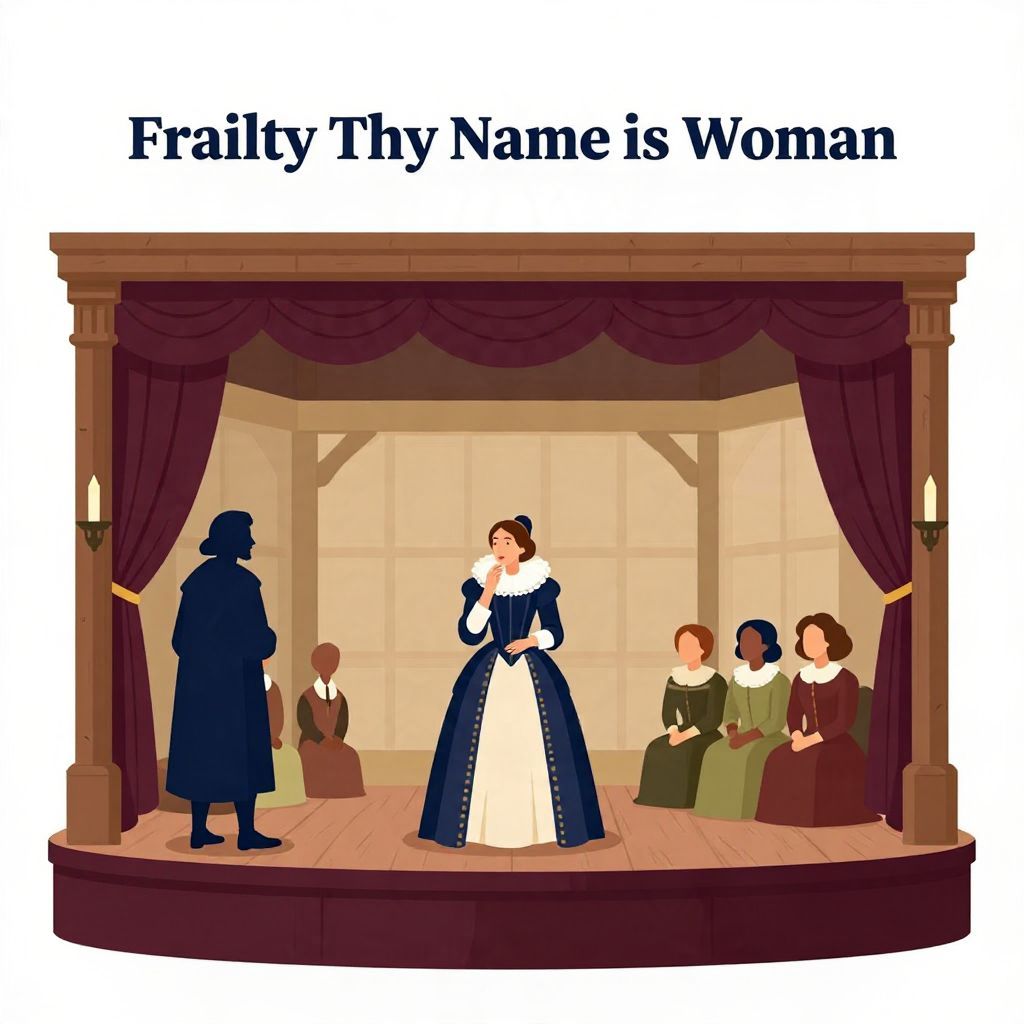
“Frailty, thy name is woman” is one of the most famous lines in English literature, but it is also a historical clue. The phrase comes from William Shakespeare’s Hamlet, written around 1600–1601, and it reflects early modern ideas about gender, mourning, marriage, and women’s supposed moral weakness.
To understand it properly, we need to separate the play’s dramatic context from the broader history behind it. The line is not a neutral statement of fact; it is Hamlet’s bitter reaction to his mother’s remarriage, and it reveals more about Elizabethan attitudes than about women in general.
What does “Frailty, thy name is woman” mean?
In Hamlet, the line means that Hamlet sees women as weak, changeable, and easily led by emotion. Historically, it reflects a patriarchal worldview common in Shakespeare’s England, where women were often described in moral and religious writing as more vulnerable to temptation, instability, and dependence than men.
Where does the phrase come from?
The line appears early in Shakespeare’s Hamlet, in Act 1, Scene 2. Hamlet has just learned that his mother, Queen Gertrude, has married his uncle Claudius shortly after the death of Hamlet’s father, King Hamlet. Distraught, he turns his grief into a sweeping judgment about women.
The dramatic context in the play
Hamlet’s speech is not a calm philosophical argument. It is an emotional outburst. He is mourning his father, disgusted by what he sees as hasty remarriage, and suspicious of the court around him. His words are shaped by anger, not by objective observation.
That distinction matters. Shakespeare gives the audience a character who speaks in absolutes, but the play does not necessarily endorse his view. In fact, Hamlet repeatedly complicates easy judgments about gender, loyalty, and appearance.
The original wording
The phrase is usually quoted in modernized spelling, but in early printed versions it appears as “Frailty, thy name is woman.” The grammar personifies frailty as if it were a person named “woman,” making the line sound universal and accusatory. That rhetorical force helped the phrase survive for centuries.
Why did Shakespeare write this line?
Shakespeare wrote in a culture that inherited long-standing ideas about gender hierarchy from classical philosophy, Christian teaching, and medieval social custom. Women were often associated with weakness, temptation, obedience, and domesticity. Hamlet’s line draws on those assumptions, even as the play itself invites audiences to question them.
Elizabethan ideas about women
In Shakespeare’s England, elite and religious writing frequently portrayed women as morally and physically weaker than men. This did not mean all people believed the same thing in the same way, but the general framework was deeply patriarchal. Women’s chastity, obedience, and silence were often treated as signs of virtue.
At the same time, women could also be admired as queens, mothers, patrons, and household managers. So the historical picture is not simply “women were hated.” Rather, women were valued within a narrow set of expectations, and those expectations shaped how male writers represented them.
Classical and biblical influences
Shakespeare was not inventing the idea from scratch. Earlier European traditions often linked women with temptation or instability, from classical moral writing to interpretations of Eve in Genesis. Such traditions did not determine every individual opinion, but they formed a powerful background for literary language.
Hamlet’s line therefore belongs to a much older history of misogynistic thought. It is one of the most memorable expressions of that tradition in English drama, which is why it is still quoted today.
Is the line historically accurate?
No, not as a factual statement. It is a dramatic generalization spoken by a fictional character in a specific emotional state. Historically, women in Shakespeare’s time were not uniformly “frail” in any simple sense; they worked, managed households, participated in trade, raised families, and sometimes exercised political influence, especially among elites.
Women’s lives in early modern England
Most women’s daily lives were shaped by labor, marriage, childbirth, and household responsibility. Many worked in agriculture, textile production, markets, brewing, or service. Widows could run businesses, and noblewomen could manage estates. These realities do not fit the stereotype of passive weakness.
Still, legal and social structures limited women’s autonomy. Married women had fewer independent rights than men, and patriarchal authority was embedded in law, church teaching, and custom. So while the line is not historically true as a universal claim, it does reflect a real system of inequality.
Gertrude is not simply “frail”
In Hamlet, Gertrude is often read as weak because Hamlet sees her that way. But the play leaves her motives ambiguous. She may be politically pragmatic, emotionally dependent, or simply trying to preserve stability in a dangerous court. Shakespeare resists a single explanation.
That ambiguity is one reason the line remains interesting to historians and literary scholars. It shows how gender prejudice can coexist with complexity in a text. Gertrude is not a historical woman, but she embodies tensions that were real in early modern society.
How has the phrase been interpreted over time?
The line has had a long afterlife because it is short, quotable, and provocative. Over time, readers have interpreted it in different ways: as a misogynistic insult, as an expression of grief, as evidence of Hamlet’s instability, or as a window into Renaissance gender ideology.
As a sign of misogyny
Many modern readers see the line as plainly misogynistic, and that reading is historically valid. The language reduces women to a single negative trait and turns one woman’s behavior into a claim about all women. That kind of generalization was common in many earlier texts, but it is still a prejudice.
As a symptom of Hamlet’s character
Other readers emphasize that the line reveals Hamlet’s own psychological distress. He is not a neutral observer. He is grieving, angry, and increasingly distrustful. In that sense, the phrase tells us as much about Hamlet’s mind as it does about gender attitudes in the play.
As a cultural artifact
For historians, the line is valuable because it captures a recognizable cultural assumption of the period. It is not a statistic or a policy, but literature can still preserve social attitudes. Shakespeare’s works are especially useful in this way because they show how elite English culture represented family, power, and gender.
What did “frailty” mean in Shakespeare’s time?
The word “frailty” in early modern English could mean weakness, moral susceptibility, instability, or vulnerability. It was not limited to physical frailty. In religious and moral discourse, frailty often referred to human weakness before sin, temptation, or error.
Moral weakness rather than medical weakness
When Hamlet uses the word, he is not talking about illness or old age. He means that women are supposedly more likely to yield to weakness of will. This moralized use of “frailty” was common in the period and helps explain why the line sounds so sweeping.
Why the word still matters
Because “frailty” sounds abstract and universal, the line seems to turn a personal grievance into a timeless truth. That is part of its power. Shakespeare compresses a private emotional wound into a memorable cultural accusation.
Why is the phrase still famous today?
The line survives because it is both poetic and controversial. It is easy to remember, easy to quote, and easy to debate. It also captures a broader historical pattern: the tendency to blame women collectively for male disappointment, fear, or loss of control.
Its place in literary history
Hamlet is one of Shakespeare’s most studied plays, and this line is among its most cited. Teachers, critics, and audiences return to it because it opens up questions about grief, gender, power, and interpretation. It is a small phrase with a large historical footprint.
Its modern resonance
Today, the line is often discussed in relation to sexism and the history of misogyny. That does not mean readers must erase the play’s historical context. Instead, it means the line can be understood both as a product of its time and as a text that still prompts reflection on how language shapes attitudes toward women.
What is the historical takeaway?
“Frailty, thy name is woman” is not a historical fact about women; it is a historical fact about how a male character in early modern drama expressed grief through prejudice. The phrase reflects Elizabethan gender assumptions, but it also reveals the emotional and political tensions at the heart of Hamlet. For readers interested in women’s history, Shakespeare, and the history of ideas, it is a reminder that literature can preserve the biases of an age as clearly as its beliefs.
If you want to explore related historical questions about women, power, and public judgment, you may also find why Marie Antoinette was killed and why Yolanda killed Selena Quintanilla useful for understanding how women have been portrayed, blamed, and remembered in very different historical settings.