
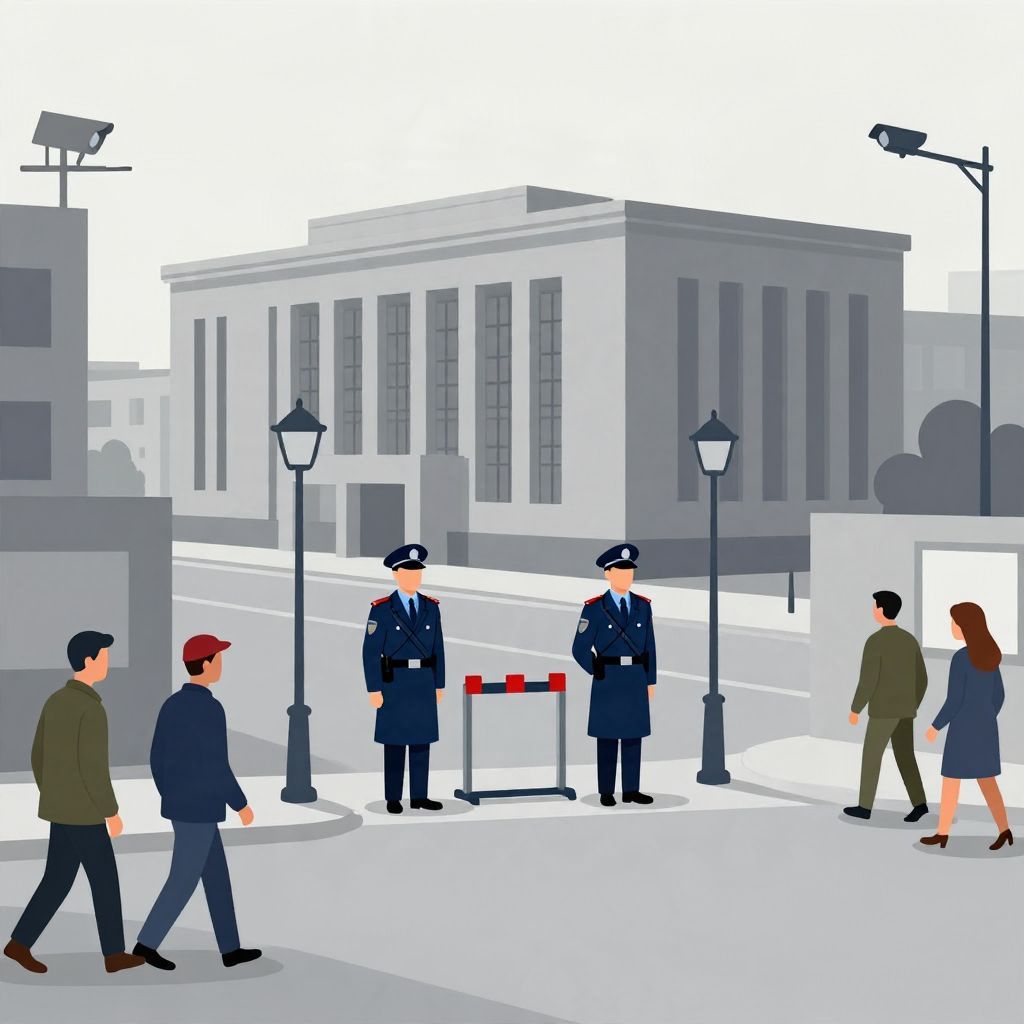
A police state is a political system in which the government uses extensive surveillance, policing, intimidation, and punishment to control society. The term is usually applied when law enforcement and security agencies have power that reaches deeply into daily life, limiting speech, movement, assembly, and political opposition.
Historically, the phrase has been used to describe modern authoritarian regimes, especially in the 20th century, but the idea is older than the term. Understanding what a police state is means looking at how states have used force, law, and bureaucracy to maintain order—and how those tools can become instruments of repression.
What Is a Police State?
A police state is a government in which public order is maintained through pervasive surveillance, coercive policing, and fear rather than through broad political freedom or independent legal limits. In a police state, the state’s security apparatus can monitor, arrest, censor, or punish people with little accountability, often targeting dissent, minorities, or perceived enemies.
The basic features
Historians and political scientists usually identify a police state by a cluster of features rather than a single law. These often include secret police, arbitrary arrests, censorship, restrictions on assembly, political trials, and the use of informants. The state may still have courts and laws, but those institutions are often subordinated to the ruling power.
How it differs from ordinary policing
All states police crime to some degree. The difference is scale, purpose, and accountability. In a normal legal order, police are constrained by law and are meant to protect public safety. In a police state, policing becomes a political instrument: it is used to suppress opposition, shape behavior, and make citizens feel watched.
Where Did the Idea Come From?
The concept developed in the modern era, especially as governments built larger bureaucracies and professional police forces in the 18th and 19th centuries. The phrase “police state” became common in discussions of authoritarian rule in the 19th and 20th centuries, when critics used it to describe regimes that relied on surveillance and coercion to govern.
Early modern roots
Before modern police institutions, rulers still used spies, informers, prisons, and military force to control subjects. Absolutist monarchies in Europe, imperial systems, and some colonial administrations all used strong coercive powers. However, the modern idea of a police state is tied to the development of centralized administration, record-keeping, and permanent police organizations.
Why the term became important in the modern age
As states expanded in the 19th century, critics became more alert to the danger that bureaucracy could be used not only for administration but also for control. Industrialization, mass politics, and revolutionary movements led many governments to increase surveillance of workers, radicals, and minorities. The phrase “police state” gained force because it captured the fear that the state’s protective functions had turned into instruments of domination.
How Police States Developed Historically
Police states usually emerge when rulers believe they face serious threats—war, revolution, civil unrest, or internal dissent—and respond by concentrating power. Over time, emergency measures can become permanent. What begins as temporary security policy may harden into a system of routine surveillance and repression.
1. Crisis and centralization
Many police states have grown out of crisis. Leaders facing rebellion or instability often justify extraordinary powers as necessary for survival. In some cases, this includes suspension of civil liberties, expansion of secret intelligence services, and harsher penalties for political opposition.
2. Institutional expansion
Once created, coercive institutions tend to expand. Police, intelligence agencies, border forces, and prison systems can become more powerful, better funded, and more embedded in everyday governance. The more a regime depends on these institutions, the harder it becomes to limit them.
3. Normalization of fear
A police state does not rely only on arrests. It also depends on uncertainty. People may self-censor because they do not know who is watching, what speech is allowed, or which associations are dangerous. This atmosphere of fear can be as effective as visible violence in preventing resistance.
Key Historical Examples
The label “police state” has been applied to different regimes across history, though scholars often debate how accurately it fits each case. The term is most commonly associated with authoritarian governments of the 20th century, especially those that used secret police and mass surveillance on a large scale.
Nazi Germany
Under Nazi rule after 1933, Germany built an extensive apparatus of political control. The Gestapo, along with the SS and other agencies, helped suppress opposition, persecute Jews and other targeted groups, and enforce Nazi ideology. Although the regime also relied on propaganda and popular support, coercion was central to its power.
Stalinist Soviet Union
The Soviet Union under Joseph Stalin is another major example. The NKVD and related institutions carried out surveillance, arrests, forced labor, and purges. During the Great Terror of the late 1930s, fear spread through party, state, and society. Historians continue to study how ideology, bureaucracy, and personal dictatorship combined to produce this system.
East Germany and other Cold War regimes
The German Democratic Republic, especially through the Stasi, became known for dense surveillance and informant networks. Other authoritarian states during the Cold War also used secret police, censorship, and detention to control dissent. The degree and form of repression varied, but the logic of political policing was similar.
Colonial and imperial settings
Police-state methods were not limited to formally totalitarian regimes. Colonial governments often used pass laws, surveillance, emergency regulations, and military policing to control colonized populations. In these settings, coercion was frequently justified as maintaining order, but it also protected unequal political and economic systems.
What Makes a Police State Different from an Authoritarian State?
Not every authoritarian state is a full police state, though the terms overlap. Authoritarianism is a broader category describing systems with limited political pluralism and weak democratic rights. A police state is a more specific type of authoritarian rule in which coercive surveillance and policing are especially central to governance.
Overlap and differences
- Authoritarian state: limits political competition and concentrates power, but may rely more on ideology, patronage, or controlled institutions.
- Police state: emphasizes surveillance, intimidation, and coercive enforcement as primary tools of rule.
- Totalitarian state: aims at deeper control over politics, society, and often private life, usually through ideology, mass mobilization, and coercion.
These categories are useful, but real regimes do not always fit neatly into one box. Some states combine propaganda, welfare, nationalism, and policing in different proportions.
Why Do Governments Become Police States?
Governments usually do not describe themselves as police states. They often claim that strong security measures are necessary to fight crime, terrorism, subversion, or chaos. Historically, police-state practices have grown where rulers fear losing control and decide that political survival matters more than civil liberty.
Common historical causes
- War or external threat: Leaders expand surveillance and emergency powers during conflict.
- Revolution or unrest: Governments respond to protest or rebellion with repression.
- Ideological rule: A regime seeks to reshape society and suppress alternative beliefs.
- Weak institutions: Courts, legislatures, and media fail to restrain executive power.
- Colonial domination: Authorities use coercion to govern subject populations.
In practice, these causes often overlap. A state may begin with one emergency and then keep the apparatus of repression long after the emergency has passed.
The Role of Law, Police, and Surveillance
A police state is not simply lawless. In fact, it often uses law very aggressively. The difference is that law becomes a tool of control rather than a limit on power. Broad security statutes, vague offenses, and emergency decrees can make almost any form of dissent punishable.
Law as a weapon
Regimes can use legal language to give repression a veneer of legitimacy. Detention without meaningful trial, restrictions on speech, and criminalization of opposition may all be framed as lawful. This is one reason historians pay close attention to legal structures as well as police violence.
Surveillance and informants
Modern police states often depend on information gathering. Mail interception, phone tapping, digital monitoring, neighborhood informants, and workplace surveillance all help authorities map networks of opposition. The goal is not only to punish enemies but to make people unsure whom to trust.
How People Experience Life in a Police State
Daily life in a police state is shaped by caution. Citizens may avoid political discussion, join approved organizations, or keep their opinions private. Public life can appear orderly on the surface, but that order is often maintained by fear rather than consent.
Social and psychological effects
People living under heavy surveillance may develop habits of self-censorship and mistrust. Families, workplaces, and schools can be affected when informants or political loyalists are present. The long-term result is often a damaged public sphere, where open debate becomes difficult and civic trust erodes.
Resistance and adaptation
Even in police states, people resist in many ways: underground publishing, coded speech, private networks, exile politics, humor, and occasional mass protest. Some adapt outwardly while maintaining private opposition. History shows that coercion can suppress dissent for long periods, but it rarely eliminates it entirely.
Is a Police State Always the Same as Total Control?
No. A police state can be severe without controlling every aspect of life. Some regimes focus intensely on political opposition while allowing limited private freedom, consumer activity, or cultural expression. Others seek broader control. The concept is best understood as a spectrum, not an absolute condition.
Why historians use caution
Because the term is often used polemically, historians are careful about applying it. A government may be repressive without being a full police state. Likewise, a state may have strong police institutions yet still retain some rule of law and political competition. Careful analysis looks at institutions, not just rhetoric.
Why the Term Still Matters
The phrase “police state” remains powerful because it describes a recognizable danger: the transformation of public security into political domination. It warns that surveillance and emergency powers, once normalized, can outlive the crisis that justified them. That lesson is not limited to any one era.
Historical significance
Studying police states helps explain how modern governments can combine bureaucracy, technology, and coercion. It also shows why constitutional limits, independent courts, free media, and civil society matter. These institutions are not merely formalities; historically, they have been among the few barriers against unchecked state power.
In historical terms, a police state is a regime where coercive control outweighs individual liberty and political accountability. The concept emerged with modern state-building, but its roots stretch back to older forms of repression. To understand it is to see how law, surveillance, and fear can be turned into tools of rule—and why societies have long struggled to prevent that outcome. For related reading, see when tyranny becomes law and what oppression means.