
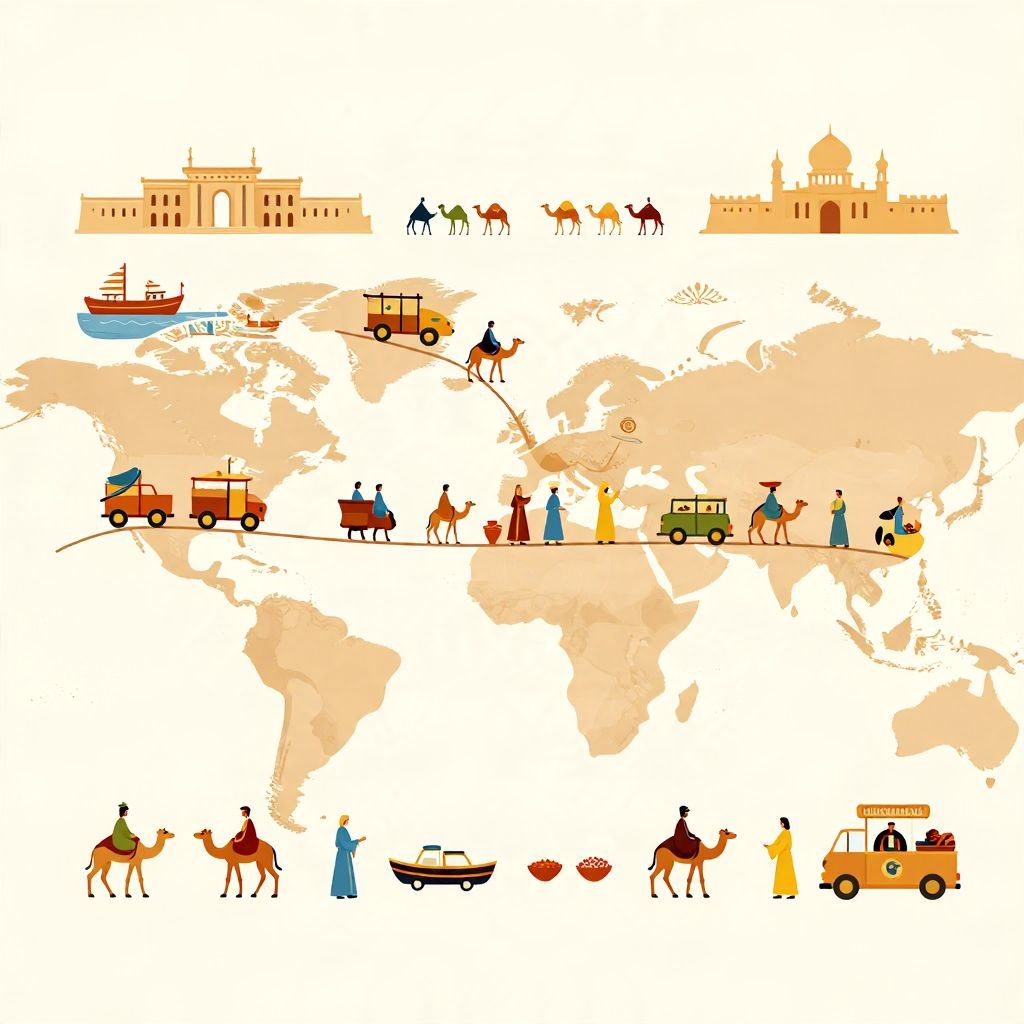
What is cultural diffusion, and why does it matter in history? Cultural diffusion is the spread of ideas, beliefs, technologies, languages, foods, artistic styles, and customs from one society to another. It has shaped civilizations for thousands of years, often through trade, migration, conquest, religion, and everyday contact.
Rather than being a single event, cultural diffusion is a long historical process. It helps explain how societies borrow from one another, adapt outside influences, and create new blended traditions that are neither entirely “foreign” nor purely local.
What Is Cultural Diffusion?
Cultural diffusion is the movement of cultural traits from one group to another. These traits can include religion, clothing, writing systems, farming methods, music, scientific knowledge, and political ideas. In history, diffusion usually happens when people come into contact through trade, war, migration, empire, or travel.
The basic idea
At its simplest, cultural diffusion means that cultures are not sealed off from one another. Instead, they influence each other over time. A society may adopt a new crop, a new tool, or a new belief and then change it to fit local needs. That is why diffusion often produces mixture, not simple copying.
How Does Cultural Diffusion Happen?
Cultural diffusion usually occurs through repeated contact between groups. Sometimes the exchange is peaceful, as with merchants along trade routes. Sometimes it is forced, as with conquest, colonization, or enslavement. In many cases, diffusion happens gradually through ordinary human interaction rather than through a single dramatic event.
Main historical pathways
- Trade: merchants carried goods, ideas, and technologies across long distances.
- Migration: people moving to new regions brought their customs with them.
- Conquest and empire: rulers and armies spread languages, laws, and religions.
- Religion: missionaries, pilgrims, and scholars transmitted sacred texts and practices.
- Communication and travel: roads, ships, and later printing and modern media accelerated exchange.
Why Cultural Diffusion Matters in History
Cultural diffusion is one of the main reasons world history is interconnected. It explains how innovations spread far beyond their place of origin and why many civilizations developed through borrowing as much as invention. Without diffusion, many of the technologies and ideas that transformed agriculture, government, religion, and daily life would have remained local.
It creates change and adaptation
Imported ideas rarely remain unchanged. Societies adapt them to local language, climate, politics, and customs. This means cultural diffusion is not just about influence from one “source” to one “receiver.” It is a process of selection, reinterpretation, and blending.
Examples of Cultural Diffusion in World History
Historical examples of diffusion are abundant and span every era. Some of the best-known cases involve trade networks, religious expansion, and the spread of technologies across continents.
The Silk Roads
The Silk Roads, a network of routes linking East Asia, Central Asia, the Middle East, and Europe for centuries, are a classic example. Along these routes moved silk, spices, glass, metalwork, and paper, but also religions such as Buddhism, Christianity, and Islam, as well as artistic styles and scientific knowledge. No single empire controlled the entire network for long, yet the exchange was continuous.
The spread of agriculture
One of the earliest and most important forms of diffusion was the spread of farming. Crops and domesticated animals moved across regions over thousands of years. Wheat and barley spread from Southwest Asia into Europe and North Africa; rice spread widely across Asia; maize moved from Mesoamerica into North America and eventually around the world after the late 15th century. These changes reshaped diets, settlement patterns, and population growth.
Religions across regions
Major world religions expanded through diffusion. Buddhism spread from northern India into Central, East, and Southeast Asia. Christianity spread from the eastern Mediterranean across the Roman Empire and later beyond Europe. Islam spread rapidly from Arabia across the Middle East, North Africa, parts of Europe, and into South and Southeast Asia. In each case, local communities adapted the religion in distinctive ways.
Language and writing
Writing systems also diffused. The alphabetic tradition that developed in the ancient Near East influenced later scripts in the Mediterranean world. Latin spread through Roman rule and later became the basis for Romance languages. Arabic spread widely through religion, administration, and scholarship. Language diffusion often leaves traces in loanwords, scripts, and place names.
Types of Cultural Diffusion
Historians and geographers often describe diffusion in several forms. These categories help explain how a cultural trait moves and why it changes along the way.
Direct diffusion
Direct diffusion happens when two cultures come into immediate contact. This may occur through trade, border contact, intermarriage, or migration. For example, neighboring peoples may exchange food, tools, or clothing styles through daily interaction.
Forced diffusion
Forced diffusion occurs when one group imposes its culture on another through conquest, colonization, slavery, or state power. European imperial expansion from the 15th century onward spread languages, legal systems, and religions across the Americas, Africa, Asia, and the Pacific, often alongside violence and displacement.
Indirect diffusion
Indirect diffusion happens when a cultural trait moves through intermediaries rather than through direct contact between the original source and the final recipient. A good example is when knowledge travels along a chain of traders, translators, or diplomats before reaching a distant society.
Stimulus diffusion
In stimulus diffusion, the underlying idea spreads even if the original form does not. A society may adopt the concept of writing, coinage, or a religious practice but develop a different version of it. This is common in history because cultures often reshape borrowed ideas to fit local conditions.
Cultural Diffusion in the Ancient World
Long before modern globalization, ancient societies were already connected by exchange. The ancient Mediterranean, Mesopotamia, the Indus Valley, Egypt, and East Asia all participated in networks that moved goods and ideas across large distances.
Empires and exchange
Large empires often intensified diffusion by creating safer travel routes, standardizing administration, and linking diverse populations. The Persian Empire, the Roman Empire, the Han Empire, and later the Mongol Empire all helped move people, technologies, and beliefs across broad territories. This did not mean harmony; empire could also mean coercion and cultural domination.
The Mongol era
In the 13th and 14th centuries, Mongol rule connected much of Eurasia more closely than before. Merchants, envoys, artisans, and travelers moved across the empire’s routes. Technologies, medical knowledge, and artistic influences circulated widely. At the same time, the same networks could also spread disease, including the plague, showing that diffusion could have both constructive and destructive effects.
Cultural Diffusion in the Modern Era
From the 15th century onward, global exploration, colonization, and oceanic trade greatly accelerated cultural diffusion. The Columbian Exchange after 1492 moved plants, animals, people, and diseases between the Americas and the Eastern Hemisphere, transforming diets and ecosystems on a global scale.
Globalization and mass communication
In the modern period, printing, industrial shipping, telegraphs, radio, film, television, and the internet have made diffusion faster and broader than ever before. Popular music, fashion, political movements, and consumer goods can spread across continents in a short time. Yet local adaptation still matters: a global influence often looks different in each place.
What Cultural Diffusion Is Not
It is easy to confuse cultural diffusion with other historical processes. Clear distinctions help avoid oversimplifying the past.
- Not the same as cultural dominance: diffusion can be mutual, while dominance usually involves unequal power.
- Not the same as assimilation: diffusion is the spread of traits; assimilation is when a group adopts another culture more completely.
- Not the same as invention: diffusion spreads an existing idea; invention creates something new.
- Not always voluntary: some diffusion is chosen, but some is imposed through force or pressure.
How Historians Study Cultural Diffusion
Historians study diffusion by examining texts, artifacts, languages, trade goods, religious practices, architecture, and settlement patterns. They look for evidence that a cultural trait appeared in one region earlier than in another, then ask how it moved and how it changed. Because evidence is often incomplete, scholars may disagree about routes, timing, or the relative importance of different channels.
Why careful interpretation matters
Not every similarity proves direct borrowing. Independent invention can produce similar results in different places, especially when societies face similar environmental or practical problems. Historians therefore compare multiple kinds of evidence before concluding that diffusion occurred.
The Lasting Significance of Cultural Diffusion
Cultural diffusion has shaped nearly every major historical development, from the spread of agriculture and religion to the rise of empires and global trade. It helps explain why human history is marked by both diversity and connection. Cultures are not isolated containers; they are living systems that borrow, resist, adapt, and transform.
In the broadest sense, cultural diffusion shows that history is made through contact. Ideas travel, people move, and societies change as they encounter one another. For related concepts, you may also want to read about relocation diffusion and hierarchical diffusion.