
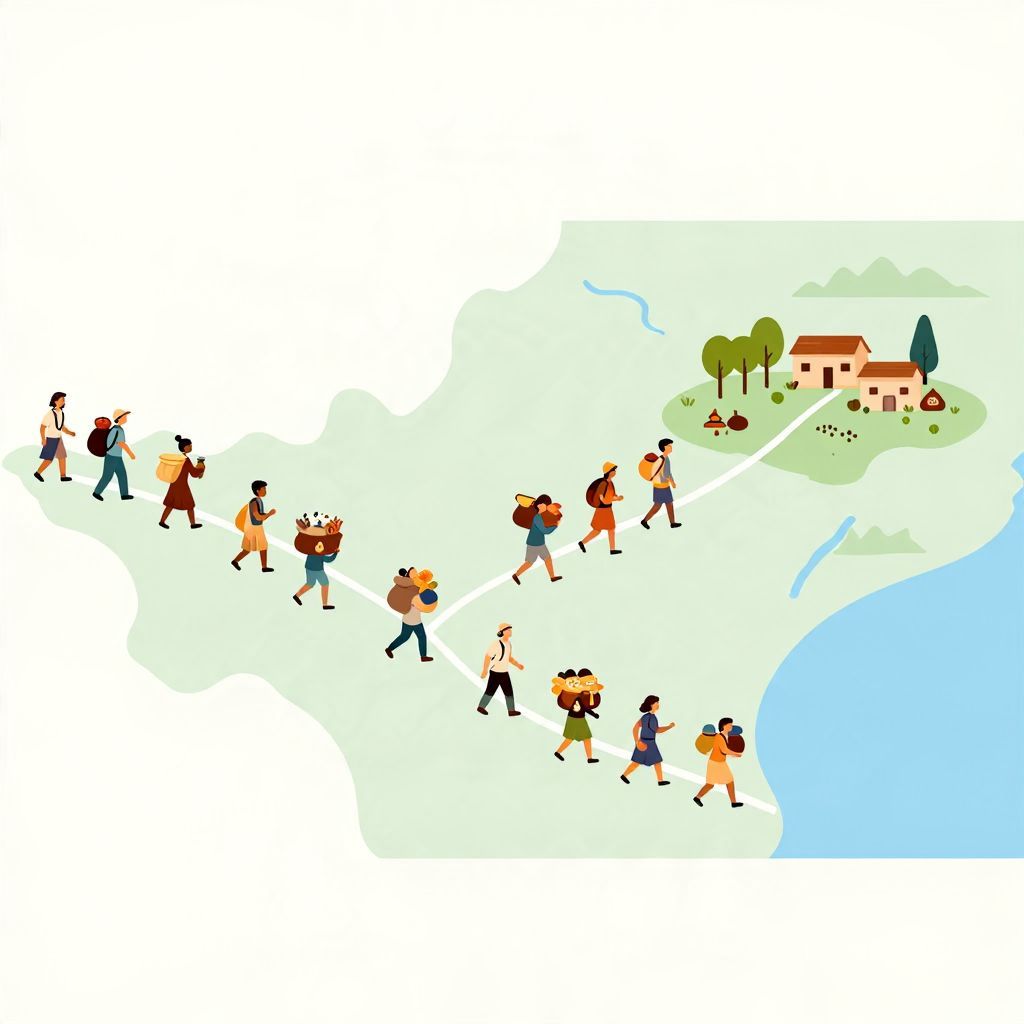
What is relocation diffusion, and why do historians and geographers use it to explain cultural change? The term describes the spread of ideas, languages, religions, technologies, or customs when people move from one place to another and carry those traits with them.
It is a useful concept because human migration has shaped societies for thousands of years. From ancient trade routes to modern urban migration, relocation diffusion helps explain how cultures travel, adapt, and sometimes transform in new environments.
What Is Relocation Diffusion?
Relocation diffusion is the spread of a cultural trait through the physical movement of people. Unlike ideas that spread by copying from neighbors, relocation diffusion happens when migrants, refugees, traders, or settlers bring their beliefs and practices into a new place. The original source may remain important, but the trait takes root elsewhere because people have moved.
How Relocation Diffusion Works
Relocation diffusion begins with migration. A group leaves one region and settles in another, carrying language, religion, foodways, dress, skills, or social customs. Some traits survive intact, while others change as migrants adapt to local conditions or interact with existing populations. Over time, the new place may become a fresh center of cultural influence.
Movement, not just contact
This is what distinguishes relocation diffusion from other forms of diffusion. In contagious diffusion, a practice spreads person to person across nearby space. In hierarchical diffusion, it spreads through power structures or influential institutions. In relocation diffusion, the key mechanism is the movement of people themselves.
Adaptation in a new setting
Relocated cultural traits rarely remain exactly the same. Migrants may modify language, cuisine, architecture, or religious practice to fit new landscapes, political systems, or neighbors. That is why relocation diffusion often produces hybrid cultures rather than simple copies of the original.
Historical Background and Origins of the Idea
The term is used mainly in geography and cultural history, especially in modern scholarship on migration and spatial change. It is not an ancient historical label, but the process it describes is as old as human movement itself. Long before the concept was formalized, historians observed that peoples on the move carried customs, technologies, and beliefs across continents.
Why scholars needed the concept
Geographers developed diffusion concepts to explain how culture spreads across space. Relocation diffusion became especially useful because many historical changes cannot be understood without migration: the settlement of new lands, the movement of enslaved people, the displacement of refugees, and the expansion of empires all moved culture as well as bodies.
Examples of Relocation Diffusion in History
Relocation diffusion appears throughout world history. Some of the clearest examples involve migration on a large scale, but smaller movements can matter too. The following cases show how people carried culture into new regions and reshaped them in the process.
Languages carried by migration
Languages often spread through relocation diffusion. When groups move and settle, they bring speech patterns with them. Over generations, the language may remain dominant, mix with local tongues, or split into new dialects. The spread of Indo-European languages across parts of Europe and Asia is often discussed in this context, though scholars debate the exact routes and timing of that expansion.
Religions on the move
Relocation diffusion also helps explain the spread of religions. Migrant communities have carried faith traditions into new lands, where they established temples, churches, mosques, synagogues, monasteries, or informal worship spaces. In many cases, the religion adapted to local customs while retaining core beliefs. Merchant diasporas, exile communities, and colonial settlers all played roles in this process.
Food, farming, and everyday life
People do not move alone; they bring seeds, animals, tools, and habits. Crops and farming techniques often spread with migrating populations. So do cooking practices, clothing styles, and building methods. A relocated community may continue familiar routines at first, then adjust them to new climates and available resources, creating new regional traditions.
Forced migration and cultural transfer
Not all relocation diffusion is voluntary. Enslaved people, deported populations, and refugees have often carried culture under coercive conditions. This is one of the most important and tragic aspects of the concept. Forced migration spread languages, music, religious practices, and skills across the Atlantic world, the Mediterranean, and many other regions, even as it caused immense suffering.
Relocation Diffusion in Ancient and Early Modern History
Although the term is modern, the historical process is ancient. Human migration has shaped societies since prehistory, and written history offers many examples of cultural movement through settlement. Empires, conquests, trade networks, and population displacement all contributed to relocation diffusion.
Ancient settlement and empire
As ancient states expanded, soldiers, administrators, merchants, and colonists moved into new territories. They brought legal practices, languages, religious rituals, and urban habits with them. Greek colonization around the Mediterranean, Roman settlement patterns, and later imperial expansions all created zones where relocated populations influenced local culture.
Medieval and early modern diasporas
In the medieval and early modern worlds, merchants and religious minorities often formed diasporic communities. These groups preserved traditions while also adapting to host societies. The movement of Jews across Europe and the Mediterranean, the spread of Islamic culture through trade and migration, and the movement of European settlers into the Americas all illustrate relocation diffusion in different forms.
Colonization and settlement
European colonization from the late 15th century onward produced especially large-scale relocation diffusion. Settlers transported languages, legal systems, crops, livestock, and religious institutions to the Americas, Africa, Asia, and Oceania. At the same time, colonized and enslaved peoples were forcibly relocated, carrying their own traditions into new and often hostile settings. The result was cultural mixing, but also domination and loss.
Key Facts About Relocation Diffusion
Several features help identify relocation diffusion in historical cases. These facts make the concept useful for analysis, especially when comparing different kinds of cultural spread.
- It depends on migration. People must physically move from one place to another.
- It transfers culture with people. Language, religion, technology, and customs travel together with migrants.
- It often creates hybrid cultures. New settings encourage adaptation and blending.
- It can be voluntary or forced. Trade migration, settlement, exile, slavery, and refugee movement can all produce it.
- It may reshape both origin and destination. The home region can lose population or influence, while the new region gains cultural traits.
Why Relocation Diffusion Matters to Historians
Historians use relocation diffusion to connect migration with long-term cultural change. It shows that movement is not only demographic; it is also intellectual and social. When people relocate, they do not leave their culture behind in a neat package. They carry memory, practice, and identity with them, and those traits can alter the places where they settle.
It explains continuity and change
The concept helps answer a basic historical question: how do traditions survive across distance? Sometimes they remain recognizable for centuries. Sometimes they change quickly in response to local conditions. Relocation diffusion explains both outcomes by focusing on the people who move and the settings they enter.
It reveals power and inequality
Migration is not always equal or free. Empires, conquest, slavery, famine, and persecution have forced many relocations. That means relocation diffusion is tied to power: who moves, under what conditions, and who controls the new environment. Studying it can reveal both cultural creativity and historical injustice.
Relocation Diffusion Compared with Other Types of Diffusion
To understand the term clearly, it helps to compare it with other diffusion models often used in geography and history. These categories sometimes overlap, but they emphasize different mechanisms.
- Relocation diffusion: people move and carry culture with them.
- Contagious diffusion: a trait spreads rapidly through direct contact across nearby space.
- Hierarchical diffusion: a trait spreads through institutions, elites, or major cities before reaching others.
- Stimulus diffusion: the underlying idea spreads, but it is adapted or modified in the new setting.
In real history, these forms often overlap. A migrant community may spread a practice by relocation, then neighboring groups may adopt it through contagious or hierarchical diffusion.
Common Misunderstandings
One common mistake is to treat relocation diffusion as a purely modern phenomenon. In fact, it has been central to human history for millennia. Another misunderstanding is to assume that relocation always preserves culture unchanged. In reality, relocation often produces innovation, blending, and selective retention rather than simple duplication.
Not every cultural spread is relocation diffusion
If a fashion trend spreads through social media or a religious idea spreads through preaching without mass movement, that is not relocation diffusion in the strict sense. The term is best reserved for cases where migration itself is the main engine of cultural transfer.
Conclusion: The Historical Importance of Relocation Diffusion
Relocation diffusion is the spread of culture through human movement. It helps explain how languages, religions, technologies, and customs travel across regions, adapt to new settings, and sometimes reshape entire societies. Because migration has been a constant feature of history, relocation diffusion is one of the most important ways to understand cultural change over time.
For related ideas, see what is sequent occupance and what is cultural divergence.