
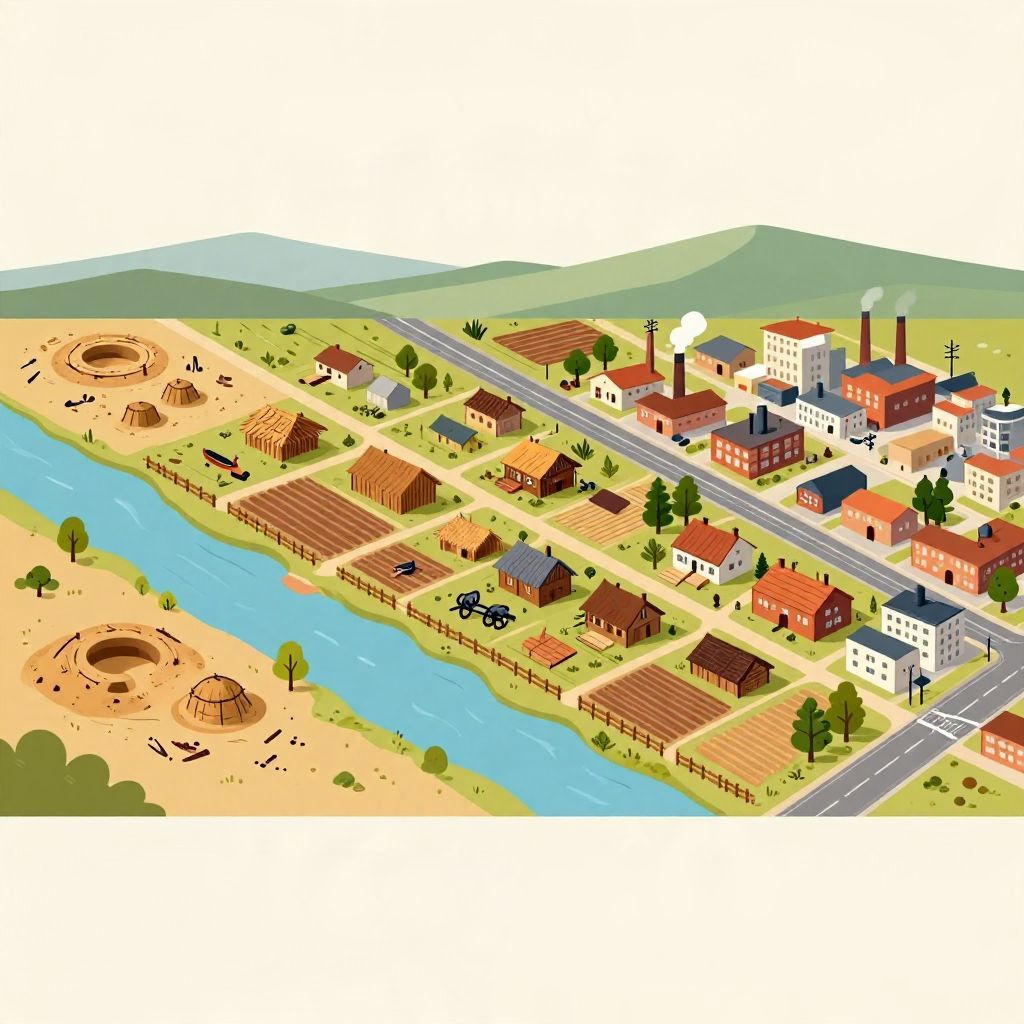
What is sequent occupance? In historical geography, it is the idea that a place is shaped by a series of different peoples, cultures, and land uses over time. Each group leaves traces behind, so the landscape becomes a record of past occupations rather than a blank slate.
The concept helps historians and geographers explain why cities, farms, roads, and borders often reflect older patterns of settlement. It is especially useful for understanding how geography and history interact across long periods.
What Is Sequent Occupance?
Sequent occupance is the study of how successive groups occupy and modify the same place over time. Instead of seeing a region as belonging to one culture or era, the concept shows that landscapes are layered. Old street plans, field boundaries, ruins, place names, and land-use patterns can all survive into later periods.
The basic idea
The term is most closely associated with American geographer Derwent Whittlesey, who used it in the early 20th century. His point was not simply that people move in and out of places, but that each occupation changes the environment in ways that influence later settlement. In this sense, history is written onto the land.
Why it matters
Sequent occupance matters because it connects geography with historical change. It helps explain why some places develop dense urban cores, why old transport routes persist, and why cultural landscapes rarely reflect only the present. The concept is widely used in historical geography, cultural geography, and regional studies.
Where Did the Concept Come From?
The idea emerged in early 20th-century geography, when scholars were trying to understand regions as historical processes rather than fixed maps. Whittlesey and other geographers were interested in how human groups adapted to environments and then altered them for later groups. The concept grew out of landscape study, not from one single event or discovery.
Derwent Whittlesey and historical geography
Whittlesey’s work helped shape the field of historical geography in the United States. He emphasized that regions should be studied through time, not only at one moment. Sequent occupance became a useful way to describe the cumulative effects of migration, conquest, colonization, economic change, and urban growth.
Related intellectual traditions
The concept also fits with broader ideas in geography and history from the late 19th and early 20th centuries, when scholars increasingly examined how humans transform environments. It overlaps with cultural landscape studies, environmental history, and regional analysis. In each case, the key insight is that places are historical documents.
How Sequent Occupance Works in History
Sequent occupance is not a single event but a process. A region may be occupied by one group, then another, and then another, with each leaving physical and cultural traces. Some traces are visible, while others survive in memory, language, or land-use patterns. The older layers may be buried, but they are rarely erased completely.
Common layers left behind
- Buildings and ruins that are reused, rebuilt, or abandoned
- Roads and routes that continue to guide movement
- Field systems and property boundaries that outlast political change
- Place names that preserve older languages or rulers
- Religious and civic sites reused by later communities
- Economic patterns such as ports, markets, or mining centers that shape later development
Why earlier patterns persist
Later groups often inherit practical advantages from earlier ones. A river crossing, natural harbor, fertile valley, or defensible hill may attract repeated settlement. Even when new rulers arrive, they usually build on existing infrastructure because it is cheaper and more efficient than starting over. That is why sequent occupance often appears as continuity mixed with change.
Examples of Sequent Occupance in the Past
The concept can be seen in many parts of the world. It is especially clear in places with long settlement histories, repeated conquest, or major migration. These examples show how different societies can occupy the same landscape in succession while leaving lasting marks.
Ancient and medieval cities
Many old cities show sequent occupance because they have been inhabited for centuries or millennia. In such places, later streets may follow older routes, and newer buildings may stand on earlier foundations. Archaeological layers often reveal a sequence of occupations, each with its own material culture.
For example, cities in the eastern Mediterranean, the Near East, and parts of Europe often contain remains from multiple eras. A Roman road might influence a medieval street, which later becomes part of a modern city plan. The city is not one civilization frozen in time but a palimpsest of successive occupations.
Colonial and postcolonial landscapes
Sequent occupance is also useful for understanding colonial history. In many regions, Indigenous peoples occupied and shaped the land long before European colonization. Colonial powers often renamed places, reorganized land ownership, and built new administrative centers. After independence, postcolonial states sometimes inherited the same roads, ports, plantations, and city layouts.
This does not mean every layer was equal or peaceful. Occupation could involve displacement, violence, forced labor, or cultural suppression. Sequent occupance is a descriptive concept, not a claim that all transitions were natural or benign. It helps historians see the sequence, but it does not erase power or conflict.
Rural landscapes and agriculture
In the countryside, sequent occupance may appear in terraced fields, irrigation systems, hedgerows, or grazing patterns. One farming community may establish a land-use system that later settlers adapt. Even when agriculture changes, older boundaries can remain visible in property lines or vegetation patterns.
Why Historians and Geographers Use the Term
Historians and geographers use sequent occupance because it captures the long-term layering of human activity. It is a useful tool for explaining why places do not simply “change” in a straight line. Instead, they accumulate histories. This makes the concept especially valuable for studying settlement, migration, urban development, and cultural memory.
It highlights continuity and change
One of the strengths of the concept is that it shows both continuity and disruption. A new population may replace an older one politically, but not physically. Roads, harbors, terraces, and sacred sites may remain in use. At the same time, new languages, religions, and economic systems can transform the meaning of the landscape.
It helps interpret the cultural landscape
The term is closely tied to the idea of the cultural landscape, meaning a landscape shaped by human activity. Sequent occupance explains how cultural landscapes develop over time. It encourages researchers to ask not only who lives somewhere now, but who lived there before and what traces remain.
How Sequent Occupance Differs from Simple Settlement History
Not every sequence of settlement counts as sequent occupance in the stronger historical-geographic sense. The term implies that each occupation leaves a visible or meaningful imprint on the place itself. A mere list of people who lived somewhere is not enough. The key question is how each group altered the landscape and influenced later use.
More than replacement
Sequent occupance is more than saying one group replaced another. It emphasizes accumulation. Even after political control changes, older structures, land divisions, and cultural habits may survive. That layered quality is what makes the concept distinctive.
More than archaeology alone
Archaeology can reveal sequences of occupation, but sequent occupance is broader. It includes historical documents, maps, oral traditions, place names, and visible landscapes. It is a way of reading history across space as well as time.
Limitations and Criticisms of the Concept
Although useful, sequent occupance has limits. It can sometimes make historical change seem smoother than it really was. In reality, conquest, forced migration, environmental collapse, and state violence can produce abrupt breaks. The concept should not be used to blur those disruptions.
It can oversimplify conflict
Some landscapes were not simply passed from one group to another. They were contested, destroyed, rebuilt, or depopulated. If used carelessly, sequent occupance may understate the severity of displacement or colonial domination. Good historical analysis must pair the concept with evidence about power and conflict.
It may hide unequal survival of traces
Not all groups leave the same kind of evidence. Dominant powers are more likely to preserve monuments, archives, and official place names, while marginalized communities may leave fewer visible traces. As a result, the landscape can reflect unequal historical survival, not a fair record of all occupants.
Sequent Occupance in Modern Scholarship
Today, the concept remains useful in geography, heritage studies, and historical interpretation. Scholars use it to explain urban layering, regional identity, and the long afterlife of older land-use systems. It also appears in discussions of preservation, because older structures often reveal how a place developed over centuries.
Urban planning and preservation
In cities, sequent occupance helps explain why modern infrastructure must often adapt to older street grids, historic districts, and archaeological remains. Planners and preservationists use this perspective to balance development with heritage. The concept reminds us that demolition can erase important historical evidence.
Environmental history
The idea is also useful in environmental history, where scholars study how people transform soils, forests, waterways, and coastlines over time. Successive occupations may intensify land use, change ecosystems, or leave long-lasting environmental effects. In this sense, sequent occupance is not only cultural but ecological.
Key Facts About Sequent Occupance
- Meaning: successive occupation of the same place by different groups over time
- Associated scholar: Derwent Whittlesey
- Field: historical geography and cultural geography
- Main idea: places retain layers of past human activity
- Common evidence: ruins, roads, field boundaries, place names, reused sites
- Historical value: helps explain continuity, change, and the layering of landscapes
Why the Concept Still Matters
Sequent occupance remains important because it offers a clear way to think about the historical depth of place. It reminds us that landscapes are not static backdrops but active records of human life. Every generation inherits a world already shaped by earlier ones, and then reshapes it again.
For that reason, sequent occupance is more than a geography term. It is a historical lens for understanding how societies build on the past, sometimes preserve it, and sometimes struggle over it. If you want to explore more historical concepts and cultural landscapes, you can also browse related articles at My Life Is History.