
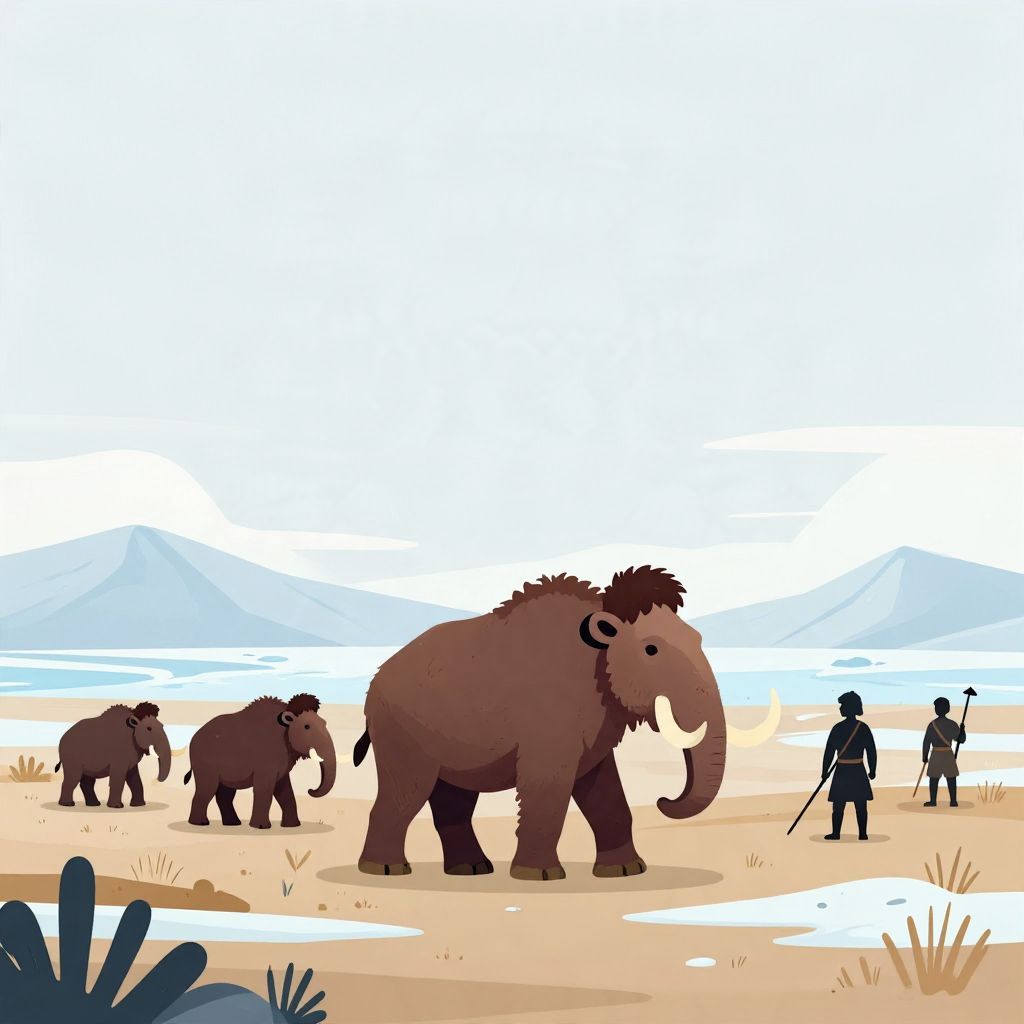
How did woolly mammoths go extinct? The short answer is that they disappeared through a combination of climate change and human hunting, with the balance varying by region and time. Their decline was not a single sudden event but a long process that unfolded as the Ice Age ended and habitats changed.
For thousands of years, woolly mammoths survived across northern Eurasia and North America. By the end of the last Ice Age, however, shrinking cold grasslands, isolated populations, and pressure from human hunters made survival much harder. The last small groups persisted on remote islands for millennia, but eventually even they vanished.
How Did Woolly Mammoths Go Extinct?
Woolly mammoths went extinct because their Ice Age environment disappeared and their populations became too small and vulnerable to recover. Warming temperatures reduced the cold, dry “mammoth steppe” they depended on, while human hunting likely added stress. Most mainland mammoths were gone by about 10,000 years ago, though a few isolated island populations survived much longer.
The World Woolly Mammoths Needed
Woolly mammoths were adapted to the cold, open landscapes of the late Pleistocene, especially the vast grasslands and tundra-steppe of Eurasia and North America. They fed on grasses, herbs, and sedges, and their thick fur, fat layer, and curved tusks helped them survive harsh winters. Their success depended on a stable Ice Age ecosystem.
The Ice Age habitat
The mammoth steppe was not a frozen wasteland. It was a productive, dry, cold environment with enough plant life to support large herds of grazing animals. Mammoths thrived there alongside other Ice Age species such as woolly rhinoceroses, reindeer, bison, and horses. When the climate warmed after the Last Glacial Maximum, that ecosystem began to break apart.
Climate Change Was the Biggest Long-Term Pressure
As the last Ice Age ended, temperatures rose and glaciers retreated. Forests spread northward, wetlands expanded, and the open grassy habitats mammoths preferred became smaller and more fragmented. In many regions, the land itself changed faster than mammoth populations could adapt. This habitat loss is widely seen as the central driver of their decline.
Why warming mattered so much
Mammoths were specialized for cold environments. They could survive in a range of conditions, but they were best suited to open, dry terrain with abundant low-growing plants. As forests replaced grasslands, mammoths lost feeding grounds and movement corridors. Smaller, isolated herds were also more exposed to disease, bad weather, and random population crashes.
Human Hunting Likely Added to the Decline
Modern humans spread into mammoth regions during the late Ice Age, and archaeological evidence shows that people hunted mammoths in some places. Hunters used stone-tipped weapons and likely targeted them for meat, hides, bones, and ivory. Most historians and archaeologists now think hunting alone did not wipe mammoths out everywhere, but it likely intensified their decline, especially in already stressed populations.
Not a simple “overkill” story
Older explanations often blamed humans almost entirely, suggesting that newly arrived people quickly exterminated mammoths across continents. Today, that view is usually considered too simple. The evidence points instead to a mixed cause: climate change reduced habitat and food, while human hunting increased mortality and slowed recovery. The importance of each factor probably varied from place to place.
Population Collapse Made Recovery Difficult
Once mammoth groups became small and scattered, they faced problems that large herds could better withstand. Fewer breeding adults meant fewer calves, and isolated populations had less genetic diversity. That made them more vulnerable to inbreeding, illness, and environmental shocks. Even if conditions improved locally, tiny populations could still disappear before rebounding.
The danger of being isolated
Large herbivores need room to roam. When mammoth habitat became patchy, herds could become trapped in shrinking refuges. Small populations are especially fragile because one harsh winter, one disease outbreak, or sustained hunting pressure can have outsized effects. Extinction often happens not because a species fails all at once, but because it gradually loses the ability to recover.
A Timeline of Mammoth Extinction
The extinction of woolly mammoths was staggered, not uniform. Different populations disappeared at different times depending on local conditions. The broad sequence looks like this:
- About 20,000–15,000 years ago: Mammoths were still widespread across northern Eurasia and North America.
- About 15,000–10,000 years ago: Rapid warming and habitat change caused major declines on the mainland.
- By about 10,000 years ago: Most mainland woolly mammoths had vanished.
- About 4,000 years ago: A small population survived on Wrangel Island in the Arctic Ocean.
- Possibly until about 3,700 years ago: Mammoths may have persisted on St. Paul Island in Alaska, though the exact date is debated.
Why some survived so long on islands
Remote islands acted as refuges because they were harder for humans to reach and sometimes retained cooler conditions longer than the mainland. But island survival came with a cost: the populations were tiny. Eventually, even these refuges could not protect mammoths from environmental change, limited resources, and the long-term effects of small population size.
What Happened on Wrangel Island?
Wrangel Island provides the clearest late-survival case. Mammoths there lived thousands of years after their mainland relatives had disappeared. Genetic evidence suggests this population was small and isolated for a long time. That isolation probably helped preserve them briefly, but it also made them vulnerable. Their final extinction likely came from a combination of resource limits, genetic weakness, and environmental instability.
Evidence from archaeology and genetics
Scientists have studied bones, tusks, and ancient DNA to reconstruct mammoth history. These studies show that the final island populations were not thriving survivors of an unchanged world; they were remnants of a once vast species. Their genomes reveal signs of low diversity and accumulated harmful mutations, which may have reduced long-term resilience.
Did Humans Cause the Final Extinction?
For the last island populations, human influence may have mattered more than it did on the mainland, but the evidence is not always straightforward. On the mainland, people and mammoths overlapped for thousands of years in some regions. On islands, even limited hunting or disturbance could have had serious effects. Still, scientists generally avoid claiming a single cause for the final disappearance.
What historians and scientists can say with confidence
The strongest conclusion is that woolly mammoths did not vanish for one reason alone. Their extinction was the result of interacting pressures: warming climate, shrinking habitat, fragmented populations, and human hunting in some places. The relative importance of each factor differed by region, but together they pushed the species beyond recovery.
Why Woolly Mammoths Matter Today
The extinction of woolly mammoths is important because it shows how large animals can disappear when environmental change happens too quickly and populations become fragmented. It is also one of the best-studied examples of the debate over climate versus human impact in prehistoric extinctions. Mammoths remain a powerful case study in ecology, archaeology, and conservation biology.
Lessons from an extinct Ice Age giant
The mammoth story reminds us that extinction is often cumulative rather than sudden. A species can survive for a long time under stress, then collapse when several pressures overlap. That makes woolly mammoths more than a symbol of the Ice Age: they are a warning about the vulnerability of specialized species in changing environments.
In the end, woolly mammoths went extinct because the world they were built for disappeared, and they could not adapt fast enough. Climate change did the largest structural damage, while human hunting likely accelerated the decline in some regions. Their story is a reminder that extinction often comes from the interaction of many causes, not just one dramatic event.