
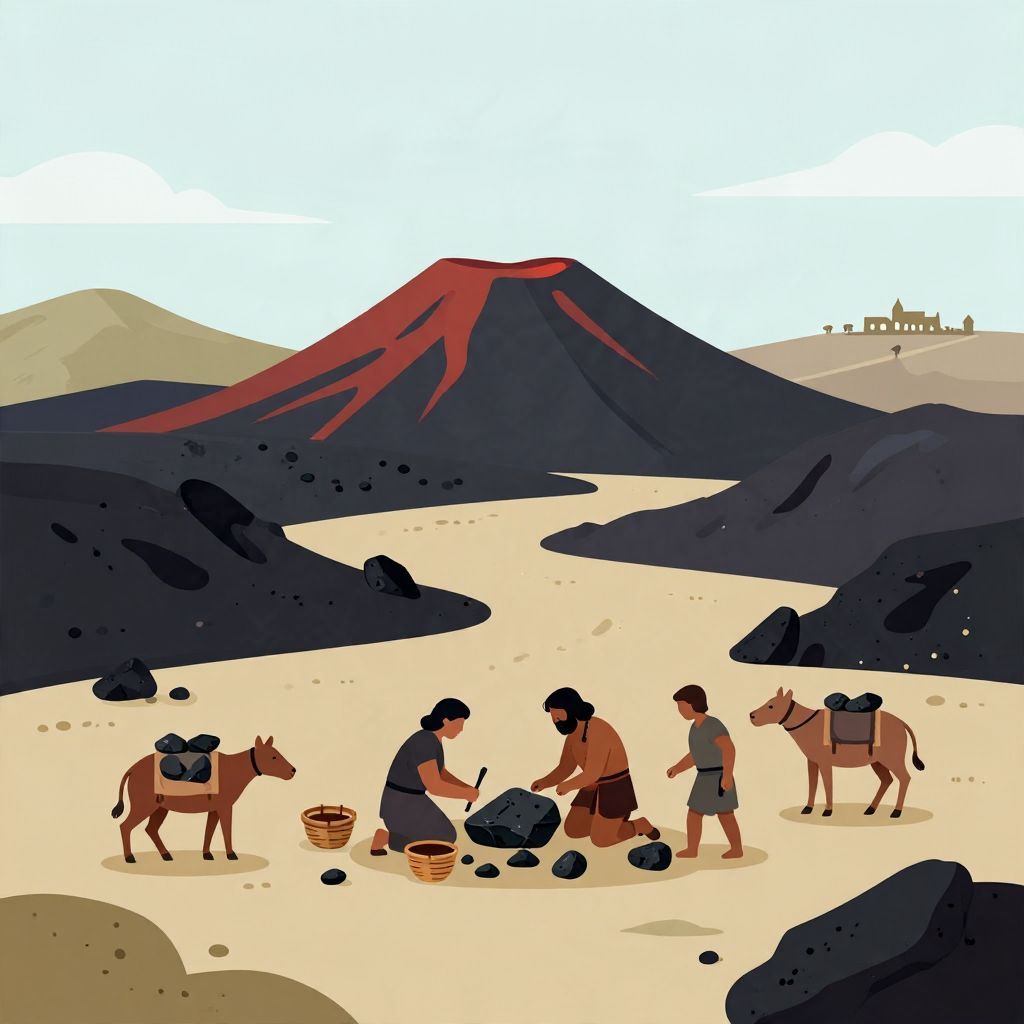
Obsidian is a natural volcanic glass, and the historical question “where is obsidian found” is really a question about where ancient people could obtain it. The short answer is that obsidian occurs in places with past or present volcanic activity, especially where silica-rich lava cooled very quickly. Because of that, it is found in many parts of the world, from the Mediterranean and the Near East to the Americas and East Africa.
For historians and archaeologists, obsidian matters because it was one of the most useful raw materials in the ancient world. Its sharp edges made it ideal for blades, scrapers, and projectile points, and its sources can often be traced, revealing long-distance trade and movement in prehistory.
Where is obsidian found?
Obsidian is found near volcanic regions where lava cooled so quickly that crystals did not have time to form. Major natural sources include Iceland, Italy, Turkey, Armenia, Ethiopia, Kenya, Japan, Mexico, Guatemala, the western United States, and parts of South America. In historical terms, people usually found it as nodules, flows, or outcrops near volcanoes rather than in broad sedimentary deposits.
Why volcanic settings matter
Obsidian forms when silica-rich lava erupts and cools rapidly at the surface. This fast cooling locks the material into a glassy state. Because the conditions required are specific, obsidian is not evenly distributed across the earth. Instead, it appears in scattered zones associated with volcanic arcs, rift valleys, and island chains.
Common geological settings
- Volcanic domes and lava flows where silica-rich magma solidified quickly.
- Rift zones such as East Africa, where volcanic activity is ongoing.
- Island volcanic regions like Japan and Iceland.
- Continental volcanic belts including the Andes and western North America.
How ancient people located obsidian sources
People in antiquity usually found obsidian close to the surface, often as dark, glossy rock exposed in cliffs, boulders, or fresh volcanic deposits. In many areas, local communities knew the nearest source and gathered it directly. Over time, some sources became famous and were visited repeatedly because the stone was so valuable for tools and exchange.
Field gathering and source knowledge
Obsidian was not mined in the modern industrial sense for most of history. Instead, it was collected from exposed outcrops or loose pieces near volcanic terrain. In some regions, such as the central Anatolian plateau or parts of Mesoamerica, people developed detailed knowledge of specific sources, which later archaeologists have been able to identify through geochemical analysis.
What made it so useful
Obsidian fractures with a conchoidal, shell-like break, creating edges that can be extremely sharp. This made it especially valuable before metal tools became widespread. Ancient communities used it for knives, sickles, scrapers, drills, and weapon points. Its practical importance helped drive trade networks over considerable distances.
Major historical obsidian regions
Obsidian has a global distribution, but some regions are especially important in human history because they supplied large amounts of stone and supported trade across wide areas. These sources helped shape prehistoric economies, settlement patterns, and technological change.
Anatolia and the Near East
One of the most important early obsidian landscapes lay in Anatolia, especially central and eastern Turkey. Sources in this region were used extensively during the Neolithic and later periods. Obsidian from Anatolia traveled into the Levant, Mesopotamia, and beyond, showing that exchange networks existed long before writing in many areas.
Archaeologists have long studied obsidian from places such as Cappadocia and eastern Anatolian volcanic areas because they supplied communities across the ancient Near East. These sources are significant not because they were the only ones, but because they were among the most heavily used in early farming societies.
The Aegean and Mediterranean
In the Mediterranean, obsidian was especially important on islands and volcanic coasts. Melos in the Aegean is one of the best-known prehistoric obsidian sources in Europe. Its stone moved widely through island and mainland networks during the Neolithic and Bronze Age. Other Mediterranean sources include parts of Italy and the volcanic islands of the central Mediterranean.
Because the sea connected communities more efficiently than rough overland routes, obsidian could travel far from its source. This makes it a valuable clue for historians studying early maritime exchange.
East Africa
East Africa contains several obsidian-bearing volcanic zones, especially in Ethiopia, Kenya, and neighboring areas. These sources were important for early human populations and later pastoral and farming communities. In archaeological studies, East African obsidian is particularly useful because it helps trace mobility and trade across landscapes shaped by rift volcanism.
In this region, obsidian is often linked to the broader story of human adaptation to varied environments. Its presence at sites far from the source can indicate seasonal movement, exchange between groups, or both.
Mesoamerica
Obsidian was one of the most important materials in ancient Mesoamerica. Major sources in central Mexico and Guatemala supplied tools for Olmec, Maya, Teotihuacan, Toltec, and Aztec societies, among others. Some of the best-known sources include Pachuca, Ucareo, and El Chayal, though many others mattered regionally.
Because obsidian was so central to daily life, politics, and ritual, control over sources and trade routes could become a source of power. In some cases, elite centers used access to high-quality obsidian to strengthen their influence over surrounding communities.
Western North America
Obsidian is widespread in volcanic areas of the western United States, including the Cascade Range, the Great Basin, California, Oregon, Idaho, and Yellowstone-related volcanic fields. Indigenous peoples used these sources for thousands of years. Archaeologists have traced obsidian from these regions across large parts of North America, showing extensive native exchange networks.
In this context, obsidian was not simply a toolstone. It was also part of social relationships, intergroup trade, and regional identity. Some sources became especially important because they produced glass of a particular quality or color.
Japan and the Pacific
Japan has numerous obsidian sources associated with its volcanic geology. These were used from the Paleolithic onward. In the broader Pacific world, volcanic islands often provided local obsidian, though the distances between islands meant that its movement could be limited or highly specialized depending on the period and community.
Obsidian in history and archaeology
Obsidian is historically important because it helps scholars reconstruct how people lived, traveled, and traded. Unlike many organic materials, obsidian survives well in archaeological contexts. Its chemical composition can often be matched to a specific geological source, allowing researchers to map ancient exchange routes with unusual precision.
What obsidian sourcing reveals
- Trade networks between communities separated by distance.
- Mobility patterns of hunter-gatherers, farmers, and pastoralists.
- Political influence where elites controlled access to sources.
- Technological change as tools shifted from stone to metal.
From local stone to long-distance exchange
In many prehistoric societies, obsidian began as a local resource. Over time, however, some sources became part of wider systems of exchange. This was especially true where high-quality obsidian was scarce or where communities valued a particular source for its sharpness, color, or symbolic meaning. The result was a material that could move hundreds of kilometers from its geological origin.
Did ancient people always use the nearest source?
Not always. While many groups used the closest available obsidian, others sought specific sources because of quality, tradition, or trade connections. In some cases, a distant source was preferred even when a nearer one existed. This suggests that obsidian was not only a practical material but also one embedded in social and economic choices.
Why source choice changed over time
Source choice could depend on access to routes, seasonal movement, political control, or the needs of specialized craft production. A community might use local stone for everyday tools while importing a distinctive obsidian for prestige items or ceremonial purposes. That pattern is especially visible in complex societies of the ancient Near East and Mesoamerica.
Myths, legends, and modern misunderstandings
Because obsidian is shiny and dramatic, it has often been surrounded by symbolic meanings. Some traditions used it in ritual or divination, and later cultures sometimes attributed mystical powers to it. Those beliefs are part of cultural history, but they should not be confused with the geological fact of where obsidian is found.
Another common misunderstanding is that obsidian comes from any volcano in large quantities. In reality, not every volcanic eruption produces obsidian. The lava must be silica-rich and cool rapidly under the right conditions. That is why obsidian is common in some volcanic regions and absent in others.
Why the location of obsidian mattered historically
Knowing where obsidian was found shaped ancient economies and technologies. Communities near good sources had access to a high-value material, while communities farther away depended on exchange. This helped create trade routes, encourage interaction between distant groups, and sometimes concentrate power in the hands of those who controlled access.
For historians, obsidian is therefore more than a rock. It is evidence of how people connected landscapes, how early societies organized exchange, and how geography influenced daily life long before modern industry.
Conclusion
So, where is obsidian found? It is found in volcanic regions around the world, especially where silica-rich lava cooled rapidly and formed natural glass. Historically, its most important sources were in places such as Anatolia, the Aegean, East Africa, Mesoamerica, and western North America, where people gathered it, traded it, and turned it into essential tools. For related historical geography and material culture topics, you may also be interested in ancient trade routes and the history of stone tools.