
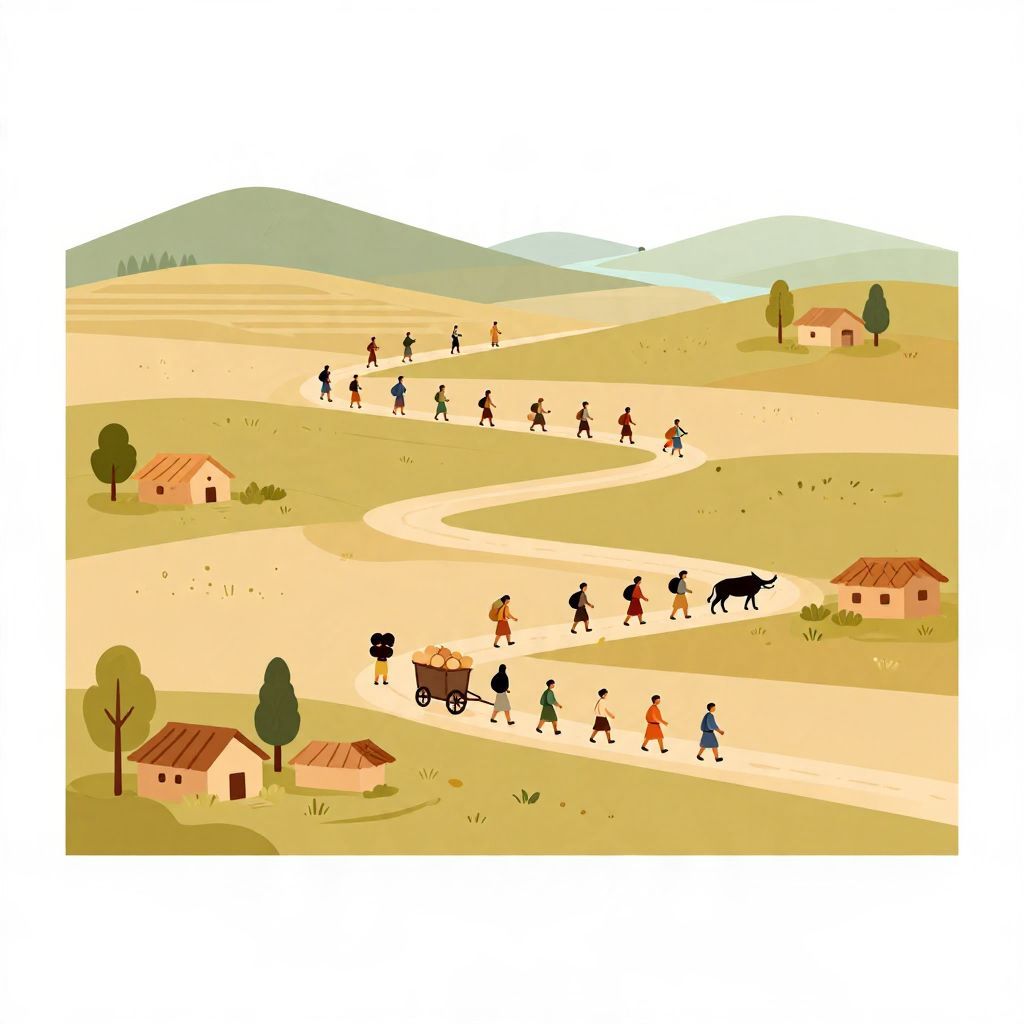
Step migration is a pattern of human movement in which people relocate in stages rather than in one long journey. Instead of moving directly from an origin to a final destination, migrants pass through a series of intermediate places, often settling temporarily before moving again. Historians use the term to explain how migration often happens in practical, incremental steps.
The idea helps make sense of many historical population movements, from rural-to-urban shifts to long-distance migration across continents. It is not a single event or a formal policy, but a useful concept for understanding how geography, economics, family networks, and opportunity shape the routes people take.
What Is Step Migration?
Step migration is a gradual migration process in which people move from one place to another in stages, often from a village to a town, then to a city, and sometimes onward to another region or country. Each stop may be temporary or semi-permanent. The pattern reflects how people adapt to barriers such as distance, cost, employment, and social ties.
The basic idea
In its simplest form, step migration means that migration is not always a single leap. A family might leave a small rural settlement for a nearby market town, then later move to a larger city with better wages, schools, or transport links. Each move is a “step” that makes the next one more possible.
Why historians use the term
Historians and geographers use step migration because it captures the layered reality of movement. People rarely migrate only because they want to “go somewhere else.” They move when conditions change, when transport becomes available, when relatives settle ahead of them, or when they gain enough resources to continue onward. The term helps explain migration as a process, not a single decision.
How Step Migration Works in History
Step migration usually develops when people move through a hierarchy of places. A smaller settlement offers the first opportunity to leave home, a larger town offers more work, and a major city or port may offer still more. Over time, these intermediate moves can reshape whole regions by concentrating people in urban centers and emptying out rural districts.
Common historical drivers
- Economic opportunity: wages, markets, land, or jobs in larger centers
- Transport routes: roads, railways, rivers, ports, and later motor travel
- Family and community networks: relatives or neighbors who moved earlier
- Political or environmental pressure: war, taxation, famine, land scarcity, or insecurity
- Education and services: schools, hospitals, and administrative centers
Typical sequence
- A person or family leaves a small place with limited prospects.
- They settle in a nearby town or regional center.
- After saving money, gaining skills, or hearing of better prospects, they move again.
- The final destination is often a larger city, industrial zone, or foreign destination.
Historical Origins of the Concept
The term “step migration” is modern, but the pattern it describes is old. People have moved in stages for as long as there have been settlements, trade routes, and unequal access to land and work. Scholars especially used the concept in the 20th century to describe urbanization and rural-to-urban migration, when millions of people moved from villages to towns and then to larger cities.
From ancient movement to modern analysis
In ancient and medieval societies, migration often followed roads, river valleys, caravan routes, or seasonal labor opportunities. People did not always travel directly to a distant destination. They often paused in trading centers, frontier zones, or fortified towns. Modern historians later recognized that this staged movement was a common pattern and gave it a name.
Why the modern world made it more visible
Industrialization, colonial expansion, and the growth of global cities made step migration easier to observe. Railways, steamships, and labor markets connected settlements in new ways. At the same time, local communities often lacked the resources for direct long-distance migration, so people moved gradually, using each move to reduce risk and gather information.
Examples of Step Migration in History
Step migration appears in many periods and regions, though the exact form changes with local conditions. It is especially visible in histories of urban growth, frontier settlement, and labor migration.
Rural-to-urban migration
One of the clearest examples is movement from countryside to town to city. In many countries during the 19th and 20th centuries, young people left villages for regional towns first, then later moved to industrial cities. This pattern allowed them to build contacts, learn new skills, and reduce the risk of moving too far too quickly.
Migration along colonial and imperial networks
In imperial settings, step migration often followed administrative or commercial routes. People moved to district centers, colonial ports, or plantation zones before relocating again. Such movements were shaped by labor demands, taxation, land pressure, and the unequal opportunities created by empire. Step migration could therefore be both voluntary and constrained.
Frontier and settlement migration
In frontier regions, settlers often moved in stages from older, more established areas into newly opened lands. A family might first move to a border town, then to a frontier village, and only later to remote farmland. This incremental process was common where roads, security, and services developed unevenly.
International migration by stages
Some migrants moved across borders in steps rather than directly from origin to final destination. For example, a worker might first move to a neighboring country, then later continue to a larger labor market elsewhere. This often happened when direct travel was expensive, legally restricted, or dependent on existing migrant networks.
Why People Moved in Stages
Step migration was often a practical response to uncertainty. Migration can be costly, risky, and socially disruptive. Moving in stages allowed people to test opportunities, avoid total failure, and adjust to changing circumstances. In many cases, the first move was not intended to be the last.
Risk reduction
A staged move reduced the danger of leaving home with too little money or information. A migrant could stop in a nearby town, work temporarily, and decide whether to continue. If conditions worsened, they might remain there rather than make a longer and more dangerous journey.
Information and chain migration
Step migration often worked alongside chain migration, in which earlier migrants help later ones by sharing information, housing, or work contacts. A person who moved first to a town could later guide relatives to the same place. Each move created a bridge to the next one.
Access to transport and labor markets
As transport systems expanded, people could move farther, but not always all at once. Rail stations, ports, and road junctions became stepping-stones. Likewise, labor markets were often organized in tiers: local work first, then regional jobs, then industrial or overseas opportunities.
Step Migration and Urbanization
Step migration is closely tied to urbanization, the long-term growth of towns and cities. As people moved through intermediate settlements, some places grew rapidly while others lost population. This process helped create urban hierarchies, with small towns feeding larger ones and larger ones feeding metropolitan centers.
The role of intermediate towns
Intermediate towns are important because they absorb migrants who are not yet ready for a major city. They provide wages, housing, markets, and transport connections. Over time, these towns can become regional hubs in their own right, even as they continue to send people onward.
Effects on rural areas
When step migration becomes widespread, rural areas may lose younger workers first. This can change farming patterns, household structures, and local economies. In some places, remittances from migrants help support families left behind. In others, depopulation weakens villages and accelerates further migration.
Is Step Migration the Same as Other Types of Migration?
Step migration is related to other migration patterns, but it is not identical to them. The term describes the route and sequence of movement rather than the reason for moving. A person can be a refugee, labor migrant, or settler and still move in steps.
Step migration vs. chain migration
Chain migration focuses on social connections: one migrant follows another because of family or community ties. Step migration focuses on the staged route. In practice, the two often overlap because earlier migrants create the conditions that make later steps possible.
Step migration vs. circular migration
Circular migration involves repeated movement back and forth between places, such as seasonal labor migration. Step migration usually means onward movement from one place to another, though a person may pause or return before continuing. The key feature is progression through intermediate places.
Step migration vs. permanent relocation
Permanent relocation suggests a single final move. Step migration emphasizes that the final destination may be reached only after several smaller moves. Some people settle permanently at an intermediate stage, while others continue moving. The process is flexible rather than fixed.
Historical Significance of Step Migration
Step migration matters because it helps explain how populations have changed over time. It shows that migration is often gradual, strategic, and shaped by everyday decisions rather than only by dramatic events. The concept also reveals how small settlements, towns, and cities are linked within wider historical systems.
What it reveals about society
Step migration highlights inequality in access to land, education, and work. It also shows how people used networks and local knowledge to navigate those inequalities. In many societies, mobility was not simply about freedom to move; it was about moving in the most realistic way available.
Long-term consequences
Over time, step migration can strengthen urban growth, deepen regional inequality, and spread languages, customs, and labor practices across wider areas. It can also create migrant communities that preserve ties to earlier homes while adapting to new ones. These patterns have shaped modern demographic history in many parts of the world.
Key Facts About Step Migration
- It is a pattern of staged movement, not a single historical event.
- It can occur in rural, urban, colonial, frontier, and international settings.
- It often involves intermediate settlements such as towns or regional centers.
- It is shaped by economics, transport, family networks, and risk.
- It is closely linked to urbanization and labor migration.
Conclusion: Why Step Migration Still Matters
Step migration is the historical idea that people often move in stages, not in one direct leap. It helps explain how human mobility has worked across centuries: cautiously, incrementally, and in response to changing opportunities. For a fuller picture of migration history, it is useful to compare this pattern with broader themes such as urbanization in history and migration and empire.