
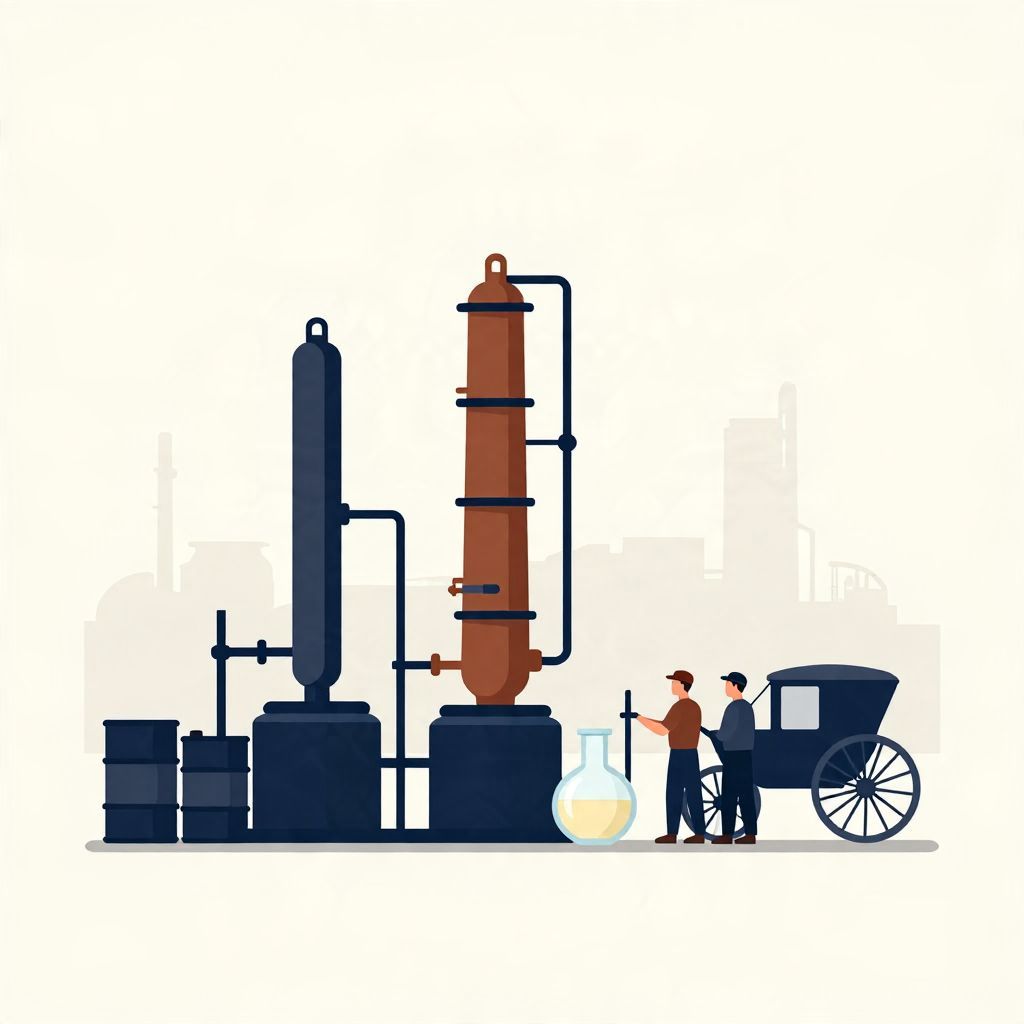
When was gasoline invented? The short answer is that gasoline was not “invented” in a single moment. It emerged as a useful fuel in the 19th century, after petroleum refining made it possible to separate lighter fractions of crude oil. By the late 1800s, gasoline had become the preferred fuel for the new gasoline-powered automobile.
Its story is really the story of oil refining, chemistry, and transportation changing together. What began as a byproduct with little value eventually became one of the most important fuels in modern history.
When was gasoline invented?
Gasoline was not invented on one exact date. It developed during the 19th century as refiners learned to distill crude oil into different products. The fuel became commercially important in the 1880s and 1890s, especially after Karl Benz and other early automobile builders used it in internal combustion engines.
How gasoline came into existence
Before gasoline was widely used, people relied on whale oil, coal gas, kerosene, and other fuels for lighting and heat. Crude oil itself had been known for centuries, but it was the rise of modern petroleum refining in the 1800s that made gasoline practical. Refiners heated crude oil and separated it into fractions based on boiling points, with gasoline among the lighter, more volatile ones.
From nuisance to useful fuel
In the early days of oil refining, gasoline was often seen as a low-value or even troublesome byproduct. Refineries were mainly interested in kerosene, which was used for lamps and was far more profitable in the mid-19th century. Gasoline could evaporate easily and posed storage problems, so it was not always treated as a prized product at first.
That changed when inventors and engineers began building engines that needed a light, fast-burning fuel. The internal combustion engine transformed gasoline from an unwanted fraction into a highly valuable one.
The 19th-century origins of gasoline
Gasoline’s history is tied to the broader history of petroleum. In the 1840s and 1850s, oil refining expanded in North America and Europe. The famous commercial oil well drilled by Edwin Drake in Pennsylvania in 1859 helped accelerate the petroleum industry in the United States, though refining techniques had already been developing before that.
By the later 1800s, refiners were increasingly able to control the separation of petroleum products. This made gasoline more available and more consistent. In other words, gasoline was not discovered all at once; it was refined into usefulness through industrial chemistry.
Why the date is hard to pin down
If you are looking for a single “birthday” for gasoline, history does not provide one. That is because gasoline began as a fraction of crude oil rather than as a brand-new substance created in a laboratory. Different refineries produced similar light petroleum fractions at different times, and the fuel’s name, composition, and uses evolved over decades.
So the best historical answer is this: gasoline emerged in the mid-19th century and became widely important by the late 19th century.
Gasoline and the rise of the automobile
Gasoline became historically important because of the automobile. In 1885–1886, Karl Benz built one of the first practical gasoline-powered cars in Germany. Around the same period, Gottlieb Daimler and Wilhelm Maybach were developing high-speed internal combustion engines that also relied on liquid fuel.
These inventions did not create gasoline, but they created a market for it. Once cars, motorcycles, and later trucks began using gasoline engines, demand for the fuel rose quickly. Refineries adapted by improving gasoline production and distribution.
Why gasoline beat many alternatives
In the late 19th and early 20th centuries, several fuels competed for use in engines, including steam power, electricity, and alternative liquid fuels. Gasoline won out in many settings because it had a useful combination of energy density, portability, and compatibility with compact engines. Drivers could carry it in a tank, and engines could be started and operated relatively efficiently.
That practical advantage helped gasoline become central to transportation in the 20th century.
Important milestones in gasoline history
Because gasoline developed gradually, it helps to think of its history as a timeline rather than a single invention date.
- Early 1800s: Petroleum refining begins to expand as an industrial process.
- Mid-1800s: Light petroleum fractions, including gasoline, are separated during refining, though often treated as byproducts.
- 1859: Edwin Drake’s oil well in Pennsylvania helps launch the modern petroleum industry in the United States.
- 1885–1886: Karl Benz builds a gasoline-powered automobile, helping establish gasoline’s future importance.
- Late 1800s: Gasoline becomes increasingly important as engines and cars spread.
- Early 1900s: Mass automobile production drives gasoline from a secondary product to a major global fuel.
What gasoline actually is
Gasoline is a refined petroleum fuel made from a mixture of hydrocarbons, usually obtained from crude oil through distillation and later processing methods. It is designed to ignite efficiently in spark-ignition engines. Because it evaporates readily and burns quickly, it is well suited to engines that compress air and fuel before a spark sets off combustion.
Modern gasoline is not exactly the same as the early fuel sold in the 19th century. Over time, refiners improved its consistency and performance, and additives were introduced to reduce engine knocking, improve storage, and meet environmental regulations.
Gasoline versus petrol
In many countries, gasoline is called petrol. The difference is mainly regional language, not a different fuel. In the United States and Canada, “gasoline” or “gas” became common; in Britain and many other places, “petrol” remained the standard term.
Who invented gasoline?
No single person invented gasoline. That is an important distinction. Gasoline came from the refining of crude oil, a process improved by many chemists, engineers, and industrial workers over time. The fuel’s rise depended on collective industrial development rather than one inventor’s breakthrough.
If one person is associated with gasoline’s historical importance, it is not because he invented the fuel itself, but because people like Karl Benz showed how valuable it could be in a practical engine. In that sense, the automobile helped define gasoline’s modern role.
How gasoline changed the modern world
Once gasoline-powered vehicles became common, the fuel reshaped transportation, commerce, and daily life. Roads expanded, suburbs grew, and long-distance travel became more accessible. Gasoline also became tied to military logistics, agriculture, and industrial production in the 20th century.
Its influence was not only technological but social. The availability of gasoline helped create a world built around cars, trucking, and mobility on a scale that earlier generations could hardly imagine.
Long-term consequences
Gasoline’s success also brought challenges. Dependence on petroleum made economies vulnerable to supply disruptions and price shocks. Later, concerns about air pollution and climate change led governments and industries to rethink how gasoline is produced and used. So the history of gasoline is also a history of modern energy problems.
The best historical answer, in one sentence
Gasoline was not invented on one exact date; it emerged from 19th-century petroleum refining and became a major fuel in the late 1800s, especially after the invention of the gasoline-powered automobile.
That is the clearest historical answer to when gasoline was invented: not by a single inventor, but through decades of refining, engineering, and industrial change. For more history of technology and modern development, you may also enjoy when nickels were silver and when the last space shuttle launched.