
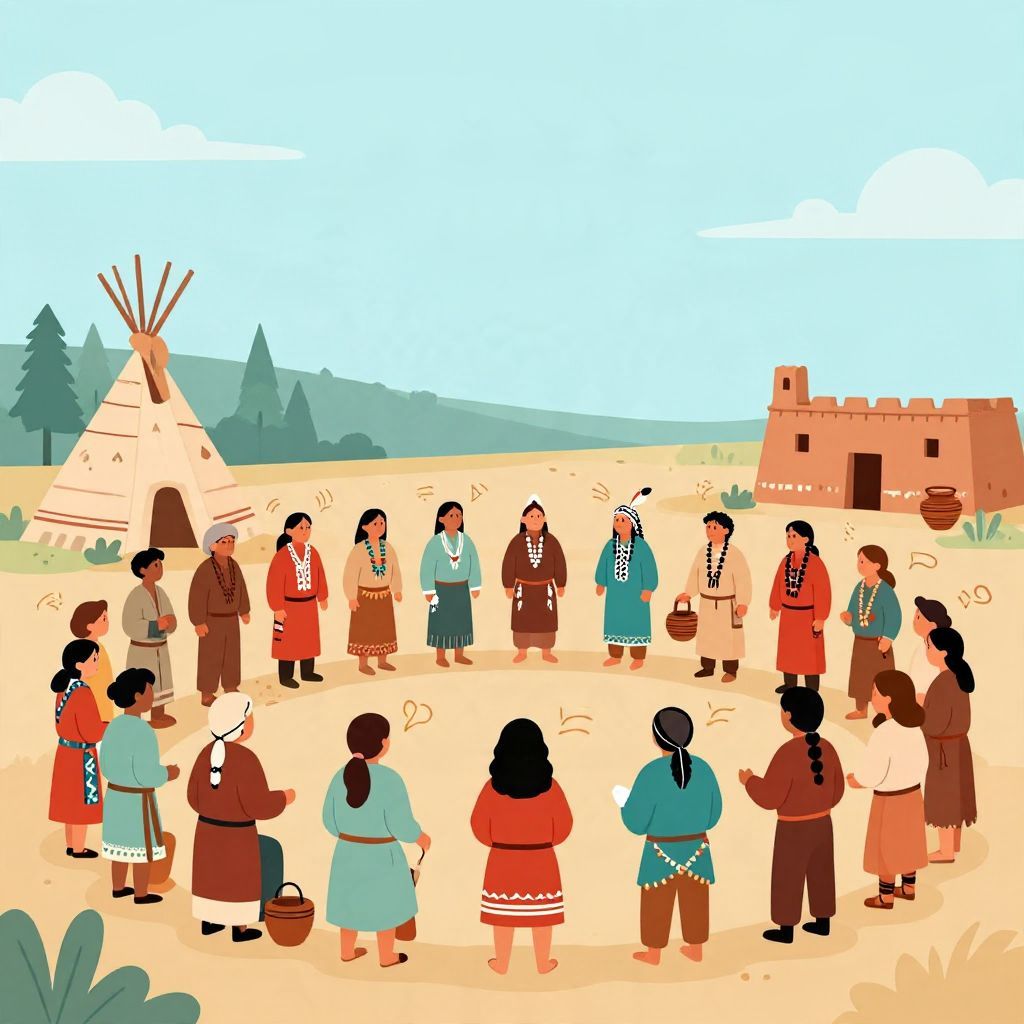
What language did Native Americans speak? The short answer is that there was no single Native American language. Before European colonization, Indigenous peoples across North America spoke hundreds of distinct languages, many of them unrelated to one another. Some communities also used shared trade languages, sign systems, or multilingual practices, especially in borderlands and trading networks.
Because “Native Americans” refers to many different nations and regions, the real historical answer depends on time, place, and tribe. A Lakota speaker, a Navajo speaker, a Cherokee speaker, and a Hopi speaker were using very different languages, each with its own history, grammar, and cultural meaning.
What language did Native Americans speak?
Native Americans spoke hundreds of languages, not one. These languages belonged to many different language families, such as Algonquian, Iroquoian, Siouan, Athabaskan, Uto-Aztecan, and others. In some areas, Indigenous peoples also used trade languages or bilingualism to communicate across nations, especially where commerce, diplomacy, and intermarriage brought communities together.
A continent of many languages, not one people
Long before European arrival, North America was linguistically diverse. Scholars generally agree that the continent contained several hundred Indigenous languages, though exact counts vary because some languages became extinct before they were fully documented. These languages were not dialects of a single tongue; they were separate languages with distinct vocabularies and structures.
Why there were so many languages
Native communities lived across mountains, deserts, forests, plains, river valleys, and coasts. Over long periods of time, groups migrated, split apart, and developed independently. Geography mattered: physical distance and environmental barriers encouraged language change and the formation of new speech communities. Just as languages diversified in Europe or Asia, they diversified in the Americas as well.
It is also important to remember that “Native American” is a broad modern label. It groups together thousands of years of history and many different nations, each with its own identity. A language spoken by one nation in the Northeast has no necessary connection to a language spoken in the Southwest or on the Pacific Coast.
Major Native American language families
Many Indigenous languages in North America can be grouped into language families, meaning they share a common ancestral language. These families help historians and linguists trace relationships among languages, though not every Indigenous language fits neatly into a widely accepted family tree. Some of the best-known families include the following.
Algonquian
The Algonquian language family was widespread across much of eastern North America and into parts of the Plains and subarctic regions. Languages in this family include Ojibwe, Cree, Blackfoot, and Mi’kmaq. Because of their wide distribution, Algonquian languages played a major role in diplomacy and trade in many regions.
Iroquoian
Iroquoian languages were spoken by peoples such as the Haudenosaunee Confederacy, including Mohawk, Oneida, Onondaga, Cayuga, Seneca, and Tuscarora speakers. Cherokee is also an Iroquoian language, though geographically separated from the northern Iroquoian languages. These languages were central to political life, oral tradition, and inter-nation relations.
Siouan
Siouan languages were spoken across parts of the Great Plains, the Mississippi Valley, and the Southeast. Lakota, Dakota, Nakota, Crow, and Omaha-Ponca are examples. Some Siouan-speaking peoples became especially prominent in the history of the Plains, where mobility, hunting, and later horse culture shaped daily life and communication.
Athabaskan
Athabaskan languages were spoken in the American Southwest and in parts of Alaska and western Canada. Navajo and Apache languages belong to this family. Their wide geographic spread is evidence of long-term migration and adaptation. Navajo, in particular, became historically significant in the twentieth century because of its use by Navajo Code Talkers during World War II.
Uto-Aztecan
Uto-Aztecan languages were spoken in the Great Basin, the Southwest, and parts of Mexico. Hopi and many Numic languages, such as Shoshone and Comanche, belong to this family. The family’s broad range reflects a long and complex history of movement and cultural exchange across western North America.
Other language families and isolates
North America also included many other language families and language isolates, meaning languages with no confirmed relatives. In California alone, linguistic diversity was especially dense. Some languages were spoken by only a small number of people, while others had large regional influence. This diversity makes any single answer to the question misleading unless the region or nation is specified.
Did Native Americans have a common language?
No single common language united all Native Americans across the continent. However, in some regions, certain languages or communication systems served as lingua francas, or shared languages used between groups that did not speak the same mother tongue. These were practical tools for trade, alliance-building, and negotiation rather than evidence of one pan-Indigenous language.
Trade languages and multilingualism
Many Native communities were multilingual. People living near trade routes or political borders often learned more than one language. This was especially common in areas where alliances shifted frequently or where seasonal gatherings brought many nations together. In such settings, multilingual ability was a social advantage and sometimes a political necessity.
Some regions also used pidgins or simplified contact languages. These were not usually full native languages in the same sense as a community’s first language, but they helped people communicate across linguistic boundaries. In the Great Plains, for example, Plains Indian Sign Language served as a powerful intertribal communication system alongside spoken languages.
Plains Indian Sign Language
Plains Indian Sign Language was not a spoken language, but it was an important historical communication system used by multiple Indigenous nations. It allowed people with different spoken languages to communicate during trade, diplomacy, and travel. Its existence shows how Native societies solved practical communication problems in sophisticated ways.
How language shaped Native American life
Language was not just a tool for conversation. It carried law, kinship, religion, memory, and identity. Oral traditions preserved histories, migration stories, moral teachings, and ceremonial knowledge. In many Native societies, language was deeply connected to land and community, because names for places, animals, and plants often reflected local knowledge and relationships.
Oral tradition and cultural knowledge
Stories were transmitted orally, often with careful attention to wording, rhythm, and audience. This meant that language was a living archive. A creation story, a clan history, or a ceremonial prayer could preserve knowledge across generations without written text. Translating such traditions into English or another colonial language often loses nuance, which is one reason language preservation matters so much.
Political and diplomatic importance
Language also mattered in diplomacy. Treaties, alliances, and negotiations depended on interpreters, and misunderstandings could have serious consequences. European colonizers often underestimated the complexity of Indigenous diplomacy, assuming that language differences were a minor obstacle. In reality, communication was a central part of power, survival, and resistance.
What happened after European colonization?
European colonization dramatically changed Native American language use. Disease, warfare, forced displacement, missionization, boarding schools, and government assimilation policies all contributed to language loss. In many places, children were punished for speaking their Native languages, and communities were pressured to adopt English, Spanish, or French.
Language suppression and survival
Despite these pressures, many Native languages survived. Some communities maintained them at home and in ceremony; others preserved them through songs, prayers, and storytelling. In certain regions, new mixed communities also emerged, blending linguistic traditions. Survival was uneven, but it was never absent. Native languages persisted because speakers actively defended them.
Written forms and adaptation
Some Indigenous languages developed written systems or were recorded by missionaries, scholars, and Native leaders. Cherokee is a well-known example because Sequoyah created a syllabary in the early nineteenth century, making written literacy possible in Cherokee on a broad scale. This was not the only Indigenous writing system, but it is one of the most famous and historically important.
Written forms could help preserve language, but they also reflected colonial pressures and changing social needs. In some cases, Native peoples adopted writing to support education, publishing, and political organization while continuing to value oral tradition.
How many Native American languages are spoken today?
Today, many Native American languages are endangered, but not all are lost. Some still have thousands of speakers, while others are spoken fluently by only a small number of elders. Exact totals change over time, but the overall pattern is clear: colonization sharply reduced the number of speakers, yet revitalization efforts continue across many communities.
Language revitalization
Across North America, Native communities are working to teach children their ancestral languages through immersion schools, language nests, community classes, recordings, dictionaries, and digital tools. These efforts are not simply about preserving words. They are about restoring cultural continuity, identity, and intergenerational knowledge.
Language revitalization is often difficult because many communities lost fluent speakers over generations. Still, the work has real historical significance. When a language is revived or strengthened, it helps reconnect people with older forms of knowledge and community life.
So, what is the best direct answer?
If you are asking what language Native Americans spoke in general, the historically accurate answer is: many different languages. There was no single Native American language. The specific language depended on the nation, region, and time period, and many Native peoples were multilingual or used shared communication systems for trade and diplomacy.
That diversity is one of the most important facts in Native American history. It shows that Indigenous North America was not a single culture but a continent of many nations, each with its own language, traditions, and history. For readers interested in broader comparisons, it can be useful to look at other Indigenous and ancient language histories such as what language the Incas spoke or even how classical empires used language, as in what language the Romans spoke.