
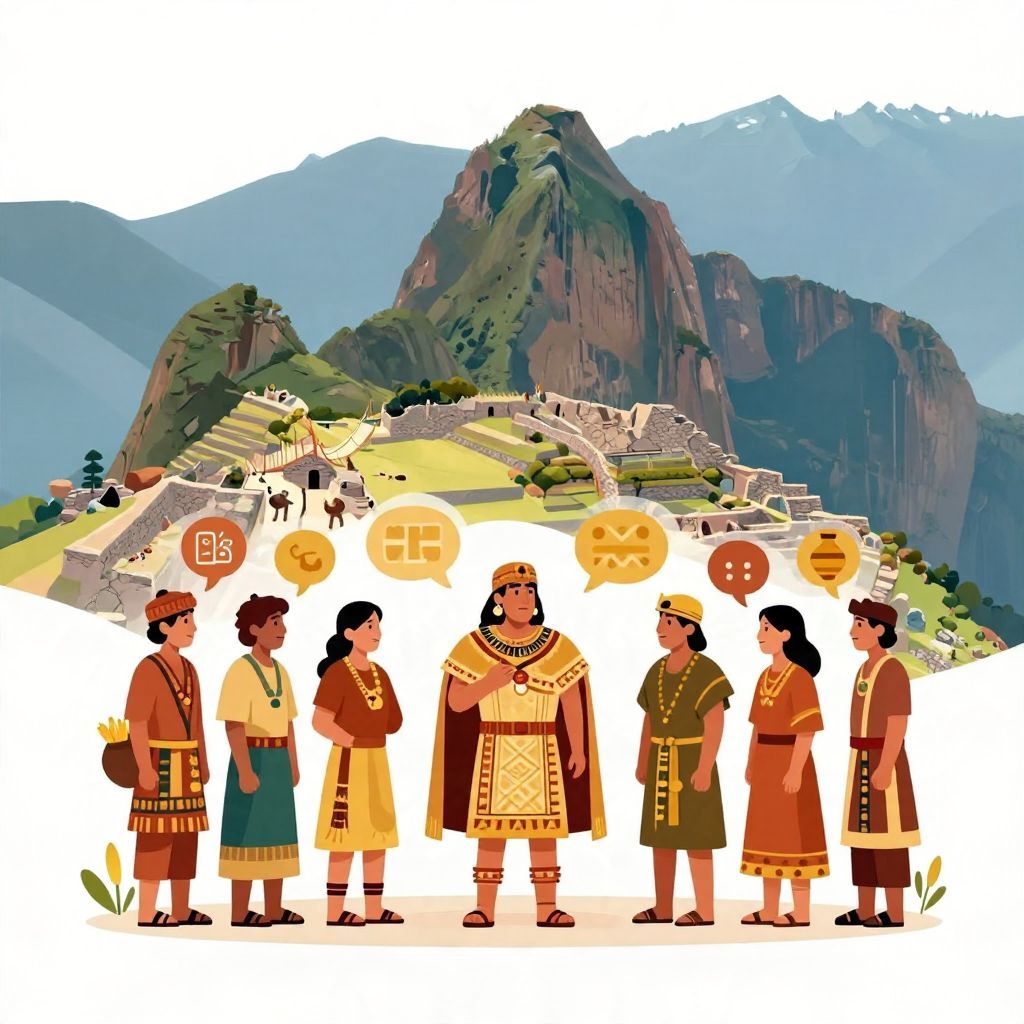
What language did the Incas speak? The short answer is that the Inca elite and much of the empire used Quechua, especially a prestigious imperial variety often called Inca Quechua. But the Inca Empire was multilingual, so many people also spoke their own regional languages.
Understanding this matters because the Incas ruled a vast Andean empire, not a single-language nation. Their language policy helped connect diverse peoples across mountains, valleys, and deserts, and it left a lasting mark on South American history.
What language did the Incas speak?
The Incas spoke Quechua, particularly a court and administrative form used by the imperial elite. However, the empire included many ethnic groups with their own languages, so Quechua functioned as a major shared language rather than the only language spoken everywhere.
Quechua and the Inca Empire
Was Quechua the original Inca language?
Scholars generally agree that the Inca ruling group came from the Cusco region of the central Andes, where Quechua was already present. The Incas did not invent the language. Instead, they adopted and promoted it as their empire expanded in the 15th century under rulers such as Pachacuti and his successors.
That distinction is important. When people ask what language the Incas spoke, they often imagine a single “Inca language.” In reality, the Incas helped turn Quechua into an imperial language, but the language itself had older roots in the Andes.
Why did the Incas use Quechua?
Quechua was useful because it allowed communication across a huge and diverse empire. The Inca state stretched from present-day southern Colombia to central Chile and northwestern Argentina at its greatest extent. A shared language made administration, tribute collection, military coordination, and religious ceremony easier.
The Incas also relied on local leaders, messengers, and trained specialists to govern. Quechua helped create a common political culture, even though many communities continued to speak their own languages at home and in local life.
Was Quechua the only language in the Inca Empire?
No. The Inca Empire was multilingual. In addition to Quechua, people spoke many regional languages, including Aymara in parts of the southern Andes and numerous local tongues in coastal, highland, and jungle regions. The empire did not erase linguistic diversity, even if it encouraged the wider use of Quechua.
A multilingual empire
- Quechua served as a major administrative and prestige language.
- Aymara was important in parts of the southern highlands.
- Local communities often kept their own languages for daily life.
- Officials and intermediaries may have needed to know more than one language.
This multilingual reality reflects how the Inca state worked. Rather than replacing all local identities, it often incorporated them into a larger imperial system. Language was one tool of rule, alongside roads, labor obligations, kinship ties, and religious authority.
How did the Incas spread Quechua?
Administration and migration
The Incas spread Quechua partly through state administration. Officials, soldiers, and colonists moved through conquered territories, bringing the language with them. In some areas, the state relocated populations, a practice that helped secure loyalty and strengthen imperial control. Such movements also encouraged language contact and mixing.
Quechua likely spread unevenly. In some places it became widely used; in others, local languages remained dominant. The process was gradual and depended on region, social status, and proximity to imperial centers.
Religion and ceremony
Religion also mattered. The Incas tied political authority to sacred power, and ceremonial language could reinforce that authority. Public rituals, state festivals, and communication with local elites helped make Quechua a language of prestige. Over time, this prestige encouraged adoption beyond the Inca heartland.
What did Inca Quechua sound like?
We do not know the exact sound of the language as spoken in the imperial period with complete certainty. Quechua has many dialects, and the forms recorded after the Spanish conquest were influenced by regional variation and later change. Still, linguists can reconstruct much of its structure from historical records and modern Quechua varieties.
Quechua is known for its rich suffix system, which means words change by adding endings to show relationships and meaning. It is an agglutinative language, so a single word can carry a lot of information. That feature made it flexible for everyday speech and administration alike.
Did the Incas have a written language?
The Incas did not use an alphabetic writing system like Spanish. Instead, they used quipu—a system of knotted cords—for recording numbers and possibly some additional information. Quipus were not a full written language in the usual sense, but they were an important administrative technology.
Because of that, much of what we know about Inca language comes from later Spanish accounts, colonial-era records, and the survival of Quechua in the Andes. This means historians must be careful: some details are well supported, while others remain debated.
What happened to Quechua after the Spanish conquest?
After the Spanish conquest in the 16th century, Quechua did not disappear. In fact, Spanish missionaries and colonial officials sometimes used it as a practical language for evangelization and administration. That helped preserve and spread it in some areas, even as Spanish gradually became dominant in many urban and political settings.
Over time, Quechua survived as a major Indigenous language family across the Andes. Today it is still spoken by millions of people in Peru, Bolivia, Ecuador, and neighboring countries, though its status and vitality vary by region.
Colonial change and language survival
The Spanish conquest transformed the linguistic landscape. Spanish became the language of colonial power, law, and elite advancement. But Quechua remained deeply rooted in rural communities and Indigenous identity. Its survival shows that conquest did not simply erase Andean languages; it reshaped how they were used and valued.
Common misunderstandings about the Inca language
“The Incas spoke one language everywhere”
This is too simple. The empire was large and diverse, and many languages were spoken within it. Quechua was important, but not exclusive.
“Quechua was invented by the Incas”
Also false. Quechua existed before the Inca Empire. The Incas elevated it and expanded its reach, but they did not create it from scratch.
“We know exactly how Inca Quechua sounded”
Not quite. Linguists can reconstruct a great deal, but the exact pronunciation of imperial-era Quechua is not fully recoverable. Modern dialects preserve important clues, yet they also reflect centuries of change.
Why the language question matters in Inca history
Language reveals how the Inca Empire worked. The Incas ruled through incorporation, not just force. By using Quechua as a shared language, they strengthened administration and identity across a vast territory. At the same time, the persistence of local languages shows that imperial unity had limits.
For historians, the language question also highlights a broader truth about the Andes: cultural continuity survived conquest. Quechua endured long after the fall of the Inca state, becoming one of the most important Indigenous languages in the Americas.
Conclusion
The Incas spoke Quechua, but their empire was multilingual and culturally diverse. Quechua became the most important imperial language because it helped the state govern, communicate, and unify a wide region. If you want to explore related language and culture topics, you may also like Is Latin a Language? and What Is Cultural Divergence?