
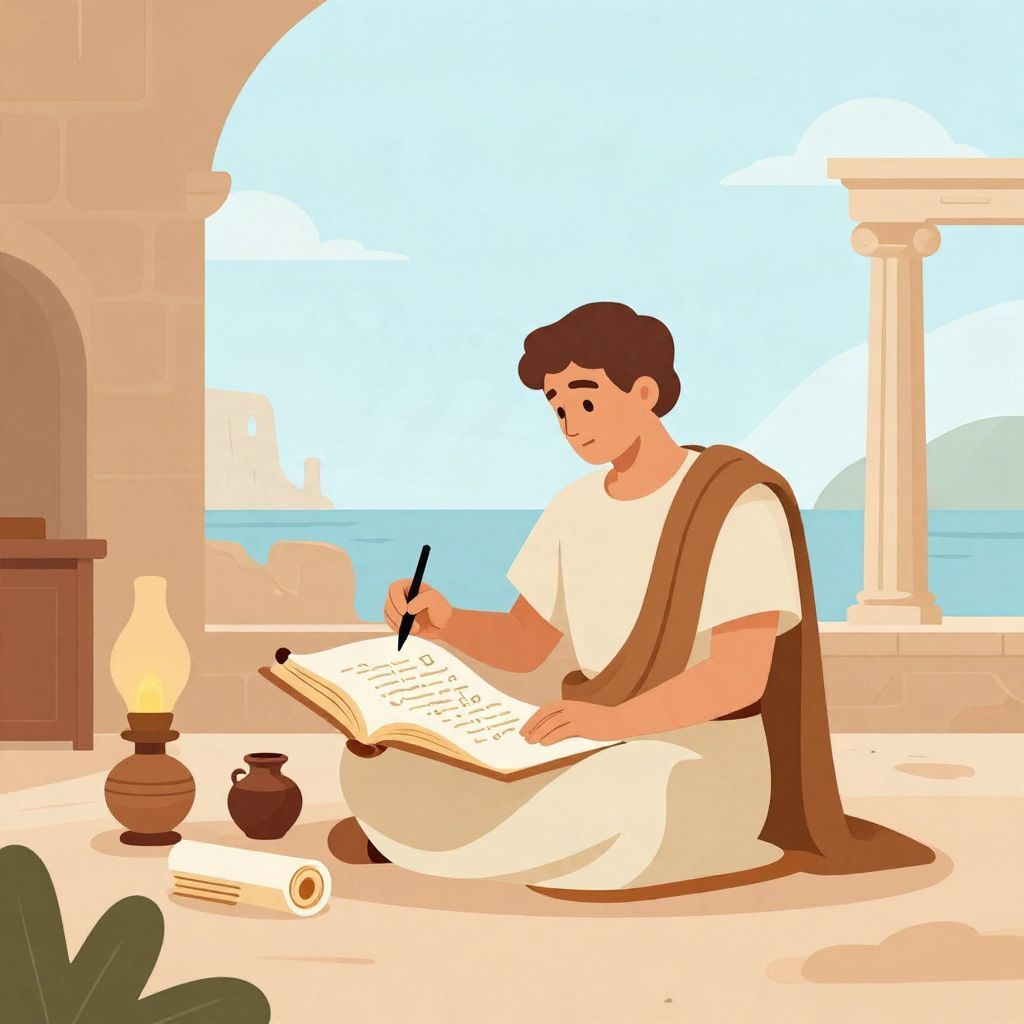
The New Testament was written primarily in Koine Greek, the common everyday Greek of the eastern Mediterranean world in the first century CE. That is the broad scholarly answer to the question of what language the New Testament was written in.
But the story is more interesting than a single language label. The New Testament emerged in a multilingual Roman Empire, where Greek, Latin, Aramaic, and Hebrew all shaped Jewish and Christian life. Understanding that setting helps explain why the text was written in Greek and why a few phrases preserve other languages.
What language was the New Testament written in?
The New Testament was written mainly in Koine Greek, not classical literary Greek. Koine was the shared spoken and written language of much of the eastern Roman Empire in the first century. A few words and sayings in the New Testament are preserved in Aramaic and Hebrew, but the books themselves were composed largely in Greek.
Why Greek was the main language
Greek had been a major language of the eastern Mediterranean since the conquests of Alexander the Great in the 4th century BCE. By the time of Jesus and the earliest Christians, it had become the common language of trade, administration, travel, and communication across many cities. That made Greek the most practical language for writing texts meant to reach Jews and non-Jews across the Roman world.
Koine Greek was the everyday language
Koine means “common” Greek. It was simpler and more widely used than the older literary forms of Greek. The New Testament reflects this style, especially in its vocabulary and sentence structure. It is not written in the high, polished style of classical authors like Plato or Thucydides, but in the living language of ordinary people, teachers, merchants, and travelers.
The Roman Empire made Greek useful
Although Rome ruled the Mediterranean politically, Greek remained dominant in the eastern provinces, including Judea, Galilee, Syria, Asia Minor, and Egypt. Latin was important in the western empire and in Roman government, but Greek was the language most likely to connect Christian communities spread across the east. This is one reason the New Testament could circulate so widely so quickly.
Were any parts of the New Testament written in other languages?
Yes. The New Testament is overwhelmingly Greek, but it preserves a handful of phrases in Aramaic, the everyday spoken language of many Jews in Palestine, and occasional references to Hebrew forms and expressions. These are usually retained for emphasis, authenticity, or because they were remembered as part of Jesus’ own speech and the earliest Christian tradition.
Aramaic phrases in the text
Examples include expressions such as “Talitha koum,” “Ephphatha,” and Jesus’ cry from the cross, “Eloi, Eloi, lema sabachthani?” The Gospel writers often translate these phrases into Greek for their readers. That suggests the original audience may not have understood Aramaic, even if the words carried special emotional or religious force.
Hebrew and Aramaic in Jewish religious life
In first-century Judaism, Hebrew remained important for Scripture and worship, while Aramaic was widely spoken in daily life. Greek-speaking Jews also existed in large numbers, especially outside Judea. The New Testament reflects this layered linguistic world. Its authors were writing for communities that could read Greek, but they were deeply rooted in Jewish traditions shaped by Hebrew and Aramaic.
Who wrote the New Testament in Greek?
The New Testament was written by multiple authors over several decades, roughly from the 50s CE to the end of the first century, though some dates are debated. Paul’s letters are generally regarded as the earliest surviving Christian writings in the collection, followed by the Gospels, Acts, other letters, and Revelation. All were composed in Greek as far as the surviving text shows.
Paul’s letters
The letters attributed to Paul are among the earliest Christian documents we have. Paul was a Jew from the diaspora, educated in a multilingual environment, and his letters show strong command of Greek. He wrote to churches in cities such as Corinth, Thessalonica, Philippi, and Rome, where Greek was a natural medium for communication.
The Gospels
The four Gospels were also written in Greek. They were likely composed for communities that included Greek-speaking Jews and Gentiles. Their authors shaped Jesus traditions into narratives that could be read aloud and understood in churches across the empire. Even when they preserve Semitic expressions, the surrounding text is Greek.
Did Jesus speak Greek?
Jesus most likely spoke Aramaic as his primary everyday language. He may also have known some Hebrew, especially in religious settings, and possibly some Greek, since Galilee and nearby regions were multilingual. But the historical evidence suggests Aramaic was the main language of Jesus’ daily speech and teaching in his local environment.
Why this matters for the New Testament
The fact that Jesus probably spoke Aramaic helps explain why the New Testament occasionally preserves Aramaic words. It also explains why the Gospels sometimes translate or interpret sayings for readers. The written New Testament is not a direct transcript of Jesus’ spoken words in one language; it is a Greek literary record of traditions that originated in a multilingual setting.
Was the New Testament ever written in Hebrew or Aramaic first?
This is a long-debated question, but the mainstream scholarly view is that the New Testament books as we have them were written in Greek, not translated from a complete earlier Hebrew or Aramaic New Testament. Some early church traditions claimed that Matthew was first written in “Hebrew” or “the Hebrew dialect,” but scholars debate what that phrase meant and whether it referred to Hebrew, Aramaic, or a collection of sayings rather than the canonical Gospel text.
Why the evidence favors Greek originals
The surviving manuscripts of the New Testament are Greek, and the books show signs of being composed in Greek rather than translated into it. Their style, wordplay, and structure often make the most sense as original Greek writing. That does not mean they were disconnected from Semitic speech; rather, they were Greek texts built from earlier oral traditions in Jewish Palestine and the wider diaspora.
The tradition about Matthew
Some ancient writers said Matthew wrote in a “Hebrew” language. This statement has generated much discussion, but it is not enough to prove that the canonical Gospel of Matthew began as a full Hebrew or Aramaic book identical to the Greek version we have today. Most historians treat the tradition cautiously because the evidence is indirect and ambiguous.
How the language of the New Testament shaped Christianity
Writing in Greek helped Christianity spread beyond Judea. Greek allowed the message to move across ethnic and geographic boundaries, from Jewish communities to Gentile audiences. It also meant that Christian theology developed in conversation with Greek vocabulary and concepts, which influenced how believers described God, Jesus, salvation, and the church.
Greek made translation and transmission easier
Because Greek was widely understood, the New Testament could circulate among diverse communities without immediate translation. Later, it became the source text for Latin, Syriac, Coptic, Armenian, Georgian, and many other versions. In that sense, Greek was not just the language of the first manuscripts; it became the bridge language of early Christianity.
It also affected interpretation
Some theological debates later turned on Greek terms that carried shades of meaning not easily captured in translation. Words such as logos, ekklesia, and charis became central to Christian thought. The New Testament’s Greek language therefore mattered not only for communication but also for how Christians understood doctrine.
What the manuscripts tell us
The earliest surviving New Testament manuscripts are Greek. They show that the text was copied, read, and preserved in Greek from very early on. While no original autograph manuscripts survive, the manuscript tradition strongly supports the conclusion that the New Testament’s earliest written form was Greek.
Why manuscript evidence is important
Historians rely on manuscript evidence because it is the most concrete surviving record. When the earliest copies, quotations by early Christian writers, and the linguistic features of the text all point in the same direction, the historical conclusion becomes stronger. In this case, the evidence consistently points to Greek originals with occasional Semitic phrases embedded in them.
So what is the short answer?
The New Testament was written mostly in Koine Greek. It was produced in a multilingual Jewish and Roman world, and it preserves traces of Aramaic and Hebrew because those languages were part of the environment in which Jesus and the earliest Christians lived. Greek, however, was the language in which the books were composed and transmitted.
That makes the New Testament both a Greek literary collection and a witness to the multilingual world of the ancient Near East and Roman Empire. If you want to explore the broader background, you may also find our articles on the original language of the Bible and what language the Romans spoke helpful for understanding the historical setting.