
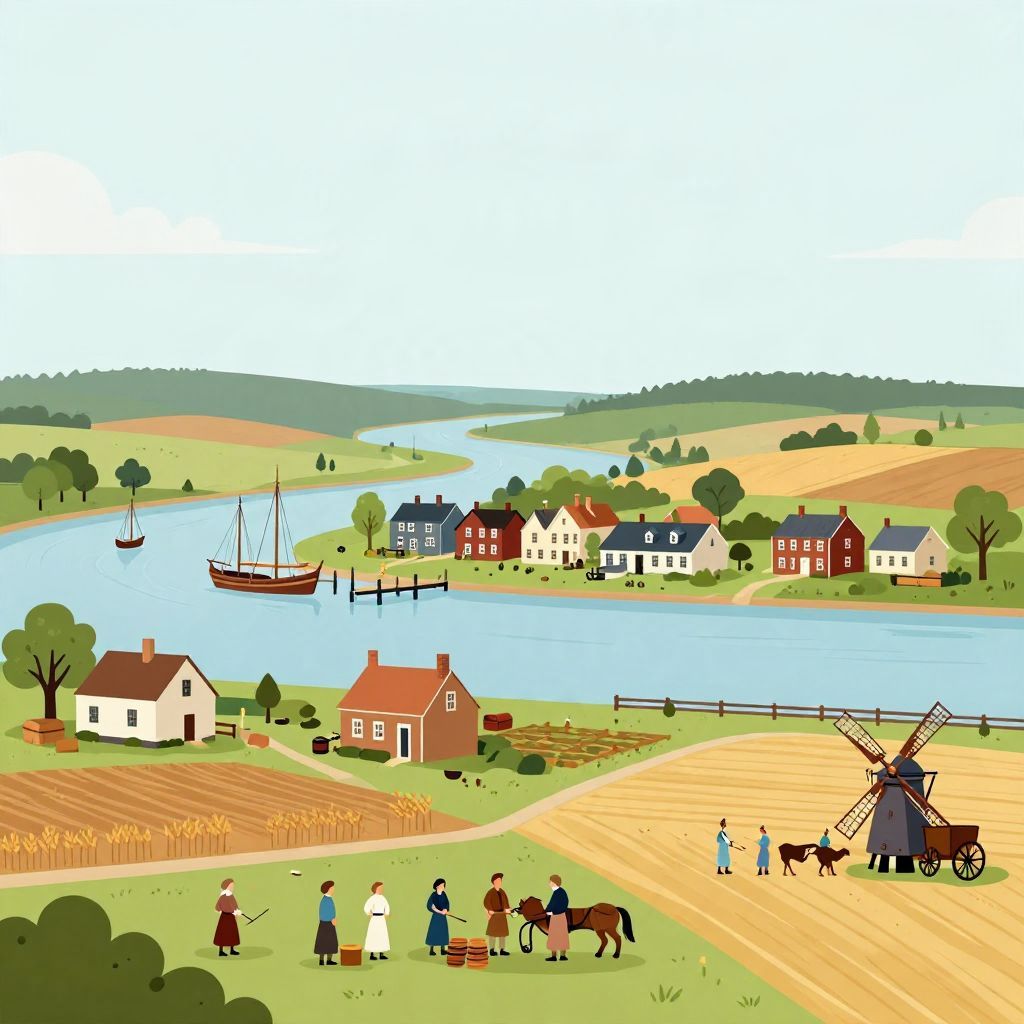
The Middle Colonies were a group of English colonies in British North America that sat between New England and the Southern Colonies. They became known for fertile farmland, busy ports, religious diversity, and a more mixed economy than their neighbors.
They were not a single political unit, but a regional label used later by historians to describe colonies such as New York, New Jersey, Pennsylvania, and Delaware.
What Were the Middle Colonies?
The Middle Colonies were British colonies in the mid-Atlantic region of North America, especially New York, New Jersey, Pennsylvania, and Delaware. They were known for grain farming, trade, and ethnic and religious diversity. Unlike New England or the plantation South, they developed as a mixed region with cities, farms, and varied populations.
Where Were the Middle Colonies Located?
The Middle Colonies stretched along the Atlantic coast between New England to the north and the Chesapeake and Southern Colonies to the south. Their location made them a natural crossroads for shipping, migration, and trade. Rivers such as the Hudson, Delaware, and Susquehanna helped connect inland farms to Atlantic ports.
A regional bridge in colonial America
This middle position mattered. The colonies linked northern and southern trade networks and became a meeting point for different peoples, languages, and religious traditions. Their geography also encouraged both farming and commerce, which shaped their societies in ways that were distinct from nearby regions.
Which Colonies Were Included?
Historians usually include four colonies in the Middle Colonies: New York, New Jersey, Pennsylvania, and Delaware. Some older or broader accounts may group nearby territories differently, but these four are the standard list. Their histories were connected, though each colony developed under different rulers, settlers, and laws.
- New York — originally Dutch New Netherland, later taken by England in 1664
- New Jersey — carved out of former Dutch and English claims
- Pennsylvania — founded by William Penn in 1681
- Delaware — closely tied to Pennsylvania for much of its colonial history
How Did the Middle Colonies Begin?
The Middle Colonies emerged from a mix of European colonization, conquest, land grants, and settlement. Some areas began as Dutch colonies, especially New Netherland, while others were established by the English after the mid-1600s. Pennsylvania was created later as a proprietary colony, shaped by Quaker ideals and planned settlement.
Dutch and Swedish beginnings
Before English control, parts of the region had already been settled by the Dutch and, in a smaller area, by the Swedes. The Dutch founded New Netherland in the early 1600s to support trade, especially in furs. New Sweden appeared along the Delaware River in the 1630s and 1640s, but it was eventually absorbed by the Dutch and then the English.
English takeover and expansion
In 1664, the English seized New Netherland from the Dutch and renamed its center New York. From there, English rule expanded across the region, though Dutch language, customs, and property patterns remained influential for years. This layered history is one reason the Middle Colonies became so culturally mixed.
Why Were the Middle Colonies Important?
The Middle Colonies were important because they combined agricultural productivity with commercial growth and social diversity. They produced large amounts of grain, especially wheat, and their ports connected colonial farmers to Atlantic markets. They also became known for relative religious tolerance compared with many other colonies.
“Bread colonies” and trade
Because of their fertile soil and climate, the Middle Colonies earned a reputation as the “bread colonies.” Farmers grew wheat, barley, oats, and corn, and mills turned grain into flour for export. New York and Philadelphia became major commercial centers, while smaller ports supported regional trade.
A diverse population
Unlike colonies founded by one dominant religious group, the Middle Colonies attracted a wide range of settlers: English, Dutch, Germans, Scots-Irish, Swedes, Africans, and others. This diversity shaped everyday life, language, religion, and labor. It also made the region less uniform than New England, where Puritan influence was stronger.
What Made the Middle Colonies Different from Other Colonies?
The Middle Colonies stood out because they were neither purely commercial like some port colonies nor dominated by plantation agriculture like the South. They had a mixed economy, a varied population, and a more flexible social structure. Their towns, farms, and religious communities all developed side by side.
Compared with New England
New England was more tightly shaped by Puritan settlement, town-based communities, and a stronger emphasis on religion and education. The Middle Colonies were more pluralistic. They included many faiths and ethnic groups, and their economy relied less on a single religious or social model.
Compared with the Southern Colonies
The Southern Colonies depended more heavily on plantation agriculture and enslaved labor, especially in tobacco-growing areas. The Middle Colonies also used enslaved labor, but their economy was broader and less plantation-centered overall. Small and medium farms were more common, and urban trade played a larger role.
What Was Daily Life Like in the Middle Colonies?
Daily life in the Middle Colonies varied by class, ethnicity, religion, and location. On farms, families worked together to plant, harvest, grind grain, and care for animals. In towns, merchants, artisans, dockworkers, and laborers shaped a busy urban life. Homes, clothing, and food reflected both European traditions and local conditions.
Farming and family labor
Most people lived outside major towns and depended on family labor. Farm households were often self-sufficient, producing food for local use and surplus crops for sale. German-speaking farmers in Pennsylvania, for example, became especially important in grain production and helped make the region a major agricultural exporter.
Town life and commerce
Philadelphia, New York, and other ports grew into centers of shipping, printing, banking, and craft production. Merchants imported manufactured goods from Britain and exported flour, furs, timber, and other products. These towns also became places where ideas circulated quickly, including political arguments that would later matter in the American Revolution.
Religion and Tolerance in the Middle Colonies
Religion in the Middle Colonies was diverse rather than uniform. Quakers, Lutherans, Dutch Reformed Christians, Anglicans, Presbyterians, Catholics, and Jews were all present in the region. While tolerance was not absolute, the Middle Colonies were often more open to religious difference than many other English colonies.
William Penn and Pennsylvania
Pennsylvania is especially associated with William Penn, a Quaker who promoted religious freedom and fair treatment of Native peoples, at least in principle. His colony attracted settlers from many backgrounds. In practice, conflict over land and power still occurred, but Pennsylvania became one of the clearest examples of colonial religious pluralism.
Limits of tolerance
It is important not to idealize the Middle Colonies. Religious diversity did not mean equality for everyone. Enslaved Africans, Native peoples, women, and poor laborers all faced major restrictions. Still, compared with some neighboring colonies, the region offered a broader range of religious communities and more social variety.
What Role Did Native Peoples Play?
Native peoples were central to the history of the Middle Colonies, not peripheral to it. The Lenape, Iroquois, Susquehannock, and other Indigenous nations shaped settlement, trade, diplomacy, and conflict. European colonists depended on Native knowledge, negotiated with Native leaders, and also displaced Native communities over time.
Trade and diplomacy
Early colonial economies depended on Native trade networks, especially in fur. Alliances could bring peace and commercial advantage, while misunderstandings and land hunger could lead to violence. The Middle Colonies were therefore shaped by ongoing Indigenous resistance and adaptation, not simply by European expansion.
Land pressure and displacement
As colonial populations grew, so did pressure on Native lands. Treaties, purchases, and coercion often favored colonists, even when they were presented as fair agreements. Over time, Native communities in the region lost territory and autonomy, a pattern common across British North America.
How Were the Middle Colonies Governed?
Governance in the Middle Colonies varied from colony to colony. Some were royal colonies under direct crown authority, while others were proprietary colonies controlled by individuals or families who received land grants from the king. This political variety affected local assemblies, land policy, and relations with Native peoples.
New York and New Jersey
New York became a royal colony after English takeover, and New Jersey’s political history shifted several times before settling into a more stable colonial structure. These changes reflected the strategic value of the region, especially its ports and river routes.
Pennsylvania and Delaware
Pennsylvania was a proprietary colony under William Penn and his heirs. Delaware was closely tied to Pennsylvania for much of the colonial period, though it developed its own assembly. The different arrangements show that the Middle Colonies were politically diverse as well as culturally diverse.
What Is the Lasting Historical Significance of the Middle Colonies?
The Middle Colonies helped shape the future United States in several ways. They demonstrated that colonial society could be multiethnic and multireligious. They also developed strong commercial centers, productive farms, and political institutions that later influenced state and national life. Their diversity became one of the defining features of the region.
A model of colonial variety
The Middle Colonies were not a perfect model of tolerance or equality, but they showed a different colonial pattern from the more homogeneous settlements of New England and the plantation South. Their mix of peoples and economies made them one of the most dynamic regions in British North America.
Key Facts About the Middle Colonies
- They were located in the mid-Atlantic region of British North America.
- The main colonies were New York, New Jersey, Pennsylvania, and Delaware.
- They developed from Dutch, Swedish, and English colonial beginnings.
- The region was known for grain farming, especially wheat.
- Major cities included New York and Philadelphia.
- The population was ethnically and religiously diverse.
- Religious tolerance was greater than in many other colonies, though limited.
- Native peoples remained central to the region’s history and were deeply affected by colonization.
So, what were the Middle Colonies? They were the mid-Atlantic British colonies that became known for fertile land, busy trade, and unusual diversity in colonial America. Their history was shaped by European settlement, Native diplomacy, and economic growth, and their legacy still appears in the region’s pluralistic character. For more context, you can also read about the Southern Colonies and what a royal colony was.