
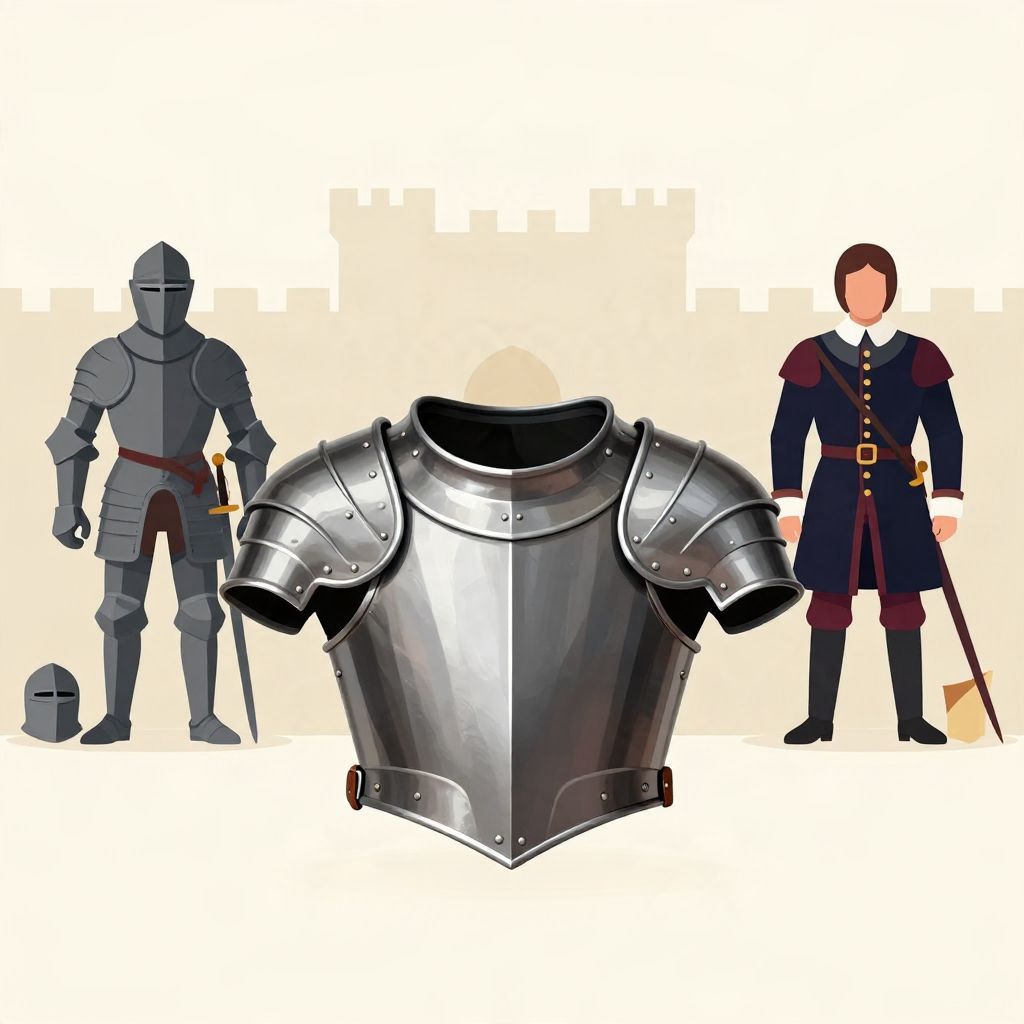
What is a gorget? In history, a gorget was originally a piece of armor worn to protect the throat and upper chest. Over time, the word also came to describe a decorative metal badge or collar worn by officers, officials, and ceremonial guards. Its meaning changed with military technology, but its symbolic importance endured.
The gorget is a small object with a surprisingly long history: it moved from battlefield protection to a mark of rank, authority, and tradition. Understanding it helps explain how armor evolved, how armies signaled status, and how older military customs survived long after plate armor disappeared.
What Is a Gorget?
A gorget is a protective or decorative neck piece, first used as armor to shield the throat and collar area. In medieval and early modern Europe, it was part of a suit of armor. Later, especially from the 17th to 19th centuries, it became a symbolic metal badge worn by officers and some civil officials.
The Origins of the Gorget in Armor
The term “gorget” comes from the French gorgette, meaning throat, and ultimately from the Latin gurgulio or related terms for the throat. The earliest gorgets were practical defenses against one of the most vulnerable parts of the body. As weapons improved, armor makers refined the gorget into a fitted metal collar or throat plate.
From mail to plate armor
Before full plate armor became common, warriors relied on mail shirts, helmets, shields, and layered protection. The neck remained especially exposed. By the late Middle Ages, armorers began adding rigid throat protection, often integrated with the helmet or breastplate. By the 14th and 15th centuries, the gorget had become a recognizable component of European armor.
In many suits of armor, the gorget was not a single fixed shape. It could be a simple collar of metal plates or a more complex arrangement that worked with the helmet and breastplate. Its purpose was straightforward: to deflect sword cuts, spear thrusts, and other attacks aimed at the neck and upper chest.
Why the throat mattered
The neck was a critical target in hand-to-hand combat. Even a small wound there could be fatal. A gorget helped reduce that risk, especially in close fighting where armor had to protect against quick, angled blows. It was one part of a wider shift in warfare toward better body protection during the late medieval and Renaissance periods.
How the Gorget Changed Over Time
As firearms became more common in European warfare, heavy armor gradually lost its battlefield importance. Full suits of armor became less practical against gunpowder weapons, and many soldiers stopped wearing complete protective kits. The gorget, however, did not disappear immediately. Instead, it changed function.
From battlefield defense to officer’s badge
By the 17th century, in many armies, the gorget survived as a smaller, decorative metal crescent or plate worn at the throat. It no longer offered meaningful protection from weapons. Instead, it served as a visible sign of rank, often issued to officers, adjutants, or guards. Its placement near the neck made it easy to see and hard to miss.
This symbolic use reflected a broader military tradition: even when practical armor faded, older forms of equipment continued as markers of authority. The gorget became part of uniform culture, linking modern officers to the prestige of earlier armored elites.
Military and ceremonial use
In some armies, gorgets were engraved, polished, or decorated with national symbols. They appeared in ceremonial dress, parade uniforms, and official portraits. The object could indicate command, service, or duty rather than protection. In that sense, the gorget became less a weapon accessory and more a badge of office.
Where and When Were Gorgets Used?
Gorgets were most closely associated with Europe, especially during the late medieval and early modern periods. Their military form spread through European states and influenced colonial and imperial armies as well. Exact styles varied by country, rank, and period, but the basic idea remained recognizable.
Medieval and Renaissance Europe
In the later Middle Ages, gorgets were part of the broader development of plate armor in western Europe. Armorers in regions such as Italy, Germany, and England produced highly specialized pieces for nobles, knights, and professional soldiers. The gorget was one element in a carefully engineered defensive system.
17th to 19th centuries
As standing armies expanded and uniforms became more standardized, gorgets shifted into ceremonial and administrative roles. Officers in several European armies wore them into the 18th century, and in some places even later. Their use declined as military dress became less ornamental and more functional in the 19th century.
Beyond Europe
European military influence carried the gorget concept into other parts of the world through colonial armies and imported military styles. In some cases, local forces adopted similar badges or throat ornaments, though not always under the same name or with the same meaning. The object’s form and symbolism could vary widely outside Europe.
What Did a Gorget Look Like?
Gorgets ranged from practical armor plates to polished ceremonial ornaments. The earlier type was usually made of metal and shaped to fit around the neck and upper chest. The later type was often a crescent-shaped plate, sometimes suspended by ribbons or attached to a uniform with cords.
- Armor gorget: a protective metal collar or throat defense
- Officer’s gorget: a decorative badge worn at the throat
- Materials: iron, steel, brass, silvered metal, or gilded metal
- Decoration: engraving, national emblems, royal symbols, or rank insignia
Because styles changed over centuries, there is no single standard appearance. A 15th-century armored gorget and an 18th-century officer’s gorget could look very different, even though they shared the same name and a common historical lineage.
Why Was the Gorget Important?
The gorget matters historically because it shows how military objects can evolve from practical tools into symbols. Its story reflects changes in warfare, technology, and social hierarchy. It also reveals how armies preserve tradition long after the original function of an item has faded.
A sign of rank and authority
Once the gorget became ceremonial, it helped distinguish officers from ordinary soldiers. In armies where uniforms were becoming more standardized, such markers were useful. They made hierarchy visible in a practical way and reinforced discipline, status, and command structure.
A link to older martial culture
The gorget also carried the prestige of armor age. Even when it no longer protected the wearer, it evoked the world of knights, nobles, and formal military honor. That symbolic value helped keep it in use long after the battlefield logic behind it had changed.
Gorget vs. Other Armor Terms
People sometimes confuse the gorget with other parts of armor or with later decorative items. The distinction is simple once the historical context is clear.
Gorget and helmet
A helmet protects the head; a gorget protects the throat and upper chest. In some armor systems, the two worked together closely, but they were separate pieces.
Gorget and cuirass
A cuirass is the breastplate and backplate that protect the torso. A gorget sits higher, at the base of the neck. In some suits, the gorget may connect visually or mechanically with the cuirass, but it is not the same object.
Gorget and collar
Not every collar is a gorget. The word applies specifically to military or ceremonial neck pieces with a historical connection to armor or rank insignia. Modern fashion collars are unrelated unless they deliberately imitate the older form.
The Gorget in Historical Memory
Today, the gorget is mostly encountered in museums, military history books, reenactments, and portraits. It is a reminder that objects can outlive their original purpose. What began as armor became a symbol, and that transformation tells us a great deal about the history of warfare and ceremony.
For historians, the gorget is especially useful because it sits at the intersection of technology and status. It shows how military equipment adapts to new weapons, how visual symbols preserve old traditions, and how language carries those changes forward. If you are interested in how everyday historical objects changed meaning over time, you may also enjoy reading about what a kippah is and what a galentine is.
In short, a gorget was first a piece of throat armor and later a ceremonial badge of rank. Its history captures a common pattern in the past: practical objects often become symbolic once their original use fades, leaving behind a small but revealing trace of older worlds.